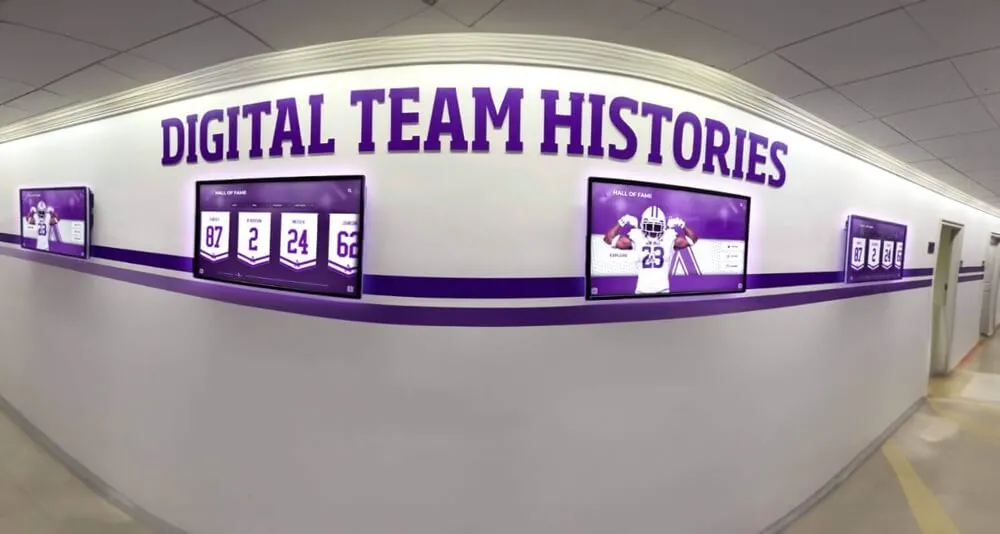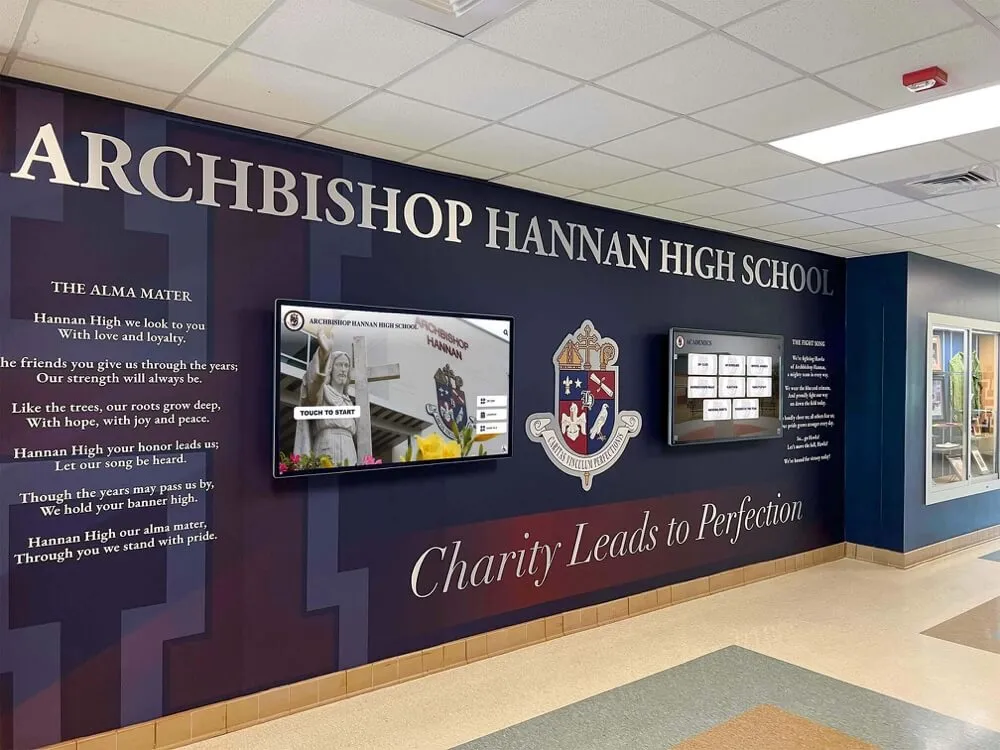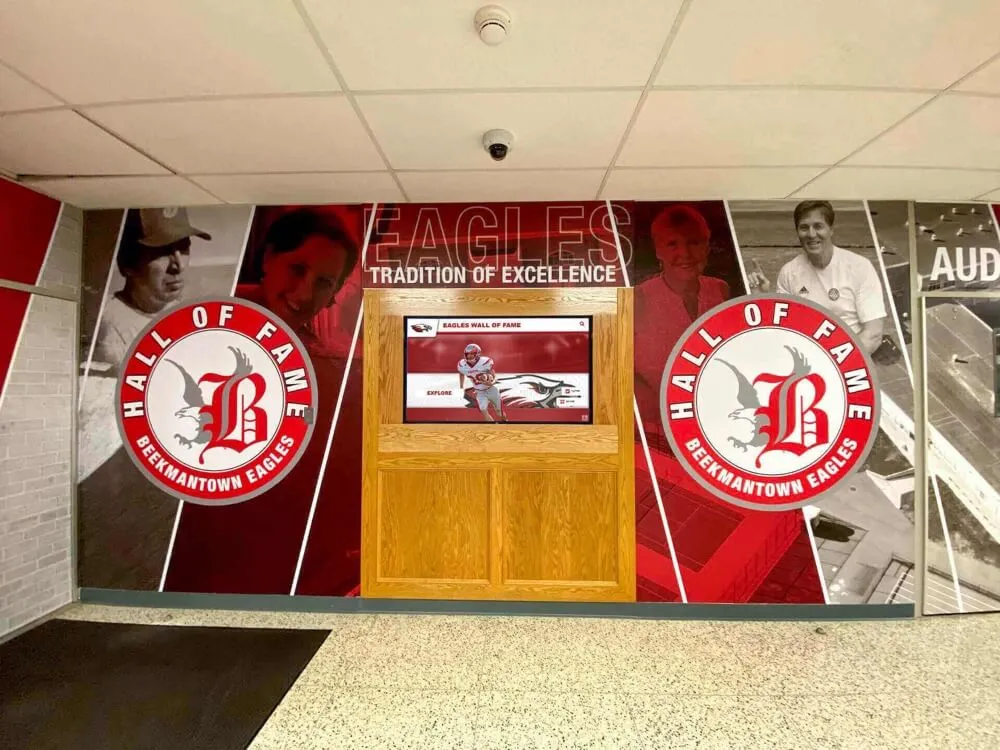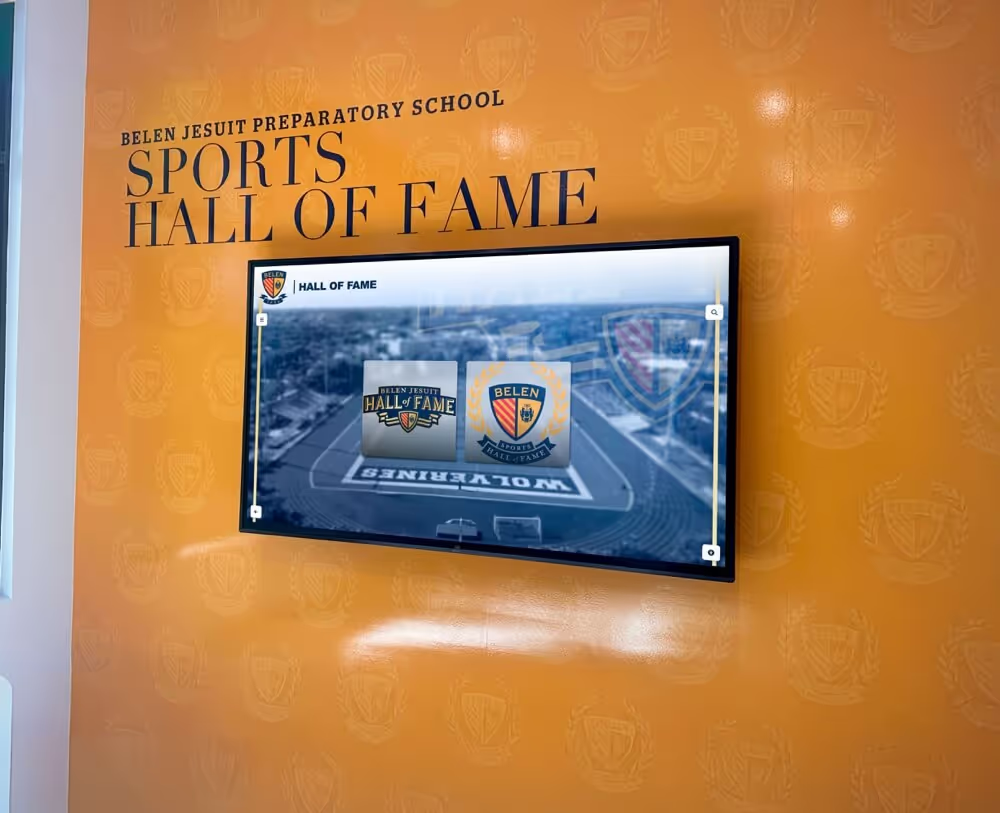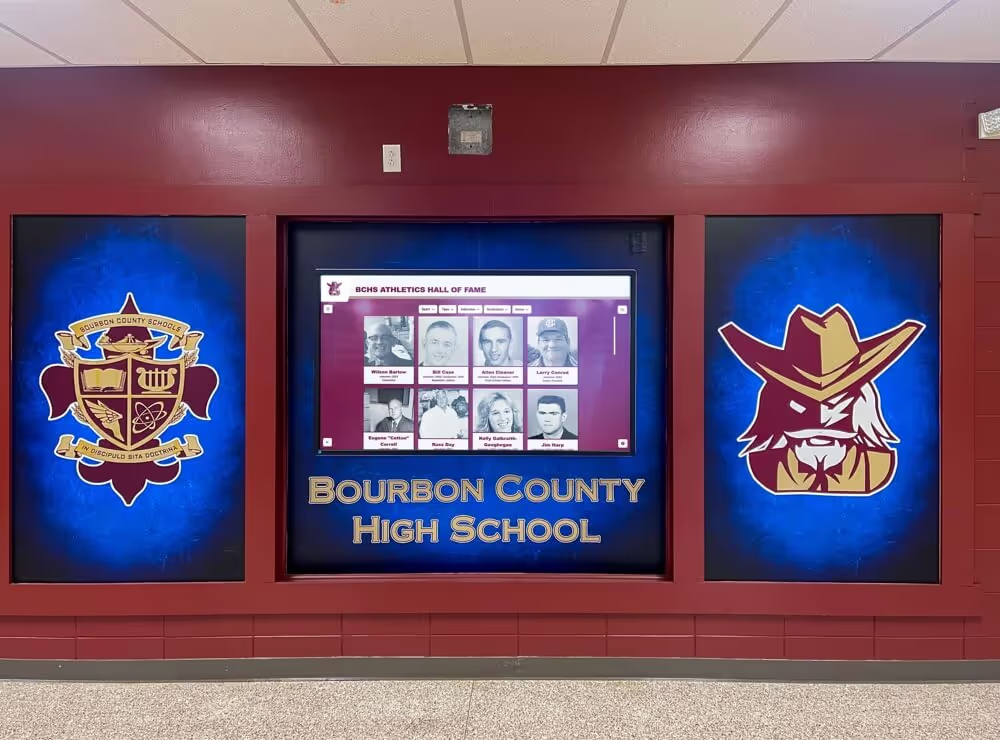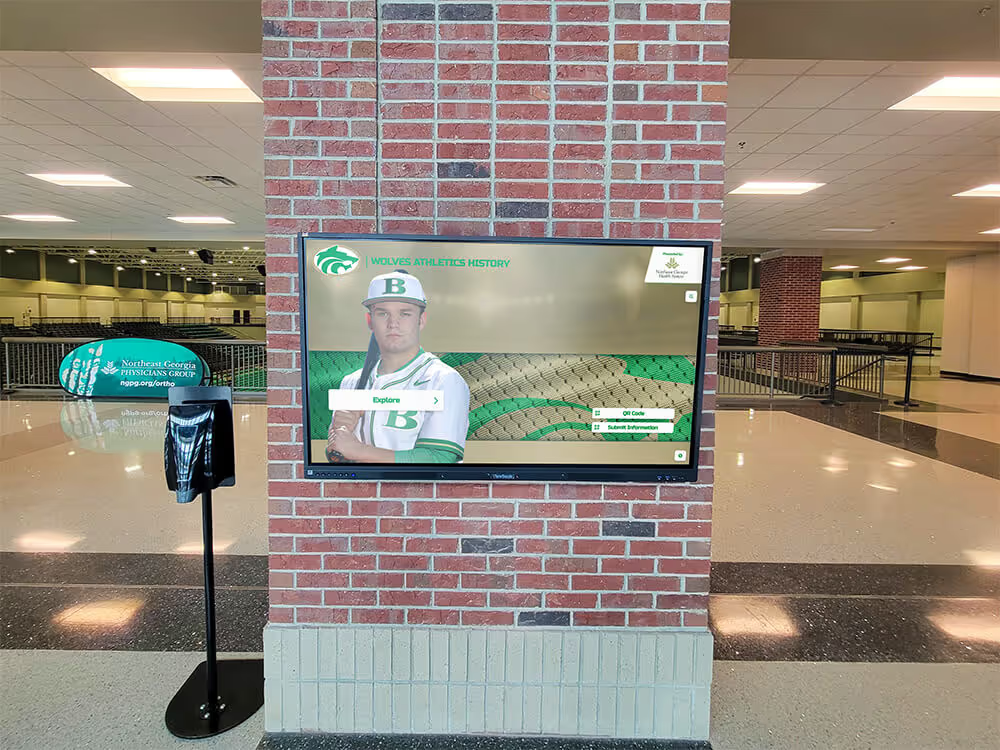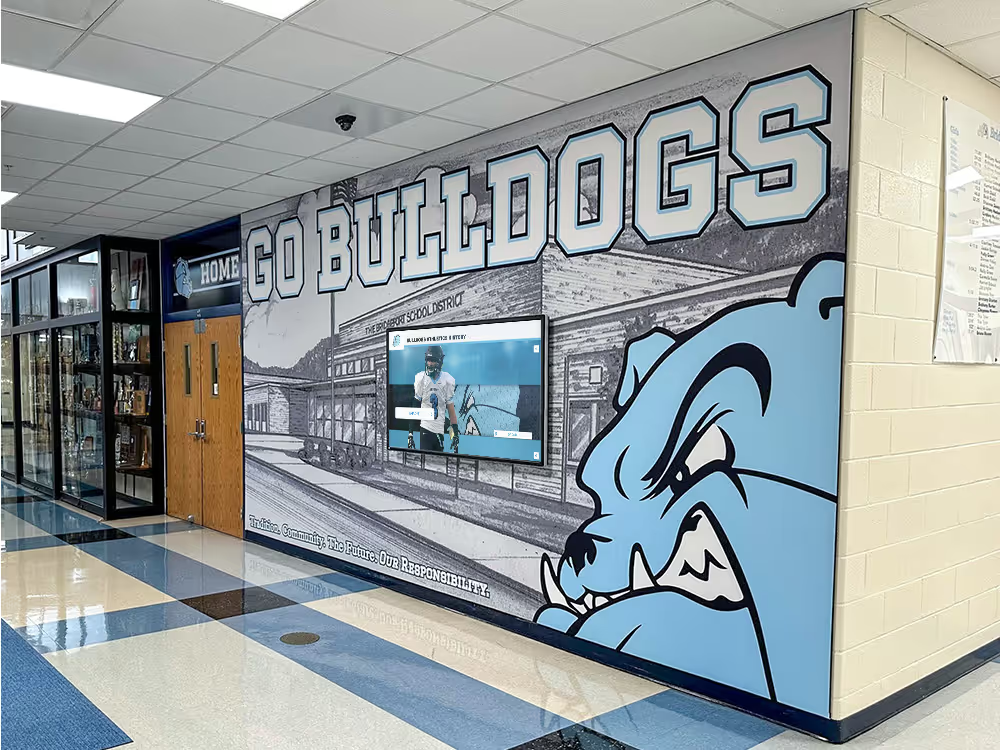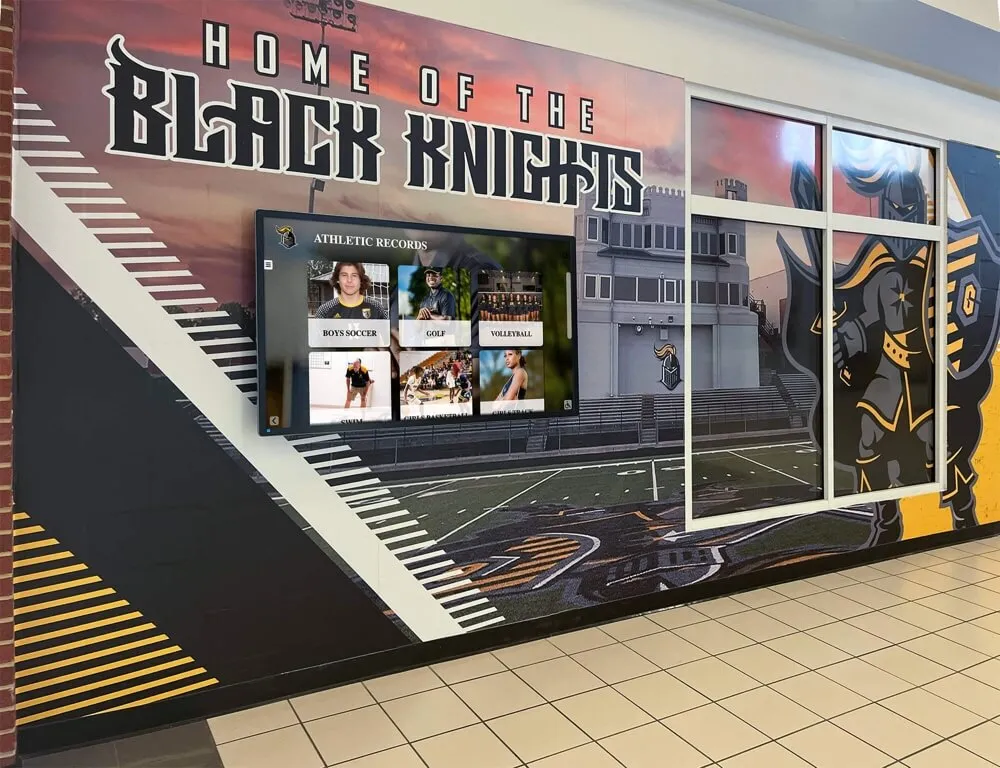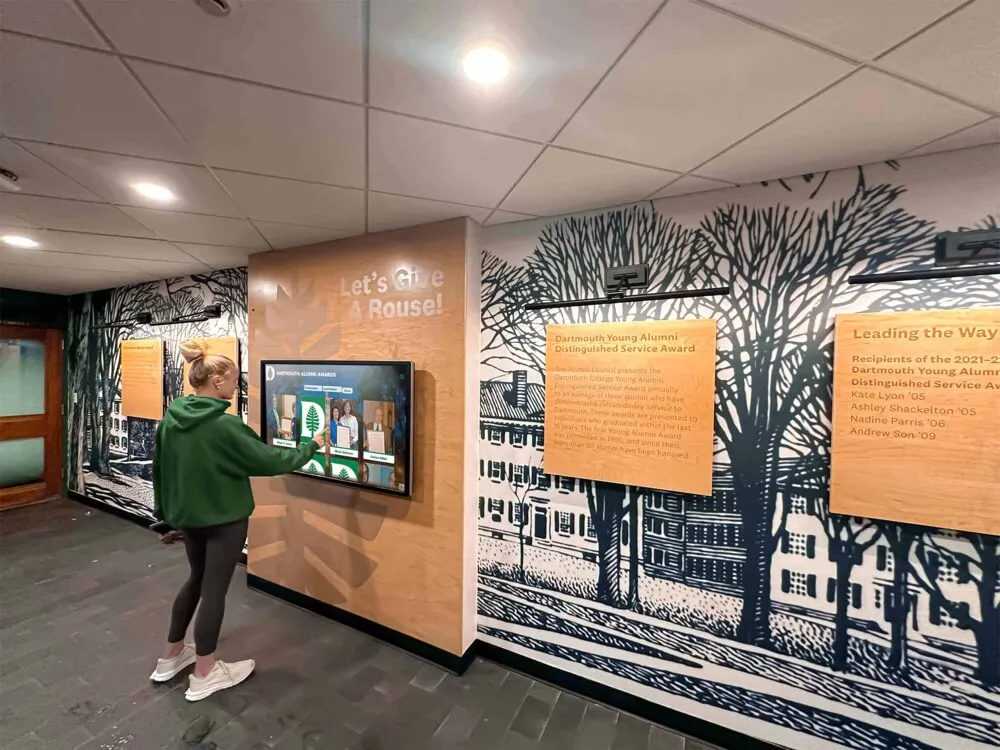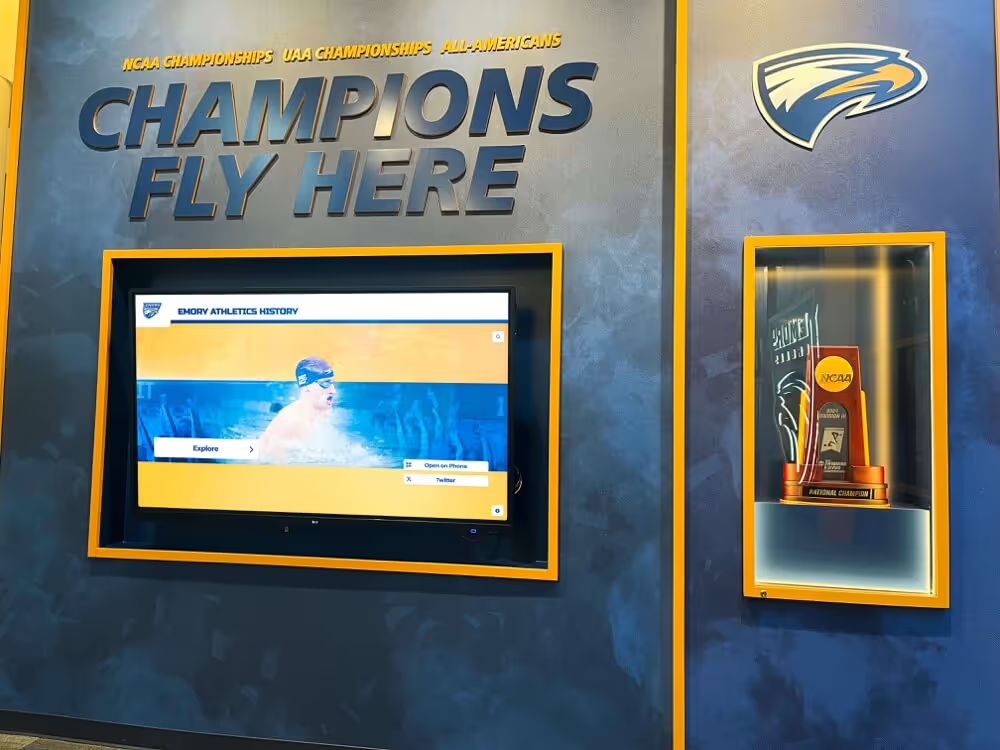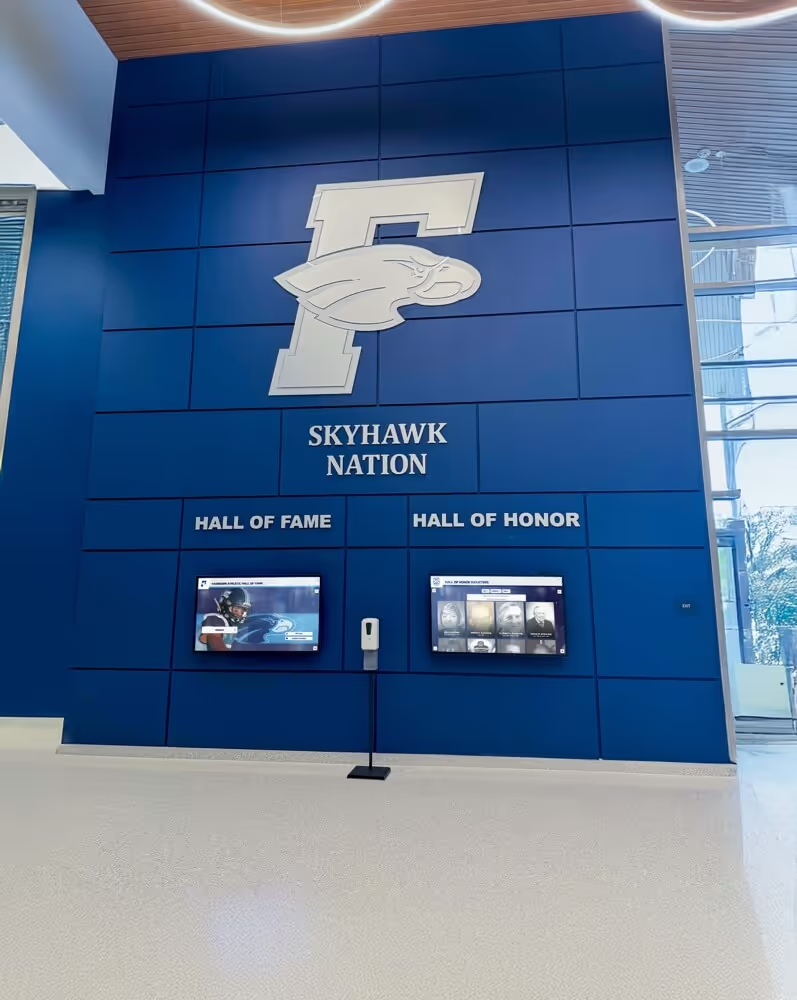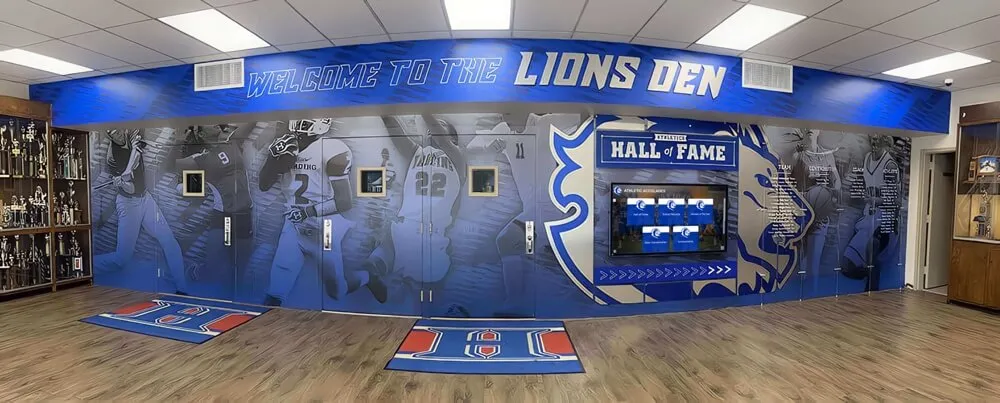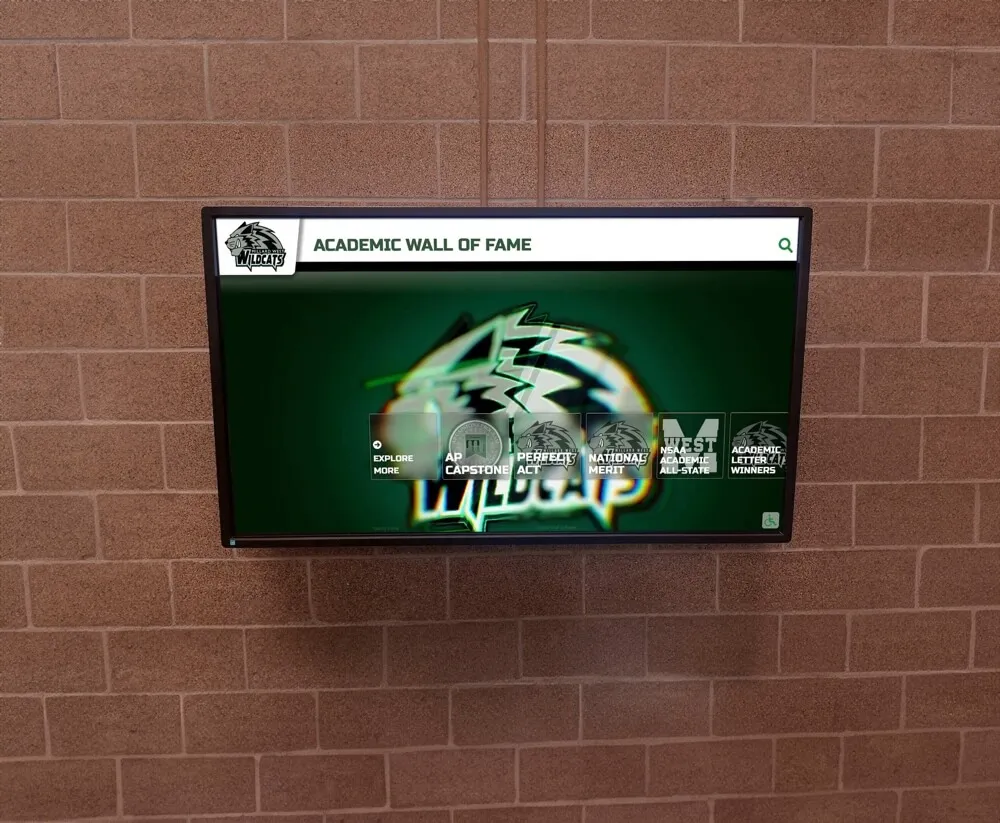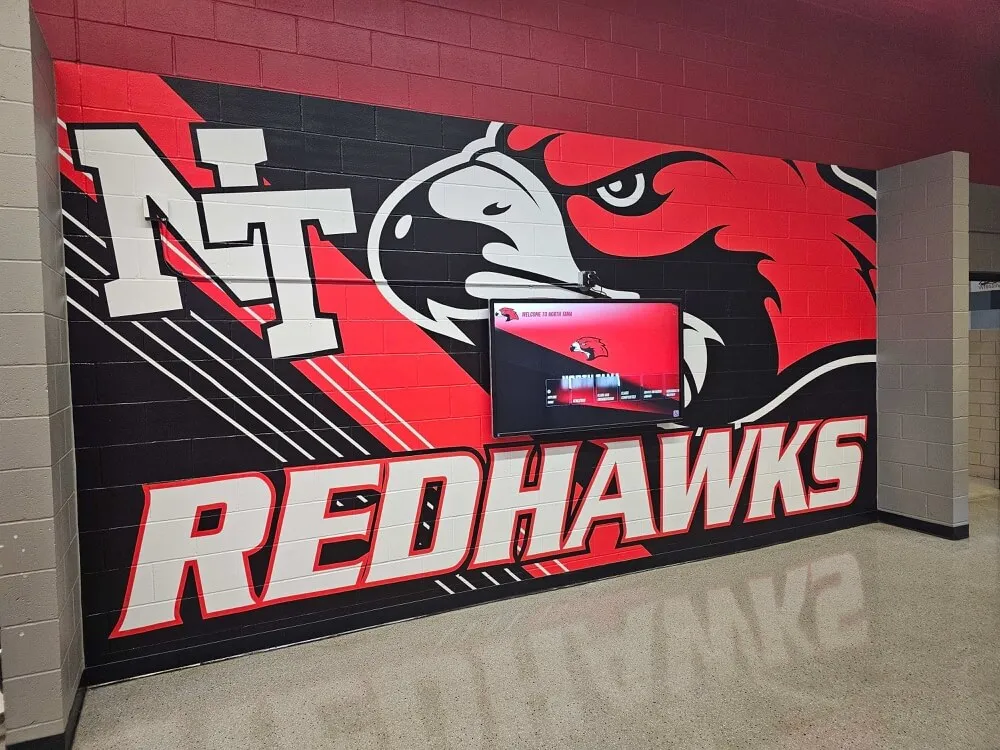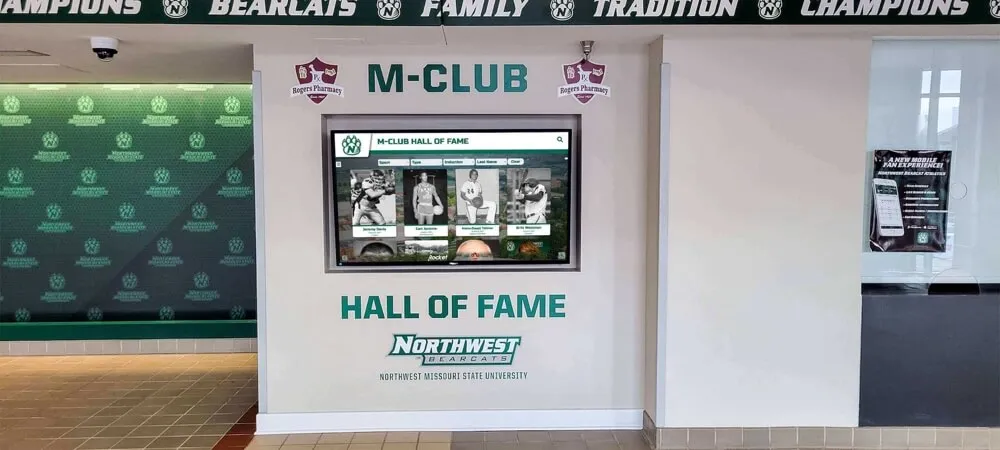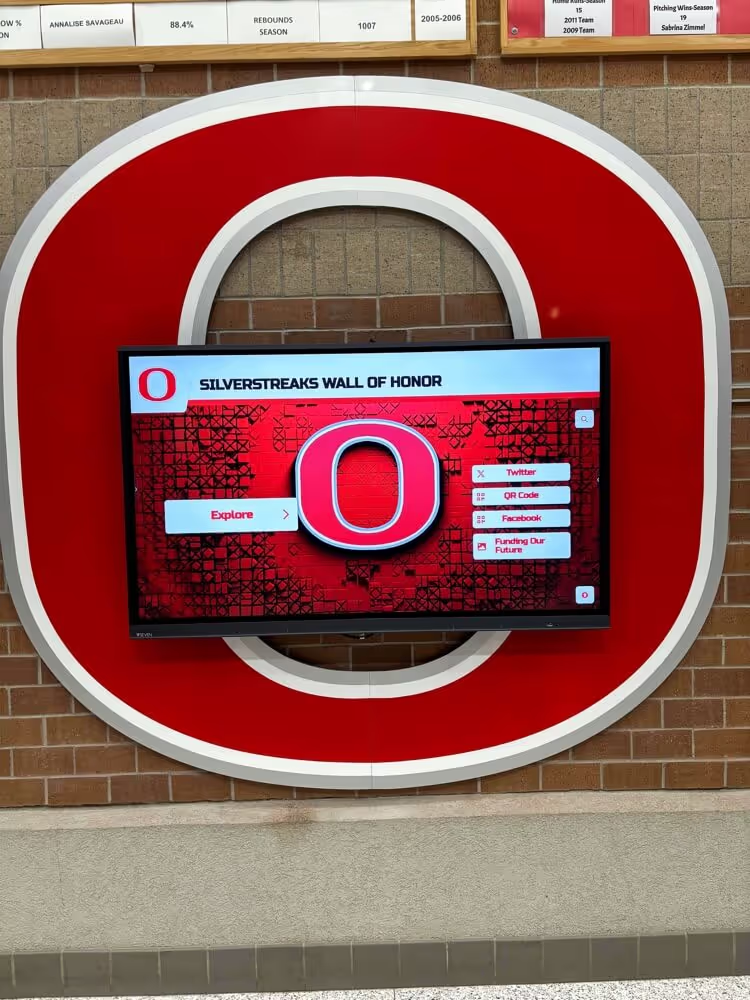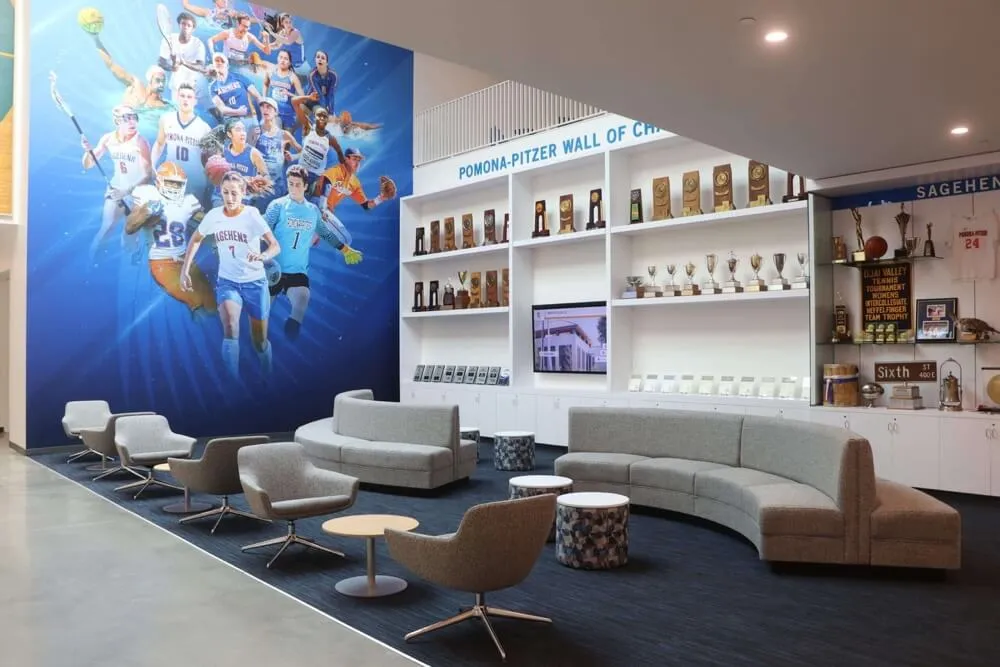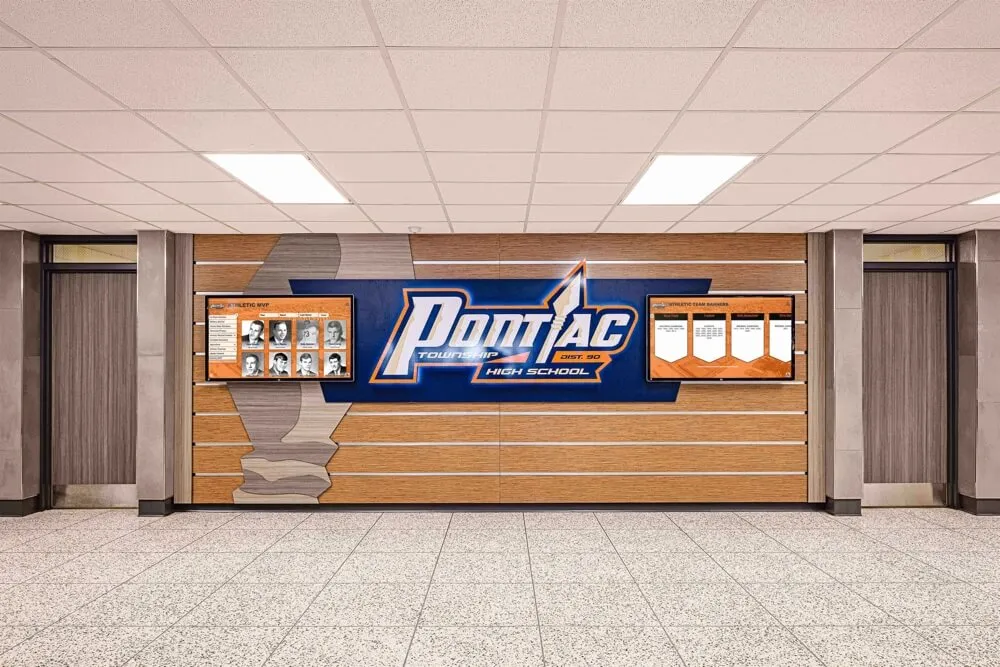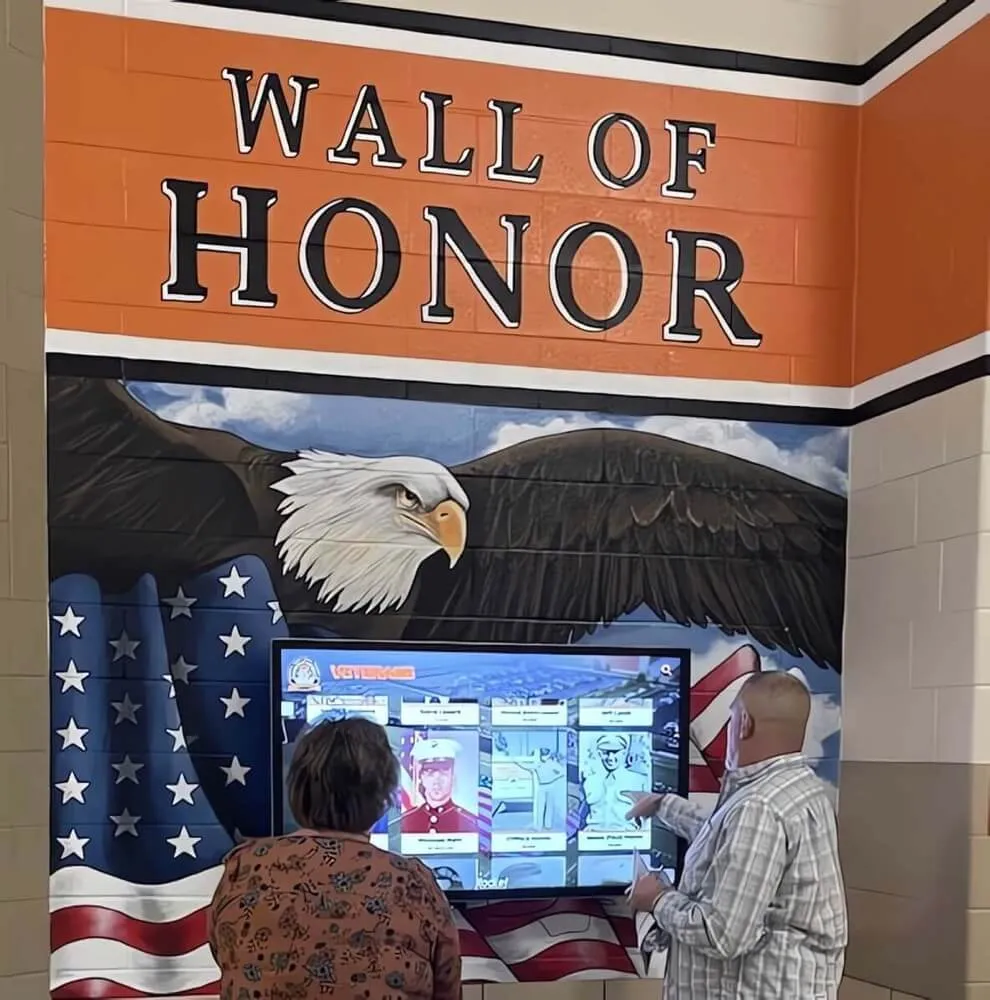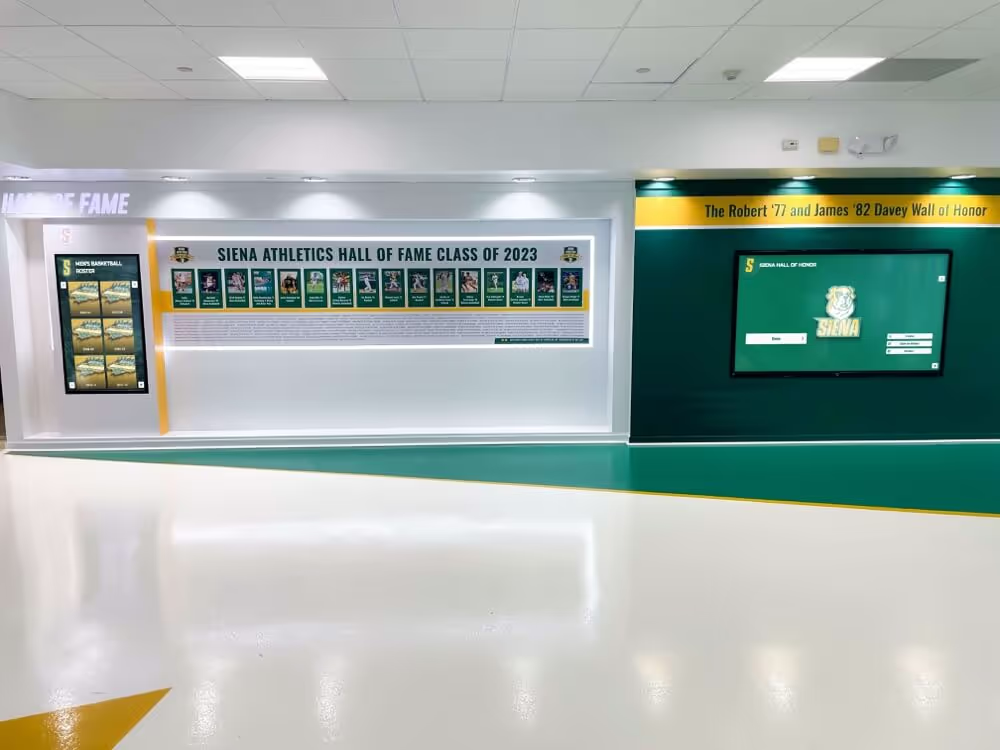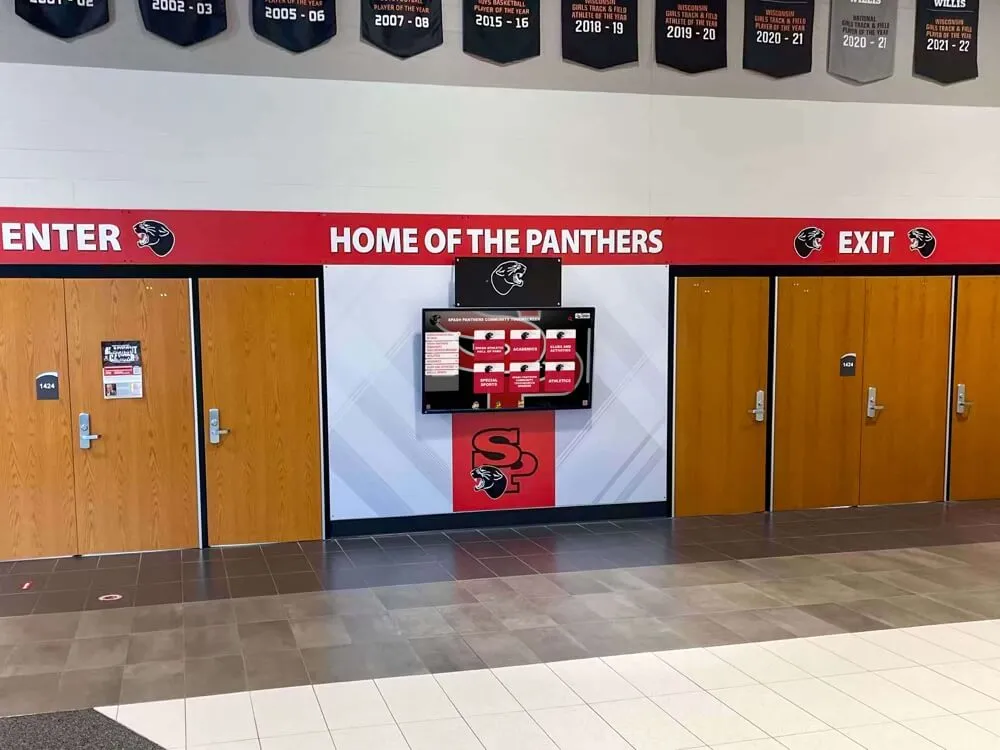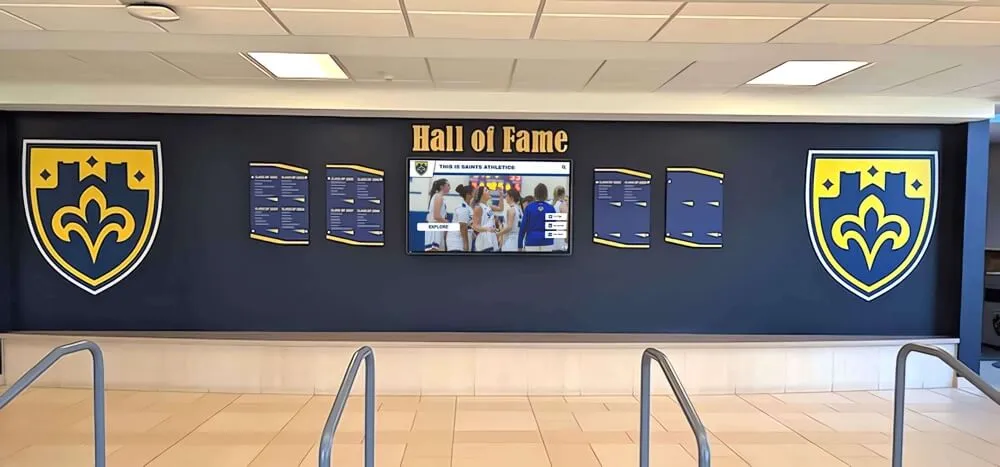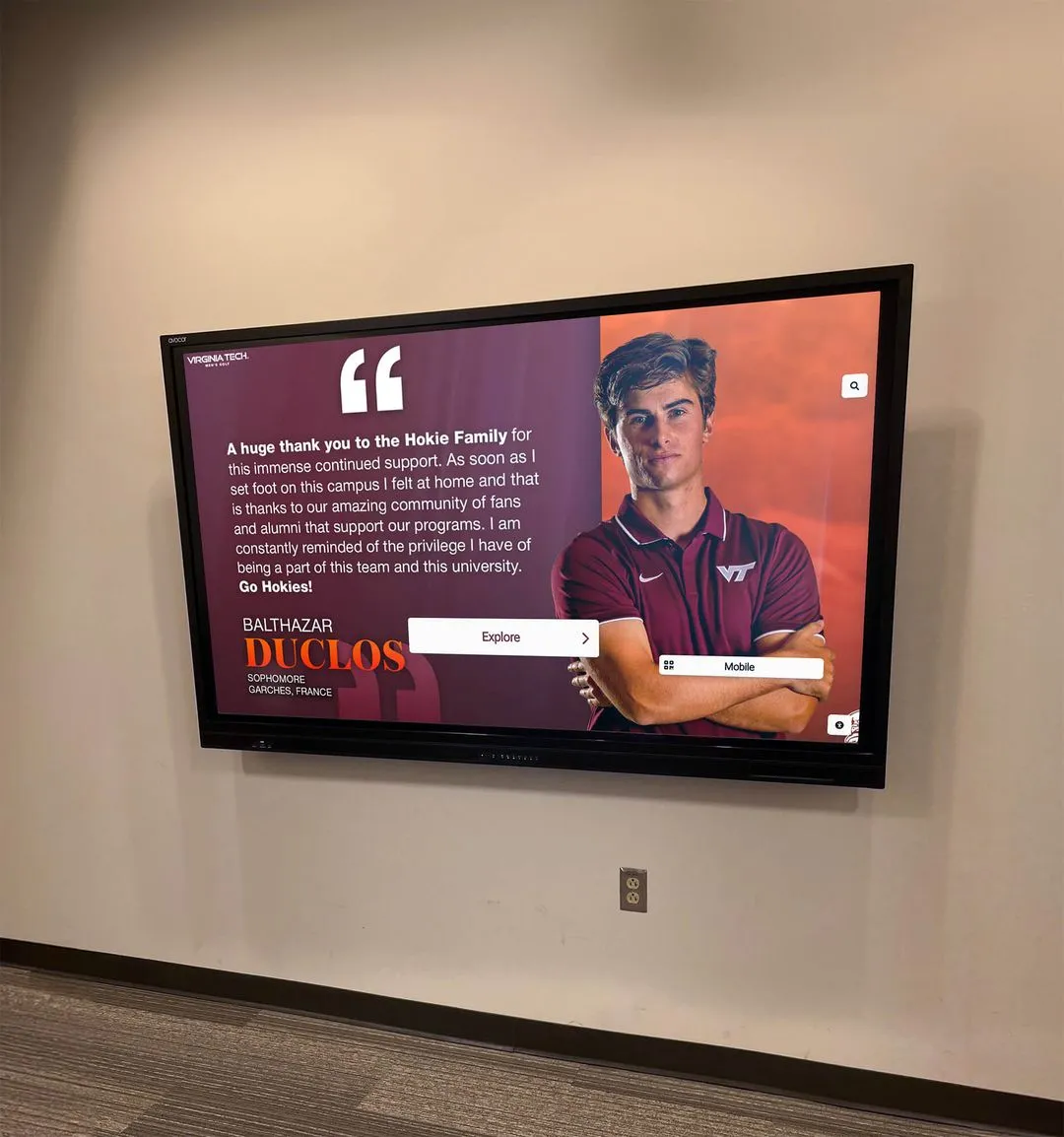




Organizations accumulate achievement faster than physical space can accommodate recognition. A high school celebrates 50 years of championships, academic excellence, and distinguished alumni. A university honors decades of research breakthroughs, athletic records, and notable graduates. A corporation recognizes employee milestones, innovation awards, and leadership achievements across multiple facilities. Traditional plaques, trophy cases, and static wall displays served recognition needs for generations—until the volume of deserving achievements outgrew available space.
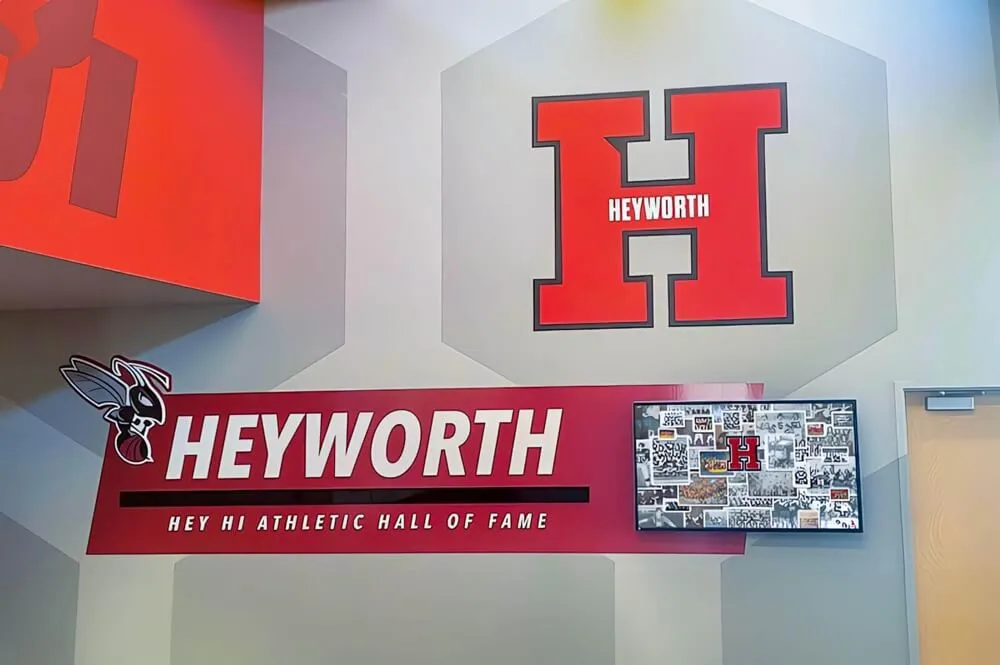
The touchscreen digital hall of fame wall solves this capacity crisis while transforming how organizations recognize excellence. Modern interactive awards systems combine unlimited digital storage, engaging touchscreen interfaces, instant content updates, searchable databases, and multimedia storytelling. These platforms preserve complete institutional histories, create memorable engagement experiences, support remote accessibility, and demonstrate that every achievement matters—not just those fitting limited physical displays.
What Makes Digital Hall of Fame Walls Different
Traditional recognition systems force difficult choices about what deserves display and what sits in storage. Touchscreen digital hall of fame walls eliminate these constraints through cloud-based platforms that store thousands of achievements, interactive interfaces that make exploration engaging, and content management systems that enable updates in minutes rather than weeks. Solutions like Rocket Alumni Solutions specialize in comprehensive recognition platforms designed for educational institutions, athletic programs, nonprofits, and corporate environments seeking to honor achievement without space or time limitations.
Understanding Touchscreen Digital Hall of Fame Walls
Digital hall of fame walls represent the next generation of recognition technology, replacing static physical displays with interactive digital platforms that combine hardware, software, and content management into unified systems.
Core Components of Digital Recognition Systems
Modern touchscreen hall of fame installations integrate several essential elements working together to create comprehensive recognition experiences.
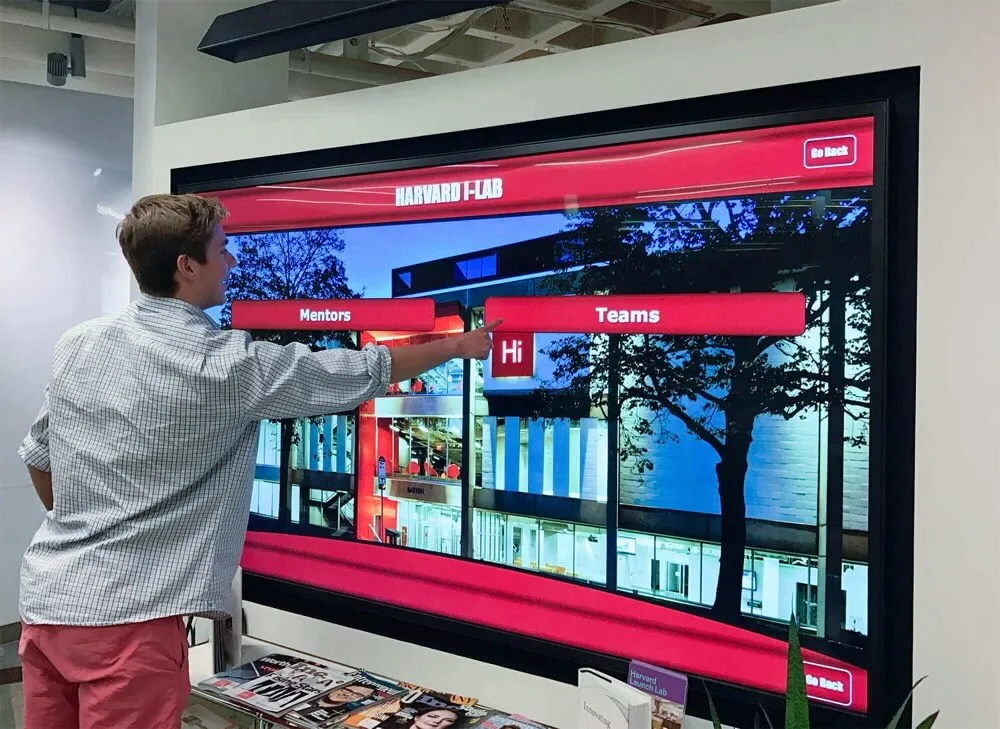
Commercial-Grade Touchscreen Displays: Professional installations use commercial displays built for continuous operation in public spaces. These screens feature responsive multi-touch capabilities supporting intuitive gesture navigation, high-resolution panels ensuring crisp text and images, anti-glare coatings maintaining visibility in various lighting conditions, and durable construction withstanding frequent public interaction. Screen sizes typically range from 43 inches for smaller spaces to 75+ inches for prominent lobby installations, with display selection depending on viewing distance and available space.
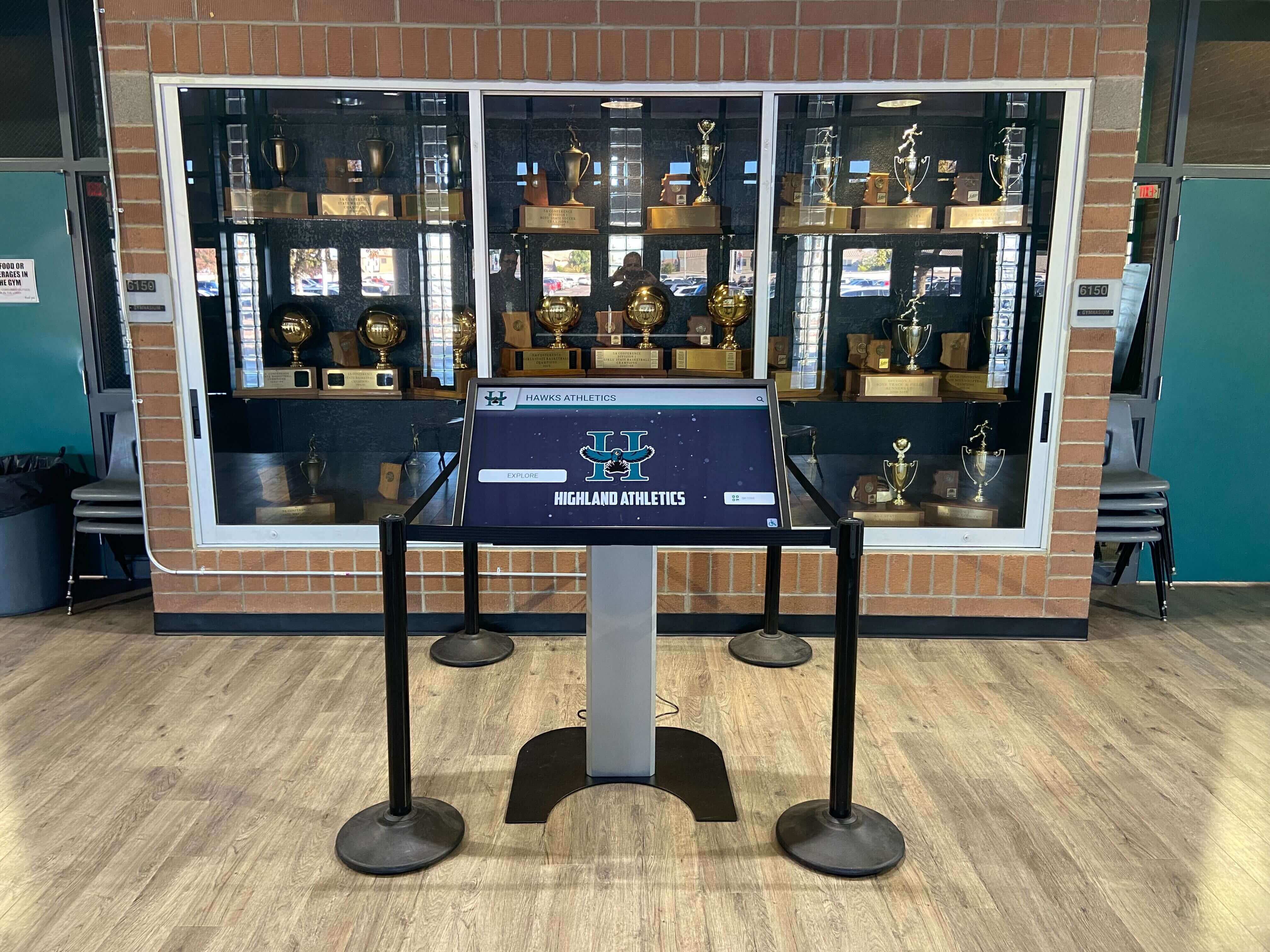
Cloud-Based Content Management: Backend platforms enable authorized staff to manage recognition content from any internet-connected device. Cloud systems provide intuitive interfaces requiring no technical expertise, templates ensuring consistent professional presentation, media libraries organizing photos and videos, bulk upload capabilities for efficient content addition, and role-based permissions controlling editing access. This centralized management means recognition updates happen immediately across all connected displays and web platforms without requiring physical access to hardware.
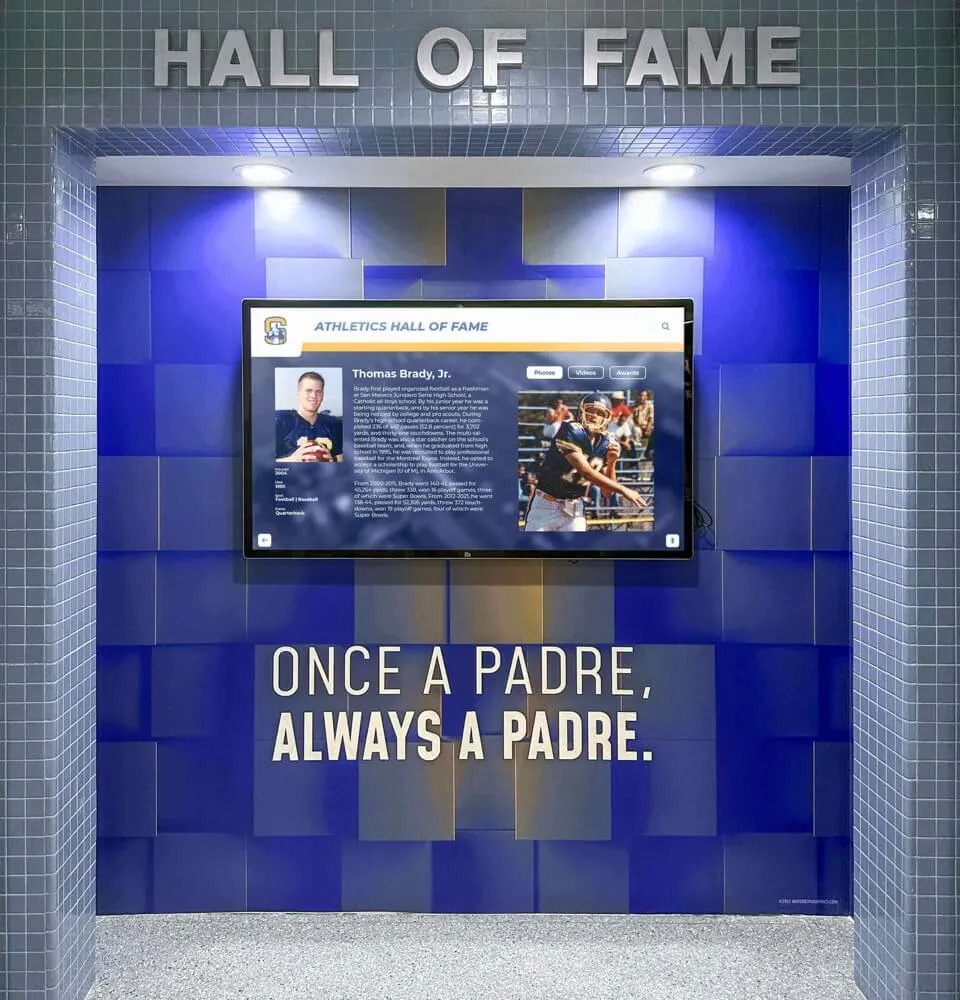
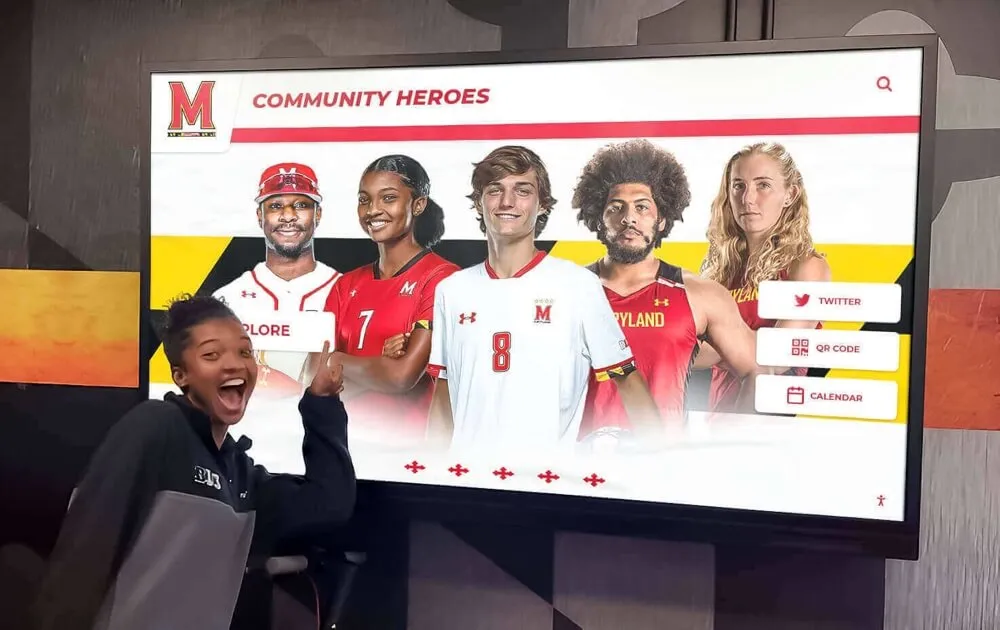
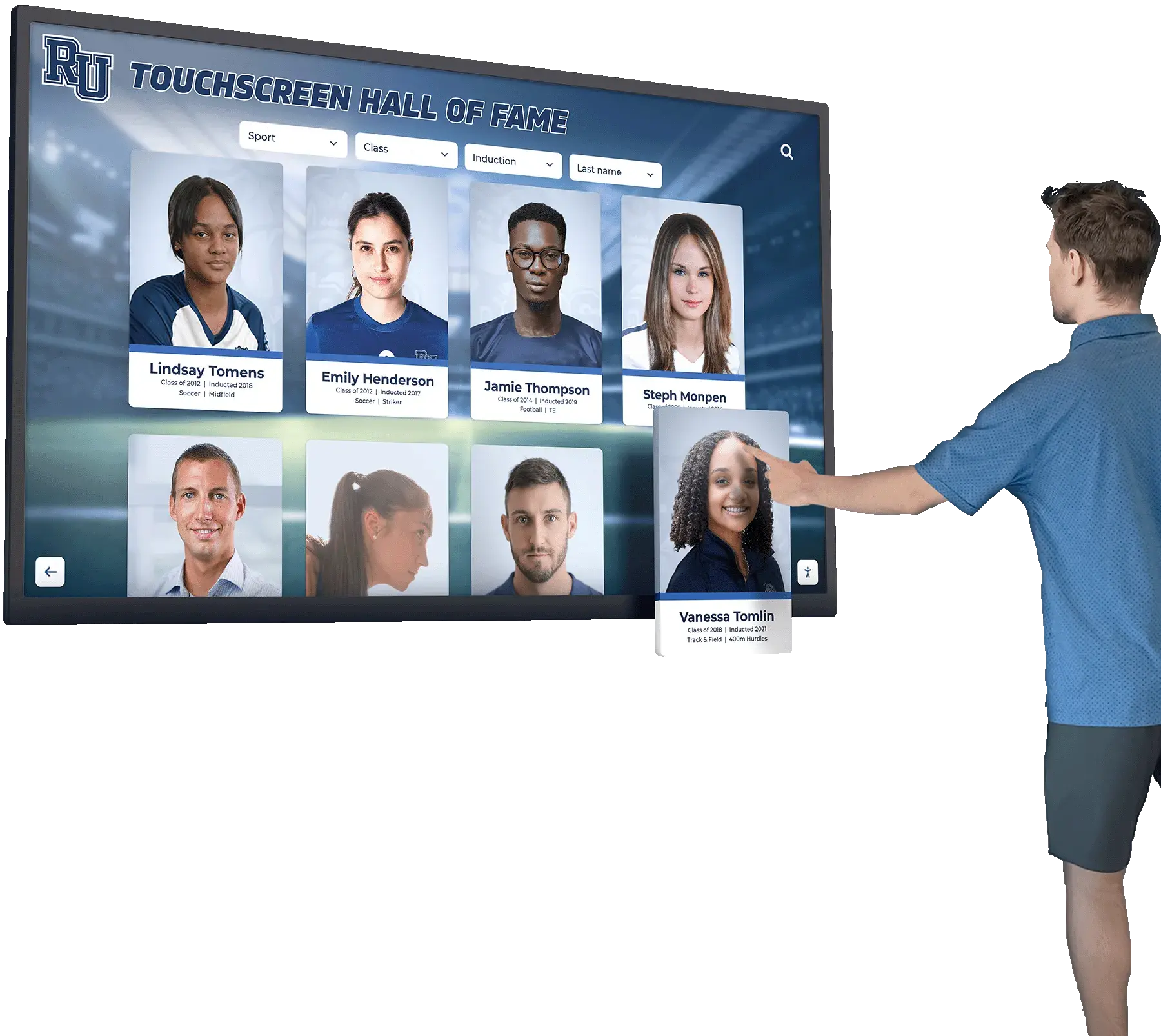
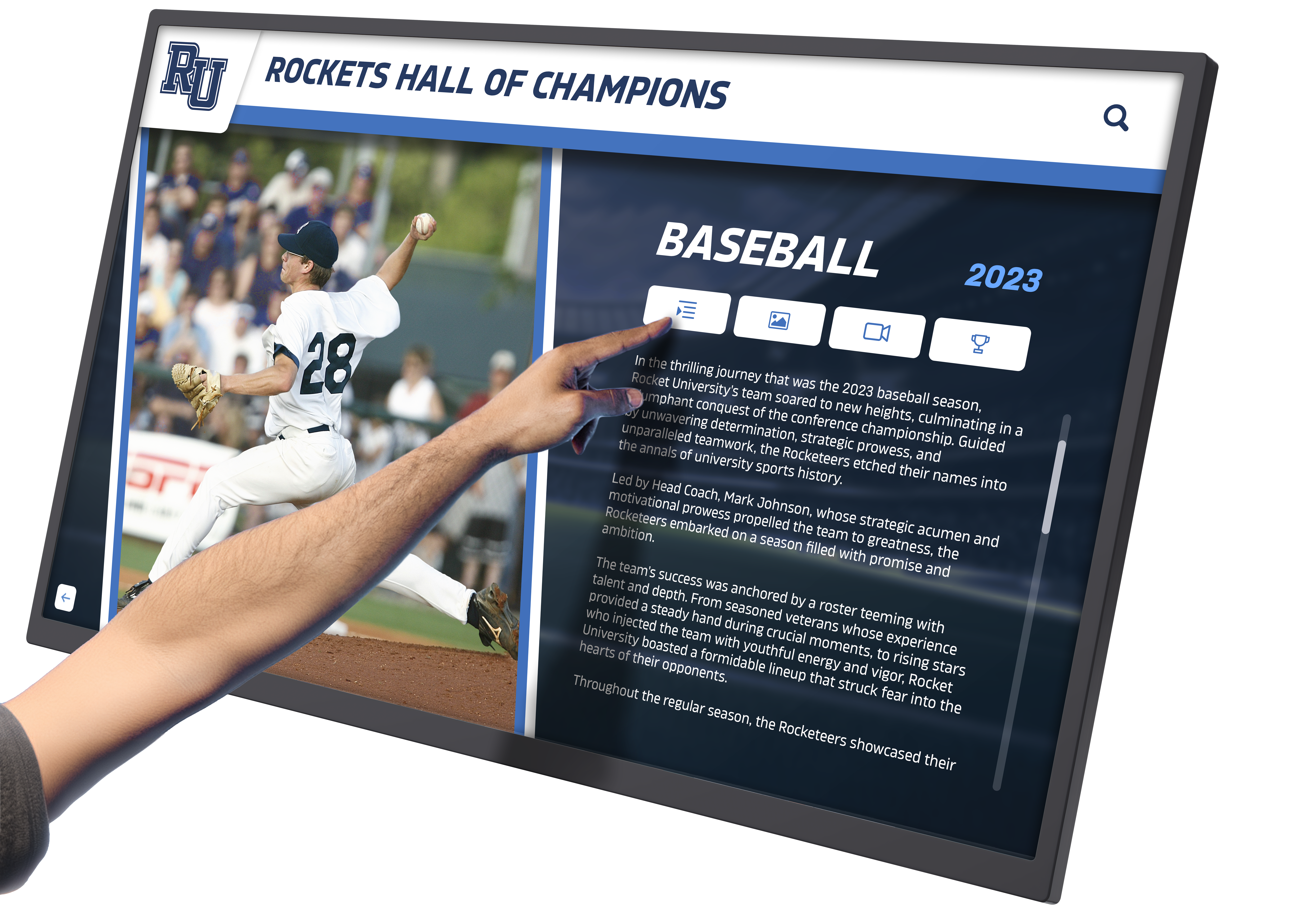
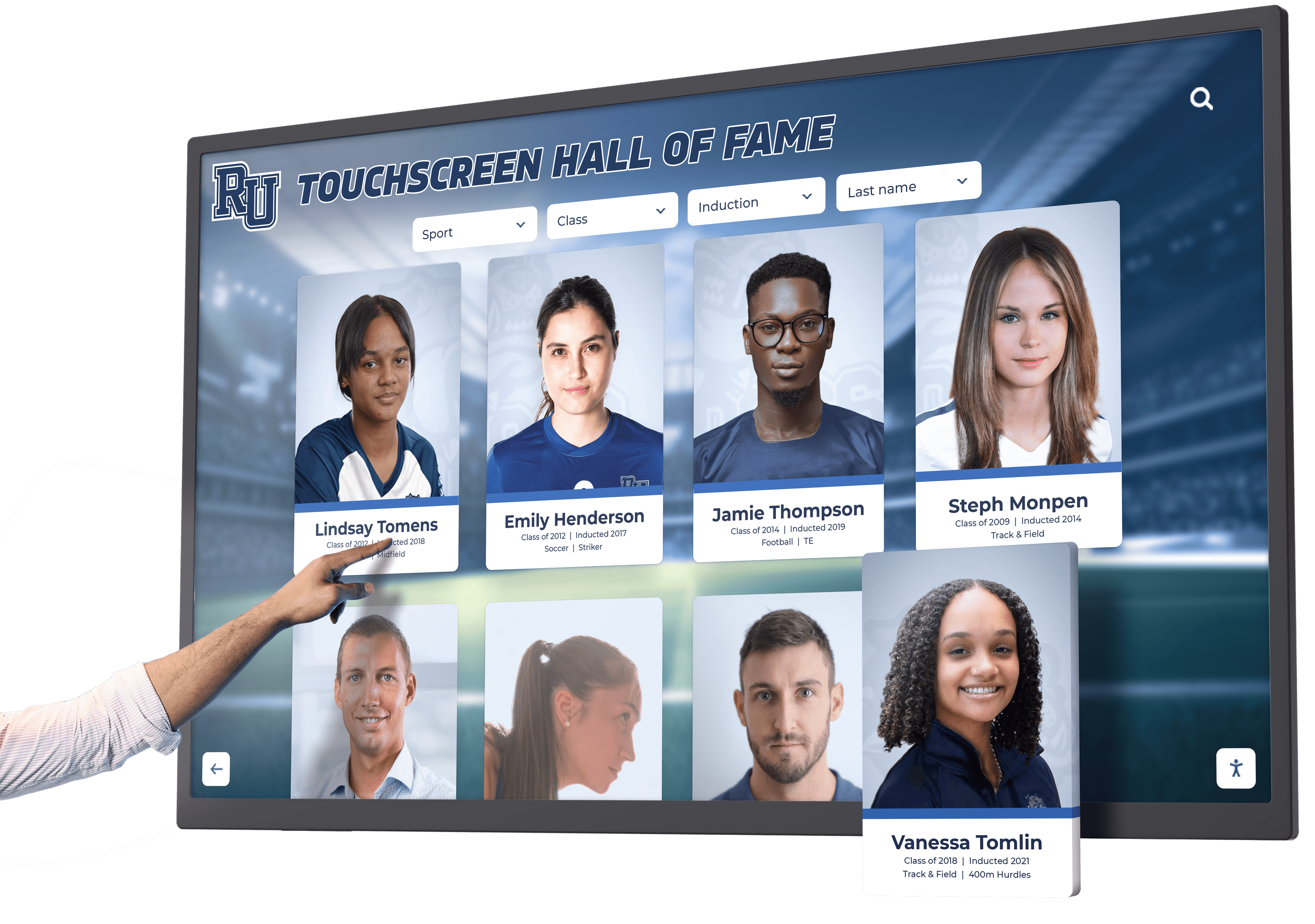
Interactive User Interface: Front-end experiences designed for public interaction make content discovery intuitive and engaging. Interfaces feature home screens highlighting featured recognition, search functionality enabling name or keyword queries, category navigation organized by sport, department, or achievement type, filtering options narrowing results by year or criteria, and profile pages displaying comprehensive achievement details. Well-designed interfaces encourage extended exploration rather than brief glances at static plaques.
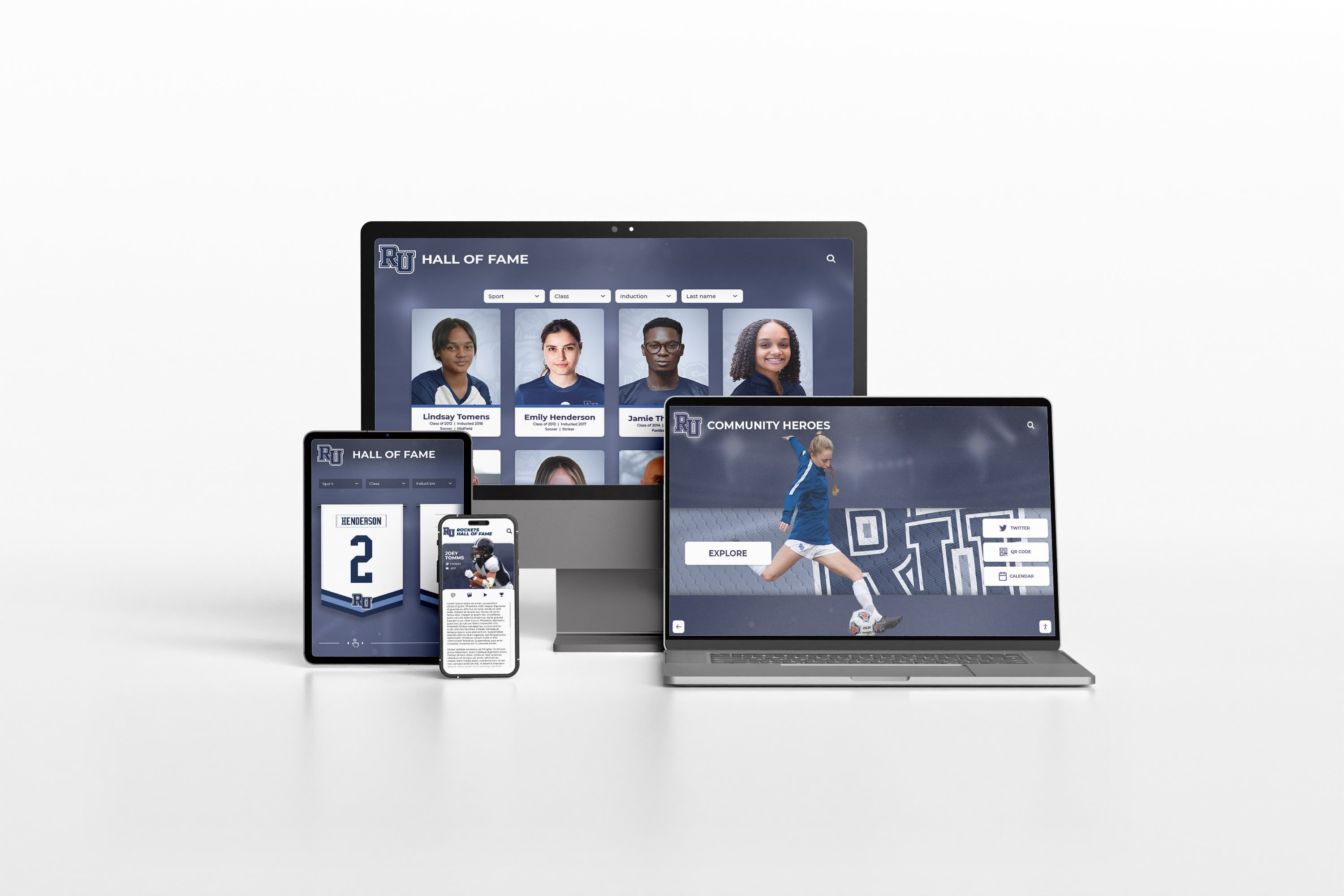
Web Accessibility Platform: Beyond physical displays, modern systems include web-based access extending recognition reach. Alumni anywhere can explore achievements through responsive websites, social sharing features enable recognition spread, permanent URLs allow direct linking to specific profiles, and mobile optimization ensures smooth experiences across devices. This accessibility transforms recognition from location-dependent displays into always-available resources strengthening connections regardless of geographic distance.
Digital Hall of Fame vs Traditional Recognition Systems
Understanding the fundamental differences between traditional and digital approaches helps organizations make informed recognition investment decisions.
Capacity Limitations: Traditional systems face hard physical constraints. Trophy cases fill. Wall space runs out. Adding recognition requires removing existing displays or finding new space. Digital systems provide effectively unlimited capacity—thousands of athlete profiles, team achievements, and award recipients fit within single touchscreen displays through organized navigation. Organizations never face choices between honoring new accomplishments or removing past recognition.
Update Speed and Cost: Physical recognition requires production time and installation labor. Ordering engraved plaques takes weeks. Scheduling installation adds delays. Each update incurs material and labor costs. Digital systems enable instant updates at zero marginal cost. When an athlete breaks a record Friday evening, updated recognition appears Saturday morning. Adding achievements requires minutes of content management rather than weeks of physical production.
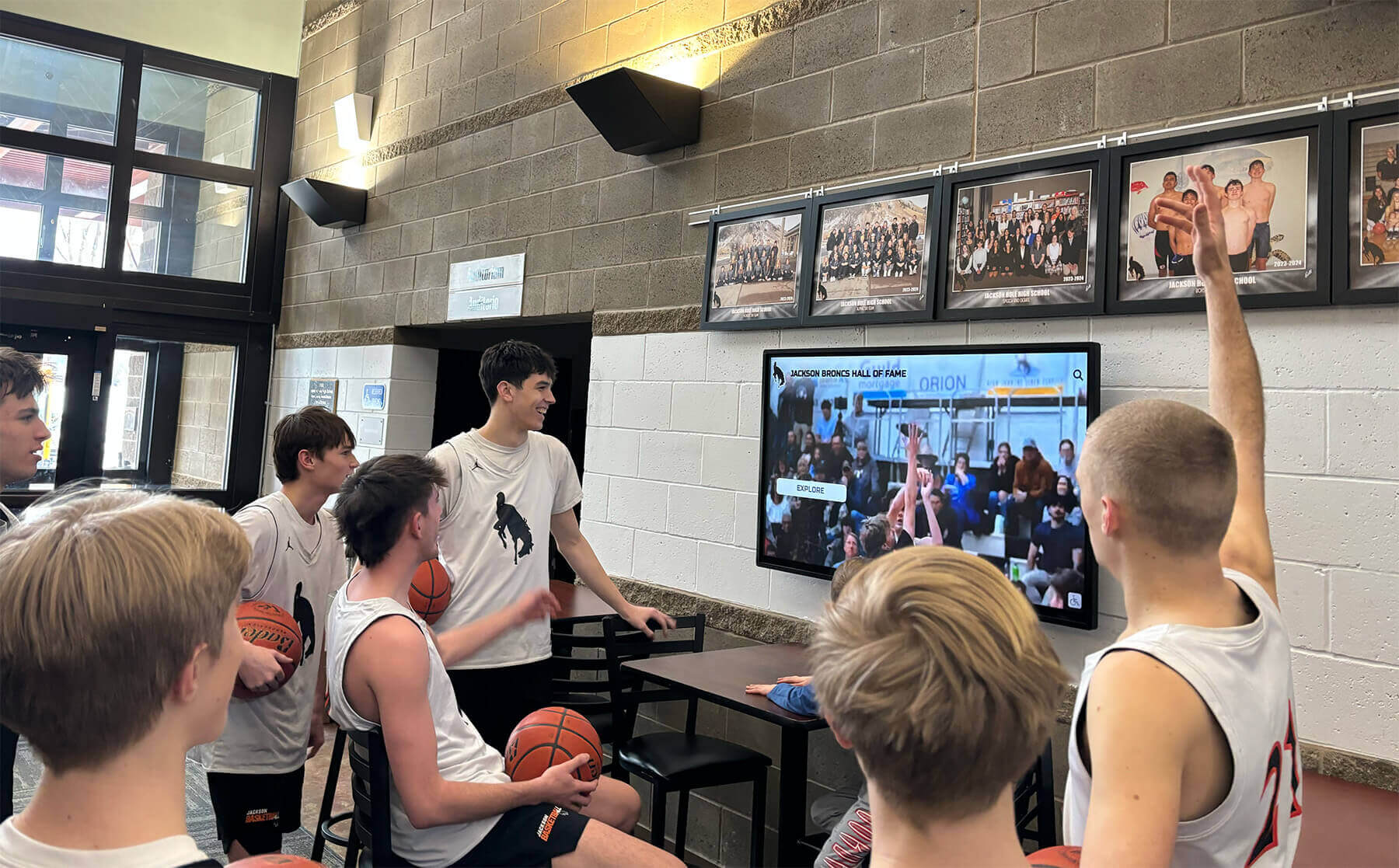
Engagement and Interaction: Static plaques provide basic information—names, dates, achievements. Viewers read text and move on. Interactive touchscreen displays transform recognition into engaging experiences. Users search for teammates, browse championship years, watch video highlights, explore career statistics, and discover connections between achievements. Analytics show visitors spend minutes rather than seconds with interactive recognition—dramatically increasing engagement depth.
Accessibility and Reach: Traditional displays serve only those physically present. Alumni must visit campus to see recognition. Parents traveling for games might miss displays in other buildings. Digital systems extend recognition reach through web access, enabling exploration from anywhere at any time. This accessibility strengthens alumni connections, supports recruiting by displaying program excellence remotely, and ensures recognition serves audiences beyond those visiting physical locations.
Maintenance and Longevity: Physical displays accumulate dust, fade from sun exposure, and suffer damage requiring replacement. Plaques become outdated as athletes advance or records fall. Digital systems maintain perfect presentation indefinitely—no fading, no physical wear, no outdated information persisting. Content updates keep recognition current automatically. When hardware eventually requires replacement after 5-8 years, content investments transfer seamlessly to new displays without starting over.
Organizations implementing digital hall of fame systems discover that advantages extend beyond solving capacity constraints to fundamentally improving how recognition serves institutional goals.
Essential Features of Effective Interactive Awards Displays
Exceptional touchscreen hall of fame walls share common capabilities ensuring they deliver lasting value across decades of operation.
Intuitive Search and Navigation Systems
Recognition value depends on discoverability. The best digital hall of fame walls make finding specific achievements effortless through multiple pathways designed for different user needs.
Comprehensive Search Functionality: Powerful search enables finding recognition instantly by entering athlete names, team years, coaches, sports, or achievement types. Search algorithms handle partial names, spelling variations, and alternative terms. Alumni visiting campus enter their names and discover their recognition in seconds. Parents search for children’s achievements immediately. Community members explore specific sports or eras efficiently without browsing through unrelated content.
Organized Category Navigation: Logical content organization enables intuitive browsing for those exploring rather than searching. Structure typically includes sport-specific sections showing all football, basketball, or other program recognition; year-based organization displaying achievements by decade or graduating class; achievement-type filtering showing championships, individual records, or team milestones; and coach-specific views celebrating coaching tenures and legacies. This multi-dimensional organization accommodates different exploration preferences and use cases.
Featured Content Rotation: Home screens rotate featured recognition ensuring diverse achievements receive visibility. Recent accomplishments appear alongside historic milestones, smaller programs gain equal rotation with high-profile sports, varied achievement types receive balanced representation, and seasonal relevance highlights timely recognition. Automatic rotation prevents any single achievement from dominating visibility indefinitely while keeping displays fresh and engaging.
Resources on best platforms for building virtual hall of fame compare navigation approaches across different systems and vendors.
Rich Multimedia Integration Capabilities
Text and statistics tell incomplete stories. Comprehensive recognition systems integrate photos, videos, and detailed documentation bringing achievements to life through multimedia storytelling.
Professional Photography: High-resolution photos show athletes in action, team celebration moments, championship ceremonies, and personal portraits. Multiple images per profile create richer narratives than single static photos permit. Historical photographs document program evolution across decades—facility changes, uniform progression, equipment development—adding contextual depth to achievement recognition. Photo requirements typically specify minimum resolutions (1920x1080 or higher), consistent aspect ratios for professional presentation, and appropriate file formats optimized for display performance.
Video Highlights and Stories: Video content creates emotional connections impossible with static displays. Championship game footage shows defining moments, record-breaking performances capture excellence visually, athlete interviews add personal reflections, coach testimonials provide leadership perspective, and historical documentary content preserves institutional memory. Video integration transforms recognition from simple data display into compelling storytelling that captivates viewers for extended periods. Modern systems support standard video formats with automatic transcoding for optimal streaming performance.
Comprehensive Achievement Profiles: Best-in-class athlete or award recipient profiles include complete career statistics and progression, detailed achievement lists with dates and context, biographical information and post-graduation accomplishments, personal statements or reflections when available, and connections showing related team successes or achievements. These thorough profiles celebrate complete individuals rather than reducing excellence to basic statistics, creating meaningful recognition that honors whole contributions.
Approaches to academic recognition programs demonstrate how multimedia integration works beyond athletic applications for academic honors, faculty recognition, and student achievement across all domains.
Cloud-Based Content Management Systems
Recognition relevance requires keeping content current. Modern touchscreen hall of fame walls use cloud-based management enabling instant updates from anywhere without technical expertise.
Anywhere, Anytime Access: Authorized staff manage content from any internet-connected device—office computers, home laptops, or mobile devices. Cloud access eliminates requirements for physical display access or specialized software installation. Athletic directors update recognition from traveling to away games. Communications staff add content during evening events. This flexibility ensures timely updates regardless of when achievements occur or where authorized personnel are located.
Intuitive Administrative Interfaces: Content management platforms designed for non-technical users feature form-based data entry requiring no coding knowledge, drag-and-drop media upload for photos and videos, preview functionality showing exactly how content will appear, batch import capabilities for adding multiple profiles efficiently, and revision history tracking all changes with rollback options. These intuitive systems mean busy staff can manage recognition confidently without technical training or IT department assistance.
Template-Based Consistency: Pre-designed templates ensure professional presentation without design expertise. Templates provide consistent layouts across all profiles, appropriate typography and spacing for readability, optimized image placement and sizing, and institutional branding integration. Using templates accelerates content creation while maintaining quality standards—new profiles take minutes to create rather than hours of custom design work.
Automated Publishing Workflows: Sophisticated systems include approval processes ensuring quality before publication. Draft content saves for review before going live, role-based permissions control who can publish versus edit, scheduled publishing enables advance preparation for time-sensitive announcements, and automatic notifications alert relevant stakeholders about pending reviews or published updates. These workflows balance update speed with appropriate oversight maintaining recognition accuracy and appropriateness.
Real-Time Updates and Synchronization
The ability to update recognition immediately when achievements occur separates modern digital systems from legacy approaches requiring physical production and installation delays.
When teams win championships Friday night, complete recognition with photos, scores, and player details can appear by Saturday morning while excitement remains high. When individual athletes break records during competitions, updated displays acknowledge achievements before events conclude. When annual awards ceremonies announce recipients, recognition appears immediately rather than waiting weeks for plaque production.
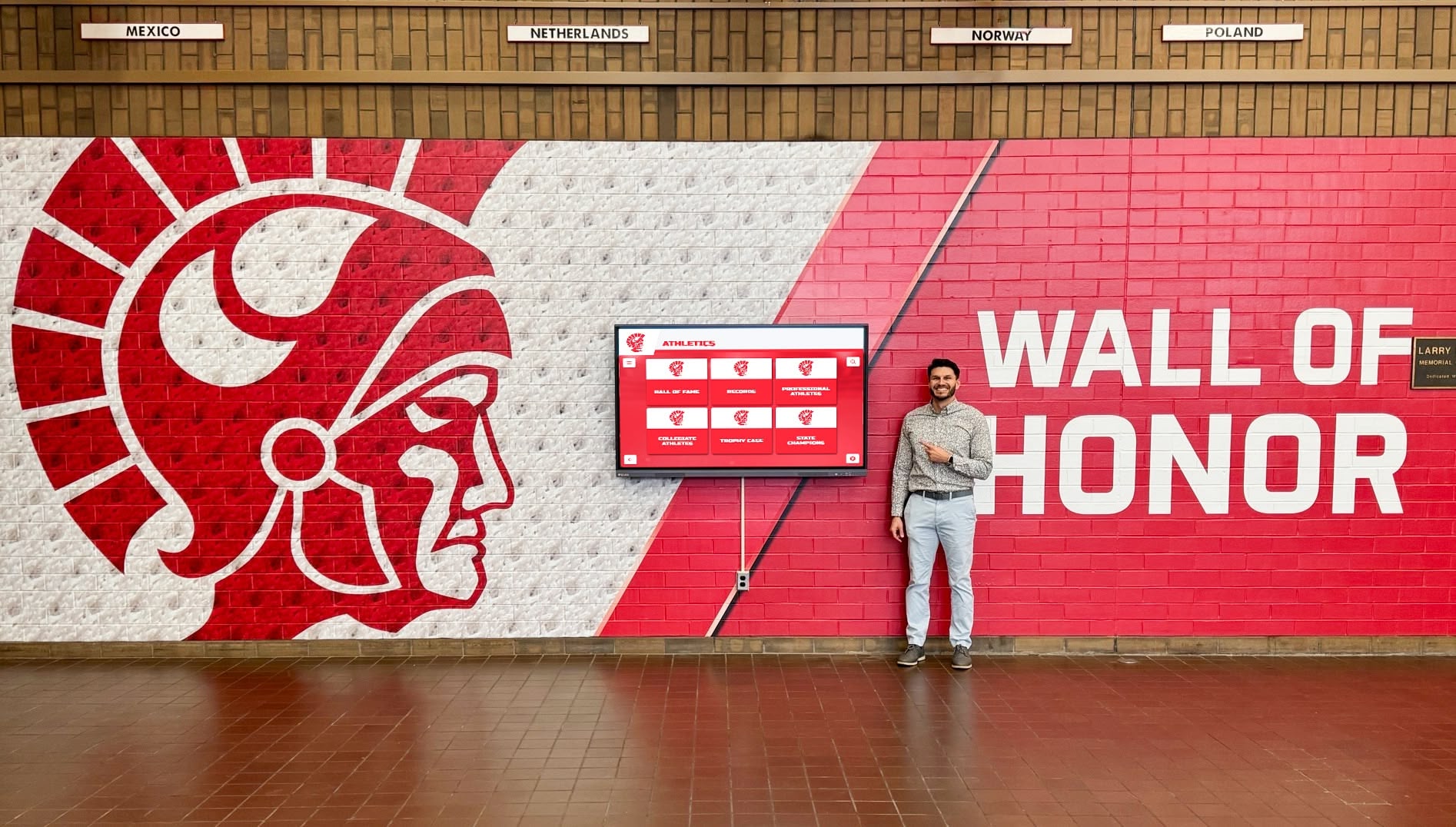
This real-time capability creates timely recognition honoring excellence when attention focuses on achievement rather than weeks later when excitement has faded. Organizations demonstrate responsiveness and appreciation immediately, strengthening recognition impact and showing that achievements matter enough to celebrate right away.
Cloud synchronization ensures all connected displays and web platforms reflect updates simultaneously. Content added to management systems propagates automatically to physical displays, web portals, and mobile interfaces without requiring individual updates to each platform. This synchronization eliminates inconsistency between different access points and reduces management burden dramatically compared to maintaining separate systems.
Advanced Analytics and Engagement Tracking
Modern recognition systems provide engagement data helping organizations understand recognition program effectiveness and guide continuous improvement through evidence-based decision making.
Comprehensive Usage Metrics: Analytics platforms track total interactions and session duration showing overall engagement levels, unique users versus returning visitors indicating audience breadth, most-viewed profiles and categories revealing popular content, search query analysis showing how users discover recognition, peak usage times informing optimal update scheduling, and geographic access patterns when web analytics are included. These metrics demonstrate recognition value to stakeholders while informing strategic decisions about content emphasis and feature improvements.
Content Performance Analysis: Detailed analytics reveal which recognition generates highest engagement. Understanding that certain sports receive limited attention might prompt improved documentation or better navigation exposure. Discovering that video content dramatically increases viewing duration supports investment in video production. Recognizing that alumni access recognition primarily through web platforms rather than physical displays might influence hardware investment decisions. Data-driven recognition management ensures continuous program improvement based on actual usage rather than assumptions.
Demographic Insights: When combined with authentication systems or voluntary user identification, analytics can reveal audience characteristics including alumni versus current students versus community visitors, age demographics showing which generations engage most, and user interests based on search and browsing patterns. These insights help tailor content and features to audience preferences while demonstrating recognition reach across diverse stakeholder groups.
Understanding donor recognition strategies shows how analytics inform recognition effectiveness beyond athletic applications in fundraising and development contexts.
Implementation Strategy: Launching Your Touchscreen Hall of Fame Wall
Successful recognition system deployments result from systematic planning, thoughtful implementation, and ongoing management commitment ensuring systems deliver value across decades.
Assessment and Planning Phase
Begin by understanding current recognition state, defining clear objectives, and developing realistic implementation roadmaps.
Current State Inventory: Document existing recognition displays, trophy cases, and plaques throughout facilities. Catalog what achievements currently receive recognition, what sits in storage, and what gaps exist in historical documentation. Assess physical space available for new installations and evaluate current electrical and network infrastructure. Survey stakeholders about satisfaction with existing recognition approaches and perceived gaps or opportunities. This assessment establishes baselines for measuring improvement and identifies specific problems new systems should solve.
Objective Definition: Establish clear goals guiding system selection and implementation. Organizations might prioritize solving capacity constraints preventing new recognition, improving alumni engagement and connection to institutional history, supporting recruiting by displaying program excellence, improving fundraising through better donor recognition, or improving accessibility for remote audiences. Different objectives emphasize different system capabilities—recruiting support might prioritize video highlights while alumni engagement might emphasize comprehensive historical documentation. Define success metrics enabling future evaluation including engagement levels, user satisfaction, recruiting impact, or fundraising connections.
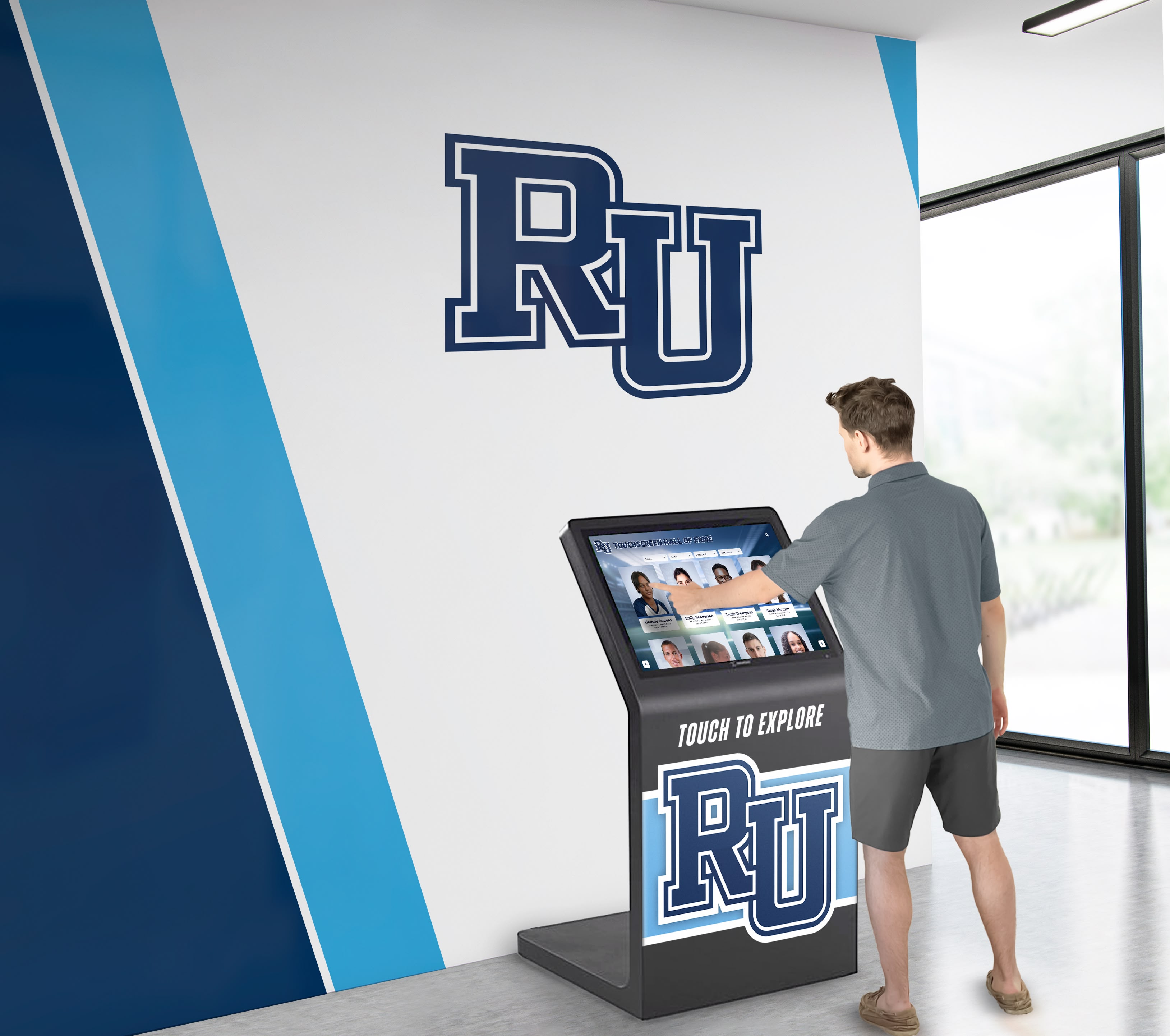
Budget Development: Establish realistic budgets considering initial hardware costs for displays and installation, software licensing for cloud platforms and content management, content development time and resources, ongoing annual maintenance and support, and contingency reserves for unexpected needs. Hardware typically represents 40-60% of initial investment, with software, installation, and content development comprising the remainder. Explore diverse funding sources including capital improvement budgets, booster or alumni contributions, corporate sponsorships offering recognition opportunities, grants focused on student achievement or facility enhancement, and memorial gift programs honoring specific individuals.
Stakeholder Engagement: Involve diverse perspectives in planning processes. Athletic directors and coaches provide sport-specific requirements, alumni representatives ensure recognition serves connection-building needs, administrative leadership offers strategic guidance and budget approval, facilities and IT staff address technical implementation considerations, students and parents contribute user perspective, and donor or booster representatives might fund implementation partially or fully. Broad engagement builds buy-in while surfacing requirements that might otherwise emerge too late to accommodate efficiently.
Solution Selection and Vendor Evaluation
Research available systems, request demonstrations, and make informed selections balancing capability, cost, and vendor quality.
Vendor Research and Shortlisting: Identify recognition system vendors serving similar organizations. Educational institutions should prioritize vendors with school and university experience understanding academic calendar rhythms, athletics program structures, and student data privacy requirements. Review vendor websites evaluating feature completeness, check references from comparable organizations, assess company stability and support reputation, and verify technical compatibility with existing infrastructure. Develop shortlists of 3-4 vendors for detailed evaluation avoiding overwhelming comparison across too many options.
Live Demonstrations and Trials: Request demonstrations using actual content similar to your use case rather than generic examples. Test content management ease by uploading sample profiles, evaluate interface intuitiveness by having stakeholders unfamiliar with the system attempt common tasks, assess visual appeal and professional presentation quality, verify claimed features work as expected in real conditions, and compare pricing transparency across options. When possible, arrange site visits to existing installations at similar organizations seeing systems in real operating environments rather than controlled demo settings.
Total Cost of Ownership Analysis: Compare solutions based on complete costs over expected 5-7 year lifecycles rather than just initial pricing. Calculate initial hardware, software, and installation costs; annual software licensing, hosting, and support fees; expected hardware replacement or upgrade costs; estimated internal labor for ongoing content management; and potential customization or integration expenses. Lower initial costs sometimes accompany higher ongoing expenses or limited capabilities requiring eventual replacement. Organizations should understand complete financial commitments before selection.
Guidance on choosing digital hall of fame providers provides detailed selection criteria and evaluation frameworks beyond basic feature comparison.
Content Development and Historical Digitization
Recognition systems provide value proportional to content quality and completeness. Comprehensive content development typically represents the most time-intensive implementation element but creates foundation for meaningful recognition.
Historical Research and Documentation: Compile achievement histories from diverse sources including yearbooks documenting team rosters and results, athletic record books tracking performance statistics, newspaper archives providing contemporary accounts, school publications offering additional context, and alumni memories filling gaps in official documentation. Systematic research approaches work backward from present to past, focusing first on most recent well-documented decades before tackling older eras with scarcer records. Establish documentation standards determining what evidence suffices for inclusion—balancing completeness against verification requirements.
Media Asset Collection: Gather photos, videos, and other media bringing recognition to life visually. Sources include school archives and yearbook photography, athletic department photo collections, newspaper and media coverage, alumni personal collections contributed voluntarily, and newly created photography for recent graduates and current honorees. Establish quality standards ensuring professional presentation—minimum resolution requirements, appropriate image composition, acceptable technical quality, and usage rights verification preventing copyright issues. Create organized asset libraries tagged by athlete, sport, year, and achievement type enabling efficient content creation.
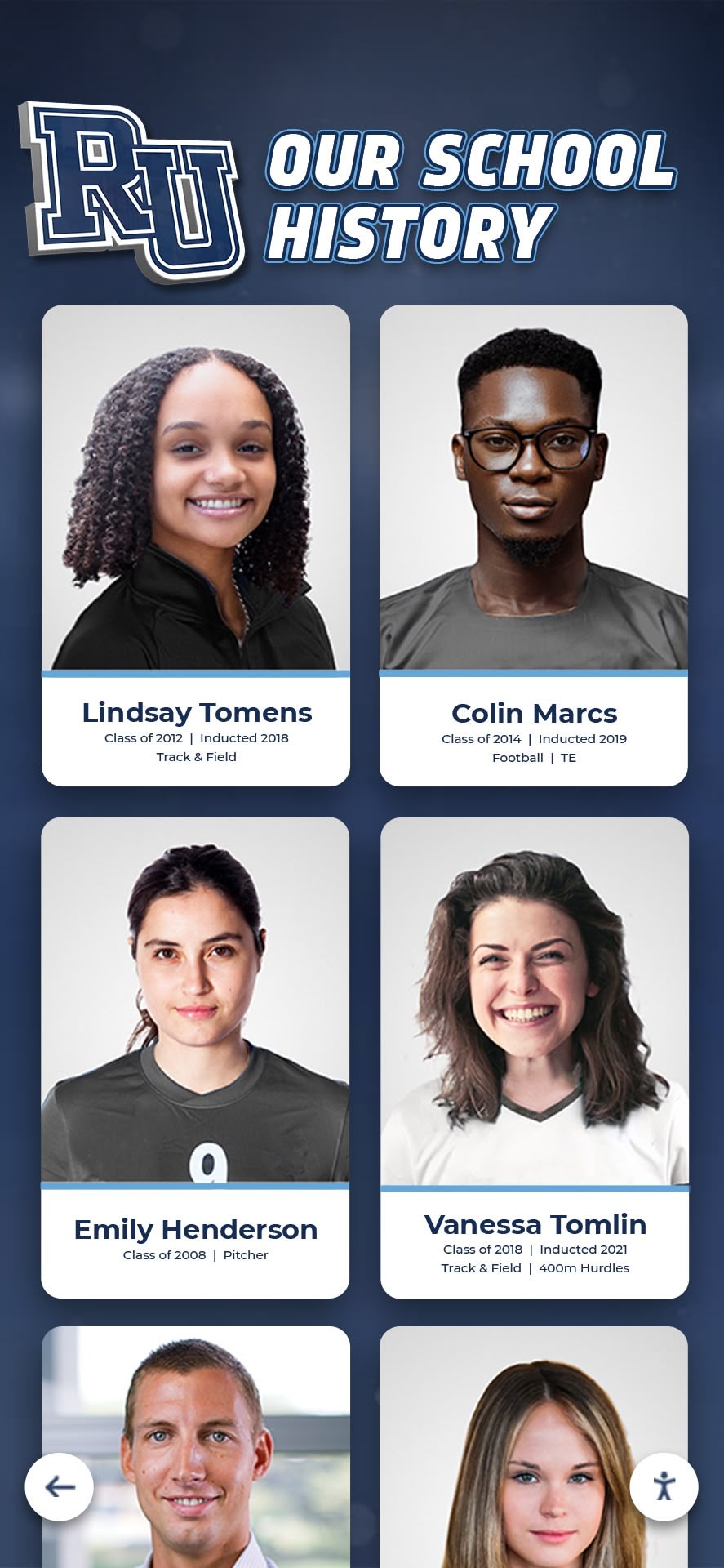
Profile and Entry Creation: Develop detailed recognition entries using consistent templates. Athletic profiles typically include full name and graduation year, sports and positions played, career statistics and records held, championships and major achievements with dates, post-graduation accomplishments when available, and personal statements or coach testimonials. Award recipient profiles adapt format appropriately—academic awards include majors and distinctions, service awards highlight contributions and impact, leadership awards recognize specific roles and achievements. Quality control processes ensure accuracy before publication including fact verification against source documents, proofreading for spelling and grammar, photo subject identification confirmation, and final approval by designated personnel.
Organization and Information Architecture: Establish logical content structures making recognition discoverable through multiple pathways. Create clear top-level categories based on user mental models—typically sports, achievement types, or time periods. Develop consistent naming conventions for teams, achievements, and eras. Establish metadata tagging enabling powerful filtering—sport, position, decade, achievement type, coach tenure. Define featured content rotation strategies highlighting diverse recognition rather than favoring specific groups. Thoughtful organization dramatically impacts user experience and recognition discovery—poor structure hides even excellent content behind confusing navigation.
Organizations undertaking digitization projects benefit from systematic approaches to digitizing historical records balancing completeness against project timeline and resource constraints.
Installation, Training, and Launch
Physical installation, staff training, testing, and public launch transform planning and preparation into operational recognition systems delivering value to audiences.
Physical Installation and Integration: Professional installation ensures optimal results and long-term reliability. Verify electrical capacity and circuit availability at installation locations, confirm network connectivity meeting bandwidth requirements, mount displays securely following all building and safety codes, configure system settings including display calibration and touch sensitivity, integrate institutional branding and customization, and conduct thorough testing before soft launch. Installation typically requires 1-2 days per display depending on facility complexity and infrastructure readiness. Coordinate installations to minimize disruption—during break periods, weekends, or after school hours.
Comprehensive Staff Training: Effective training enables confident content management ensuring systems remain current. Train all staff managing content updates on content management platform navigation and basic functions, profile creation using templates and media upload, publishing workflows including review and approval processes, basic troubleshooting for common issues, and backup procedures ensuring continuity when primary administrators are unavailable. Provide documentation and quick-reference guides supplementing live training, create video tutorials for complex procedures, establish clear escalation paths for technical issues beyond staff capability, and schedule refresher training sessions reinforcing skills and introducing new features. Resources on training staff for digital displays provide frameworks for effective knowledge transfer.
Soft Launch and Testing Period: Limited release before public announcement identifies issues requiring correction. Invite select stakeholder groups—coaching staff, athletic directors, alumni board members, student athletes—to test systems and provide feedback. Gather input about functionality, content accuracy, navigation intuitiveness, and overall impression. Identify bugs, usability concerns, or content errors requiring correction. Verify all content displays correctly across displays and web platforms. Refine based on testing results before broader launch. Soft launches typically span 1-2 weeks providing adequate testing time without excessive delay.
Public Launch and Awareness Campaign: Grand opening events generate awareness and excitement ensuring stakeholders know recognition systems exist and how to explore them. Host formal unveiling ceremonies with relevant dignitaries, invite recognized alumni and current students creating personal connections, engage local media for publicity coverage, promote through school communications, social media, and email announcements, demonstrate features during events encouraging hands-on exploration, and create printed materials with web addresses and basic instructions. Successful launches build momentum that sustains interest beyond initial novelty—recognizing this as beginning of ongoing recognition journey rather than destination.
Best Practices for Sustaining Recognition Excellence
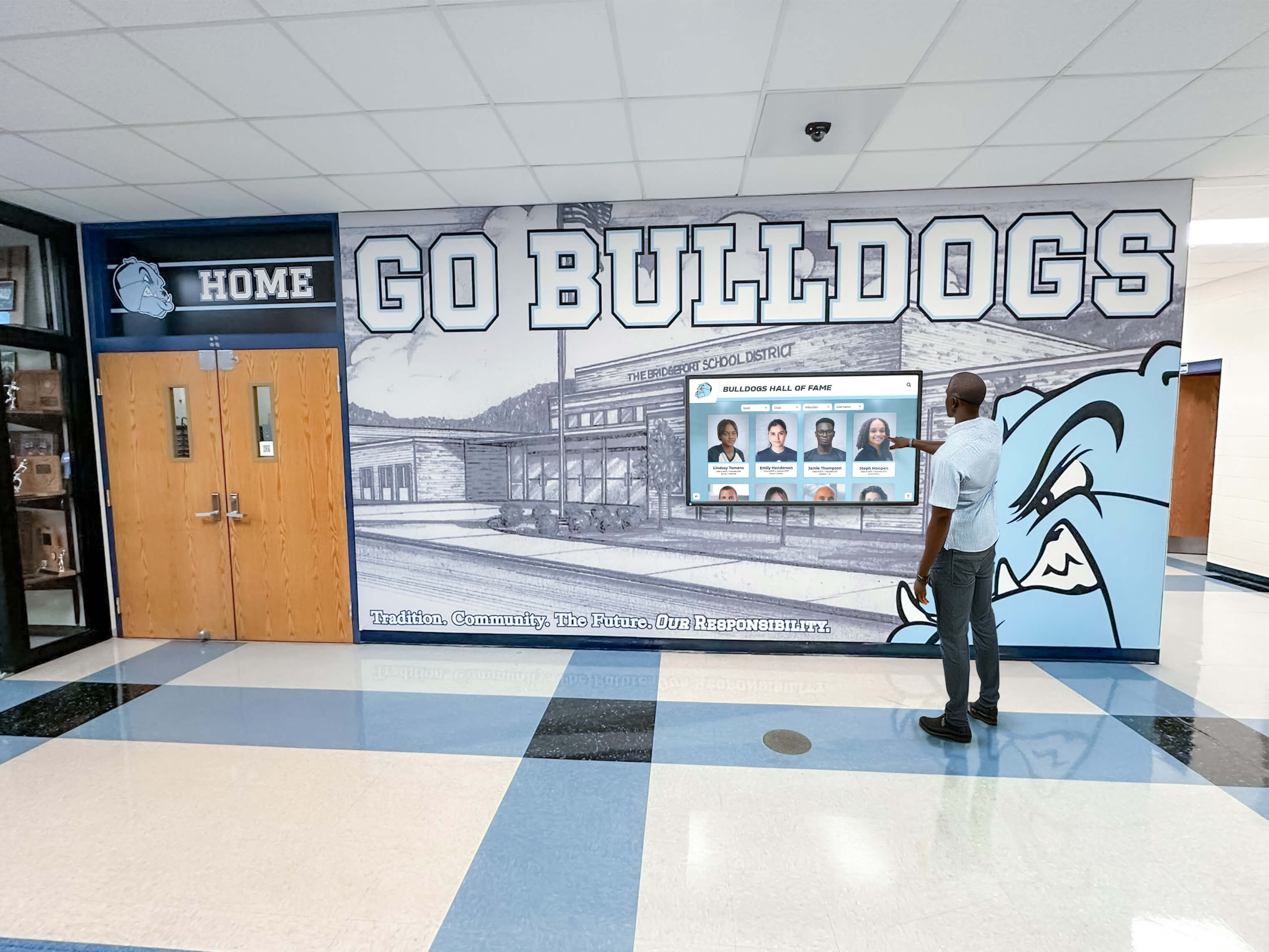
Hall of fame walls require ongoing attention maintaining relevance and value across years and decades. Initial launch enthusiasm fades without systematic management keeping content fresh and engaging.
Regular Content Updates and Maintenance
Recognition currency requires systematic processes keeping content accurate and complete as new achievements occur and historical research expands understanding of past accomplishments.
Achievement Recognition Cadence: Establish clear update timelines preventing backlogs. Add recognition immediately for milestone achievements—championships, school records, special honors—capitalizing on peak attention. Schedule weekly updates during active seasons ensuring timely acknowledgment. Conduct monthly reviews ensuring no accomplishments fell through gaps. Perform comprehensive end-of-season updates adding complete rosters, statistics, and team achievements. Execute annual historical content expansion projects systematically filling gaps in earlier decades. Consistent cadence demonstrates institutional commitment to recognition while distributing work manageably rather than creating overwhelming backlog.
Content Quality Standards: Maintain consistency across recognition through documented standards. Specify minimum photo quality requirements including resolution, composition, and technical acceptability. Define biographical detail expectations ensuring comparable depth across profiles. Establish verification procedures preventing factual errors—cross-referencing multiple sources, requiring athletic department approval, and implementing editorial review before publication. Enforce uniform formatting and presentation using templates and style guides. Quality standards prevent gradual degradation in professionalism as different staff members contribute content over time.
Historical Expansion Projects: Continuously expand historical recognition filling documentation gaps. Focus research projects on specific eras, sports, or achievement types enabling systematic progress. Engage alumni contributions through reunion events, social media campaigns, or targeted outreach to classes or teams. Accept donated photos, verify historical claims, and fill incomplete profiles. Over time, these incremental efforts create increasingly comprehensive institutional histories that would be overwhelming to compile in single projects but accumulate naturally through sustained commitment.
Strategies for capturing school history provide systematic approaches to historical documentation balancing completeness against practical resource constraints.
Alumni and Community Engagement
Recognition systems create opportunities for ongoing engagement connecting diverse audiences with institutional heritage and each other through shared history and excellence.
Alumni Participation and Contribution: Invite alumni involvement in recognition programs beyond being passive subjects. Solicit historical photos and memorabilia filling collection gaps, request achievement verification and additional context enriching profiles, encourage personal reflections about experiences and teammates, invite participation in recognition ceremonies and unveiling events, and create alumni ambassador programs promoting recognition systems through personal networks. This involvement strengthens alumni connections while improving content quality through insider knowledge and personal artifacts.
Social Media Integration and Amplification: Extend recognition reach through coordinated social media strategies. Feature specific achievements or athletes regularly with links to full profiles, create hashtags for recognition discussions enabling organic community conversation, celebrate historical anniversaries of major achievements maintaining relevance across time, encourage recognized individuals to share their profiles through easy sharing buttons, and cross-promote recognition during relevant events—homecoming, reunions, championships. Social amplification increases visibility far beyond those visiting physical locations while driving web traffic demonstrating broader recognition value.
Educational Integration: Incorporate recognition into curriculum and student life maximizing touchpoints and demonstrating relevance. Include institutional history in orientation programs introducing traditions to new students, develop school history curriculum modules exploring heritage and excellence, assign student research projects documenting specific eras or achievements, integrate recognition into campus tours highlighting excellence to prospective families, and create student ambassador programs where current students guide alumni through digital systems during reunions. These integrations transform recognition from standalone displays into embedded cultural elements reinforcing institutional identity.
Performance Monitoring and Continuous Improvement
Analytics and stakeholder feedback inform continuous recognition evolution ensuring systems adapt to changing institutional needs and audience preferences rather than remaining static after initial implementation.
Engagement Analytics Review: Monitor usage patterns revealing recognition effectiveness. Track total interactions and viewing duration showing overall engagement levels, analyze most-viewed content identifying popular recognition types, examine search query patterns revealing discovery approaches, identify peak usage times informing optimal update scheduling, and observe trends over time indicating sustained interest versus declining engagement. Review analytics quarterly identifying patterns requiring response—declining engagement might prompt content refreshes or feature improvements while strong specific interest could guide content expansion priorities.
Stakeholder Feedback Collection: Systematically gather qualitative input complementing quantitative analytics. Conduct user surveys assessing satisfaction and gathering improvement suggestions, maintain suggestion boxes or digital forms collecting ongoing input, organize focus groups exploring specific experiences in depth, solicit alumni feedback during reunions and events, and engage student advisory groups providing youth perspective. This feedback surfaces issues analytics might miss—confusing navigation, missing content categories, desired features, or technical problems affecting specific user segments.
Continuous Improvement and Evolution: Use insights to guide ongoing improvements maintaining recognition relevance across changing times and preferences. Add requested features or content types responding to user needs, refine navigation based on observed usage patterns, expand popular content categories capitalizing on demonstrated interest, improve search functionality addressing common query patterns, improve visual presentation based on feedback and design trends, and integrate new technologies as they mature and add value. Recognition systems should evolve continuously through small improvements rather than remaining static for years before major overhauls.
Addressing Common Questions and Concerns
Organizations considering touchscreen hall of fame walls frequently ask similar questions about costs, implementation, and outcomes. Understanding these common concerns helps inform decisions and set realistic expectations.
Investment and Pricing Considerations
Total investment depends on scale, features, and content development scope. Organizations can implement effective recognition at various budget levels aligned with different organizational sizes and objectives.
Entry-Level Implementation ($8,000-$15,000): Single 43-55 inch touchscreen display with cloud-based content management, basic content including recent graduates and major achievements, template-based design with institutional branding, and standard installation. Appropriate for smaller organizations, single sports or departments, or initial installations planning future expansion. Provides core recognition capabilities solving immediate capacity constraints while establishing foundation for growth.
Mid-Range Implementation ($20,000-$40,000): Single 55-75 inch premium display with improved hardware, comprehensive software platform including analytics and advanced features, extensive content development spanning multiple decades, custom design elements beyond standard templates, professional installation with electrical and network infrastructure work, and comprehensive staff training. Appropriate for most schools, athletic programs, and organizations seeking balanced investment delivering professional results without enterprise-scale commitment.
Comprehensive Implementation ($50,000-$150,000+): Multiple displays across facilities creating campus-wide recognition networks, extensive historical digitization with dedicated research, video production for highlights and storytelling, custom software features and integrations, premium commercial-grade hardware built for demanding environments, and ongoing content management support. Appropriate for large institutions making recognition central to identity and culture or organizations with complex multi-location requirements.
Compare these investments against alternatives and ongoing costs of traditional systems. Physical plaque production costs $50-$200 per plaque with dozens needed annually. Trophy case expansion runs $3,000-$8,000 per case. Physical maintenance and periodic updates add recurring costs. Storage costs for achievements not fitting displays. Wasted recognition value from accomplishments sitting unseen. Many organizations discover digital systems achieve cost parity within 3-5 years while providing capabilities physical systems never could.
Implementation Timeline and Effort
Timeline depends on scope and particularly content development depth. Organizations should plan realistically to avoid rushed implementation sacrificing quality.
Expedited Implementation (6-10 weeks): Limited initial content focusing on recent achievements, basic profiles with essential information, streamlined vendor selection and installation, and plan for gradual content expansion post-launch. Appropriate when time pressure exists or when organizations prefer launching with core content then building comprehensiveness over time. Delivers value quickly while acknowledging recognition will expand.
Standard Implementation (3-5 months): Comprehensive recent content back 10-15 years, selective historical recognition for major achievements and distinguished alumni, thorough vendor evaluation and customization, proper staff training and soft launch testing, and professional public launch event. Appropriate for most organizations balancing speed with quality and reasonable completeness. Delivers substantial value at launch while leaving room for historical expansion projects.
Extensive Implementation (6-12 months): Deep historical research back to institutional founding or program inception, comprehensive content across all decades and achievement types, custom design and feature development, coordination with facility renovation projects, and integration with existing systems like student information databases or athletic statistics platforms. Appropriate when quality and completeness outweigh launch urgency or when recognition projects tie to larger institutional initiatives enabling longer timelines.
Phased approaches enable faster initial launches while continuing to expand content over subsequent periods. This strategy provides immediate value demonstrating return on investment while spreading content development effort sustainably across months or years as resources allow.
Technology Longevity and Future-Proofing
Modern cloud-based platforms minimize obsolescence concerns through regular updates and standardized components enabling straightforward hardware upgrades when eventually needed.
Software Platform Evolution: Cloud-based recognition systems receive automatic updates adding features and maintaining current technology without requiring reinstallation or migration. Vendors continuously improve platforms responding to customer feedback, technology advances, and competitive pressures. Select vendors committed to long-term platform investment—established companies serving educational or nonprofit markets rather than consumer-focused startups likely to pivot or discontinue products. Ask about platform development roadmaps, update frequency, and customer advisory boards indicating commitment to ongoing evolution.
Hardware Lifecycle Management: Commercial-grade touchscreen displays operate reliably 5-8 years before replacement becomes advisable—comparable to other institutional technology lifecycles like projectors or interactive whiteboards. Standardized display connections and mounting systems mean replacements simply swap old screens for newer models without rebuilding entire installations. Component-based architecture enables targeted upgrades—replacing displays while retaining mounting hardware or upgrading touch sensors without replacing screens—extending effective lifecycles and reducing upgrade costs compared to monolithic systems requiring complete replacement.
Content Investment Protection: Recognition content represents the primary long-term value transcending any particular display technology. Cloud-based content management ensures achievement documentation remains accessible regardless of hardware changes. Even if entire systems eventually require replacement, comprehensive content exports prevent starting documentation efforts over. Organizations protect decades of achievement history regardless of future technology evolution by selecting platforms providing content portability and avoiding proprietary formats locking data into specific vendor ecosystems.
Well-chosen recognition systems protect achievement documentation for generations regardless of future technology changes. Content—not display technology—represents lasting institutional asset.
Applications Beyond Athletics: Comprehensive Recognition Programs
While athletic hall of fame walls represent common implementations, touchscreen digital recognition platforms serve diverse applications across organizational types and recognition domains.
Academic Achievement and Scholarship Recognition
Educational institutions increasingly apply digital recognition to academic excellence creating comprehensive celebration systems honoring all forms of student achievement equally.
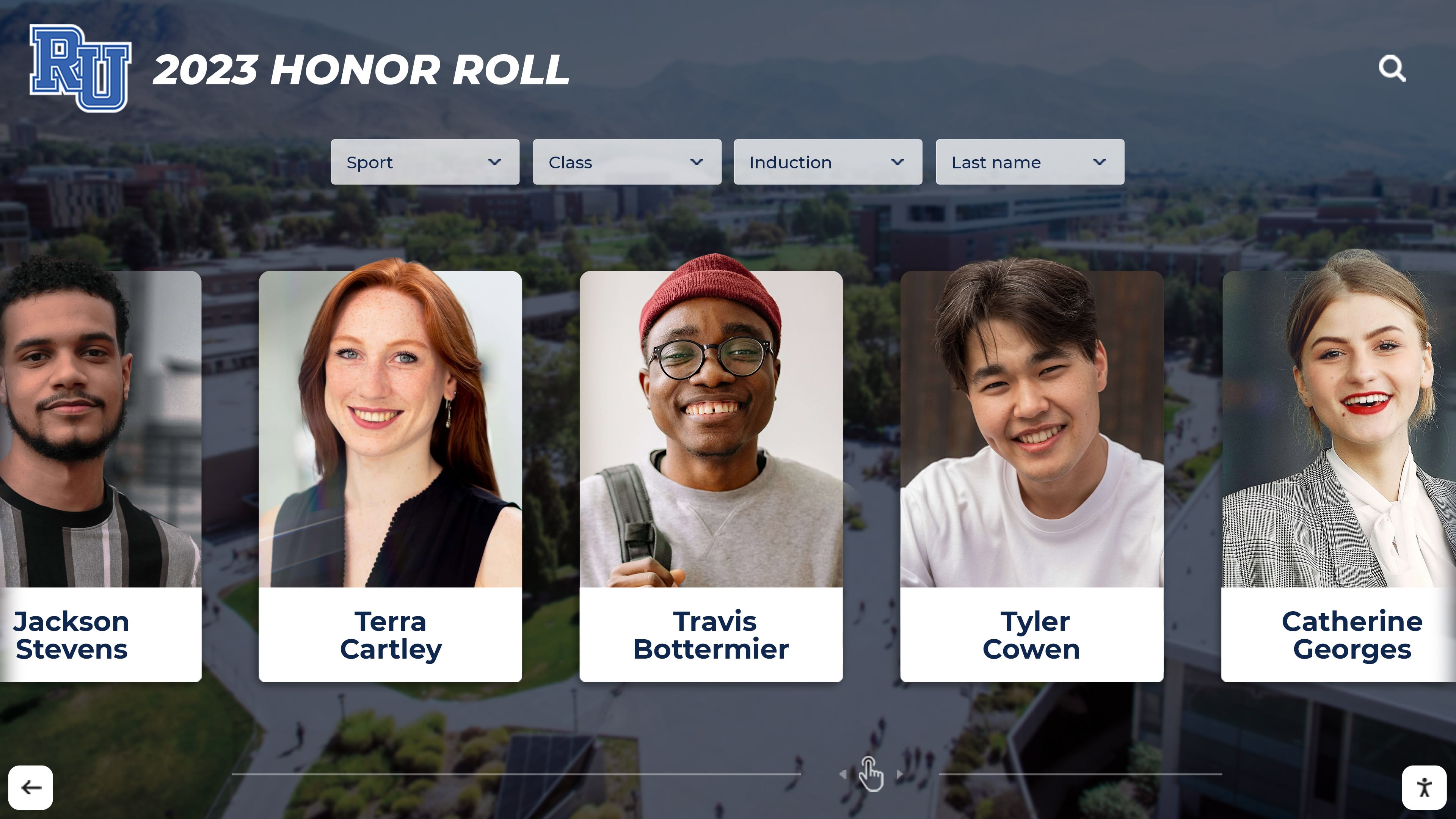
Honor Roll and Academic Awards: Digital systems display honor roll recipients, valedictorians and salutatorians, perfect attendance achievers, scholarship winners, academic competition success, and subject-specific excellence awards. Searchable databases enable students and families to find specific recognition quickly while comprehensive capacity ensures every achievement receives acknowledgment regardless of class size or achievement volume.
National Recognition Programs: Highlight students earning National Merit Scholar status, AP Scholar distinctions, National Honor Society membership, academic all-state recognition, and specialized program completions. These prestigious achievements deserve prominent celebration demonstrating institutional academic strength to prospective families while honoring student dedication and excellence.
Alumni Academic Achievement: Recognize graduates earning advanced degrees, publishing research or books, receiving patents or innovation awards, achieving professional certifications and licensure, and earning industry recognition or professional honors. This recognition demonstrates long-term educational outcomes validating institutional effectiveness while inspiring current students through successful alumni examples.
Comprehensive approaches to academic recognition programs show systematic frameworks for celebrating intellectual excellence across educational institutions.
Corporate and Employee Recognition
Businesses apply touchscreen recognition platforms for employee achievement celebration, creating cultures of appreciation while documenting organizational history and excellence.
Performance and Achievement Awards: Display top sales performers, customer service excellence recipients, innovation and idea generation contributors, safety record milestone achievers, and quality improvement initiative leaders. Digital recognition makes achievements visible to entire organizations rather than limiting celebration to individual ceremonies or department announcements, multiplying recognition impact through extended visibility and reinforcing desired behaviors through prominent acknowledgment.
Service Milestones and Anniversaries: Honor tenure milestones—5, 10, 15, 20+ year anniversaries—with profiles documenting career progression, contributions, and accomplishments. Retirement recognition celebrates complete careers and enduring contributions. This service recognition demonstrates organizational appreciation for loyalty and sustained contribution while showing newer employees that dedication receives meaningful acknowledgment.
Leadership and Culture Awards: Recognize exemplary leadership demonstration, mentorship and talent development contributions, culture ambassadorship and values modeling, community involvement and volunteer leadership, and diversity, equity, and inclusion advancement. These awards reinforce desired organizational culture by celebrating behaviors and contributions supporting cultural priorities beyond just performance metrics.
Nonprofit and Community Organization Recognition
Nonprofits, community organizations, and charitable institutions use digital hall of fame walls for donor recognition, volunteer celebration, and mission impact documentation.
Donor Recognition and Stewardship: Digital donor walls provide unlimited capacity for recognizing contributions at all levels without physical space constraints forcing minimum giving thresholds. Multimedia capabilities enable showing donation impact through photos and videos of programs funded. Easy updates ensure recognition appears immediately after gifts rather than waiting for annual physical recognition updates. Remote accessibility enables donors anywhere to see recognition and share with networks, extending institutional visibility while deepening donor connection.
Volunteer and Board Recognition: Celebrate volunteer contributions, board member service, committee leadership, and community partnership. Recognition demonstrates appreciation encouraging continued involvement while highlighting organizational dependence on volunteer support attracting additional community participation.
Program Impact and Success Stories: Document program beneficiaries and success stories (with appropriate consent and privacy protection), display program milestones and achievements, and demonstrate mission impact through compelling multimedia storytelling. This impact documentation supports fundraising by showing prospective donors concrete results while reinforcing community understanding of organizational importance and effectiveness.
Understanding donor recognition strategies provides frameworks for nonprofit applications of interactive recognition technology.
Selecting the Right Provider for Your Organization
Vendor selection significantly impacts long-term satisfaction, system effectiveness, and total cost of ownership. Thoughtful evaluation against clear criteria ensures optimal provider choice aligned with organizational needs and resources.
Essential Evaluation Criteria
Feature Completeness and Quality: Verify vendors offer capabilities meeting your requirements including intuitive content management requiring no technical expertise, responsive touchscreen interfaces supporting multi-touch gestures, comprehensive multimedia support for photos and videos, robust search and navigation accommodating different user preferences, web accessibility extending recognition beyond physical displays, reliable analytics tracking engagement and usage, and mobile responsiveness ensuring quality experiences across devices. Request demonstrations using content similar to your use case evaluating real-world performance beyond marketing materials.
User Experience and Interface Design: Assess both public user interfaces and administrative systems. Public interfaces should feature intuitive navigation requiring no instructions, attractive professional presentation reflecting well on organizations, responsive performance with no delays or lag, and accessibility compliance supporting users with disabilities. Administrative interfaces should enable efficient content management without extensive training, provide helpful error messages and validation, support batch operations for efficiency, and offer adequate preview capabilities before publishing.
Vendor Stability and Support Quality: Research vendor viability and support reputation. Evaluate company longevity and financial stability, client base size and retention rates, support availability and response time commitments, training and documentation quality, platform update frequency and improvement commitment, and customer advisory board existence indicating client input value. Contact references asking specifically about support responsiveness, issue resolution effectiveness, vendor partnership quality, and whether they would select the same vendor if choosing today.
Integration and Compatibility: Verify technical compatibility with existing infrastructure. Confirm network connectivity requirements are reasonable, display hardware meets facility capabilities, content import supports your existing data formats, potential integration with student information systems or athletic statistics platforms is feasible if desired, and single sign-on authentication integrates with existing systems if needed. Technical incompatibility discovered late can delay implementations or require unexpected infrastructure investments.
Pricing Transparency and Total Cost: Evaluate complete costs over expected lifecycle. Request detailed pricing including initial hardware and software costs, installation and configuration expenses, training and onboarding, annual licensing and support fees, expected hardware replacement timeline and costs, and content migration support if switching from existing systems. Hidden costs or unexpected renewal increases create budget problems and erode trust. Prefer vendors with transparent pricing and predictable cost structures over those providing only high-level estimates requiring extensive negotiation for actual pricing.
Important Contract Considerations
Licensing Terms and Renewals: Understand software licensing structure and renewal expectations. Clarify whether pricing is per display, per institution, or per user; what renewal increase caps exist preventing unexpected cost escalation; what happens to content if organizations don’t renew—can content be exported or does it become inaccessible; and what features require base licenses versus premium upgrades. Avoid surprises by documenting complete licensing terms before commitment.
Data Ownership and Portability: Ensure clear data ownership protecting institutional investment in content development. Contracts should confirm organizations own all content uploaded regardless of licensing status, specify content export capabilities and formats if switching vendors, prohibit vendor use of organizational content for marketing without explicit permission, and establish data retention after contract termination. Content represents years of institutional investment deserving strong protection ensuring it remains accessible regardless of vendor relationship evolution.
Support Terms and Service Levels: Document support expectations preventing frustration with inadequate assistance. Clarify support availability hours and channels, response time commitments for different issue severity levels, whether support is included or costs extra, escalation procedures for unresolved issues, and proactive monitoring versus reactive support only. Quality support dramatically impacts long-term satisfaction—inadequate support turns minor issues into major frustrations while excellent support enables confident system management.
Customization and Development Rights: Understand flexibility for future customization. Determine what configuration options exist without custom development, whether custom feature development is possible and at what cost, how feature requests feed into product roadmaps, and whether organizations can develop their own integrations or whether vendor must perform all customization. Some organizations never need customization while others require flexibility for evolving needs—ensure terms align with your preferences and expectations.
The Future of Digital Recognition Technology
Recognition technology continues evolving with emerging capabilities promising better engagement, accessibility, and applications expanding beyond current implementations.
Emerging Technologies and Capabilities
Forward-looking recognition systems will incorporate advancing technologies as they mature from experimental to practical implementations delivering clear value.
Artificial Intelligence and Natural Language: AI-powered features will enable conversational interaction—users asking “Show me all basketball championship teams from the 1990s” or “Find athletes who played both football and baseball” through natural language rather than structured searches. Content generation assistance will help staff create compelling profile narratives from basic facts and statistics. Automatic tagging and categorization will reduce manual content organization burden. Translation capabilities will provide multilingual recognition serving diverse communities. While some AI features exist today, continued advancement will make recognition systems increasingly intuitive and powerful.
Augmented Reality Integration: Mobile augmented reality applications will overlay digital recognition content on physical spaces through smartphone or tablet cameras. Point devices at trophy cases to see expanded achievement information, historical photos, and video highlights beyond physical artifacts. Scan QR codes throughout facilities triggering AR experiences bringing locations to life with relevant recognition and stories. AR creates engaging hybrid experiences combining physical presence with digital depth unavailable through either modality alone.
Personalization and Customization: Recognition systems will increasingly personalize experiences for different users. Alumni might see their own achievements and teammates featured prominently. Prospective students interested in specific sports would see relevant program excellence highlighted. Parents could bookmark their children’s recognition receiving notifications when new content appears. Personalization increases relevance and engagement by adapting experiences to individual interests rather than providing identical views to all users.
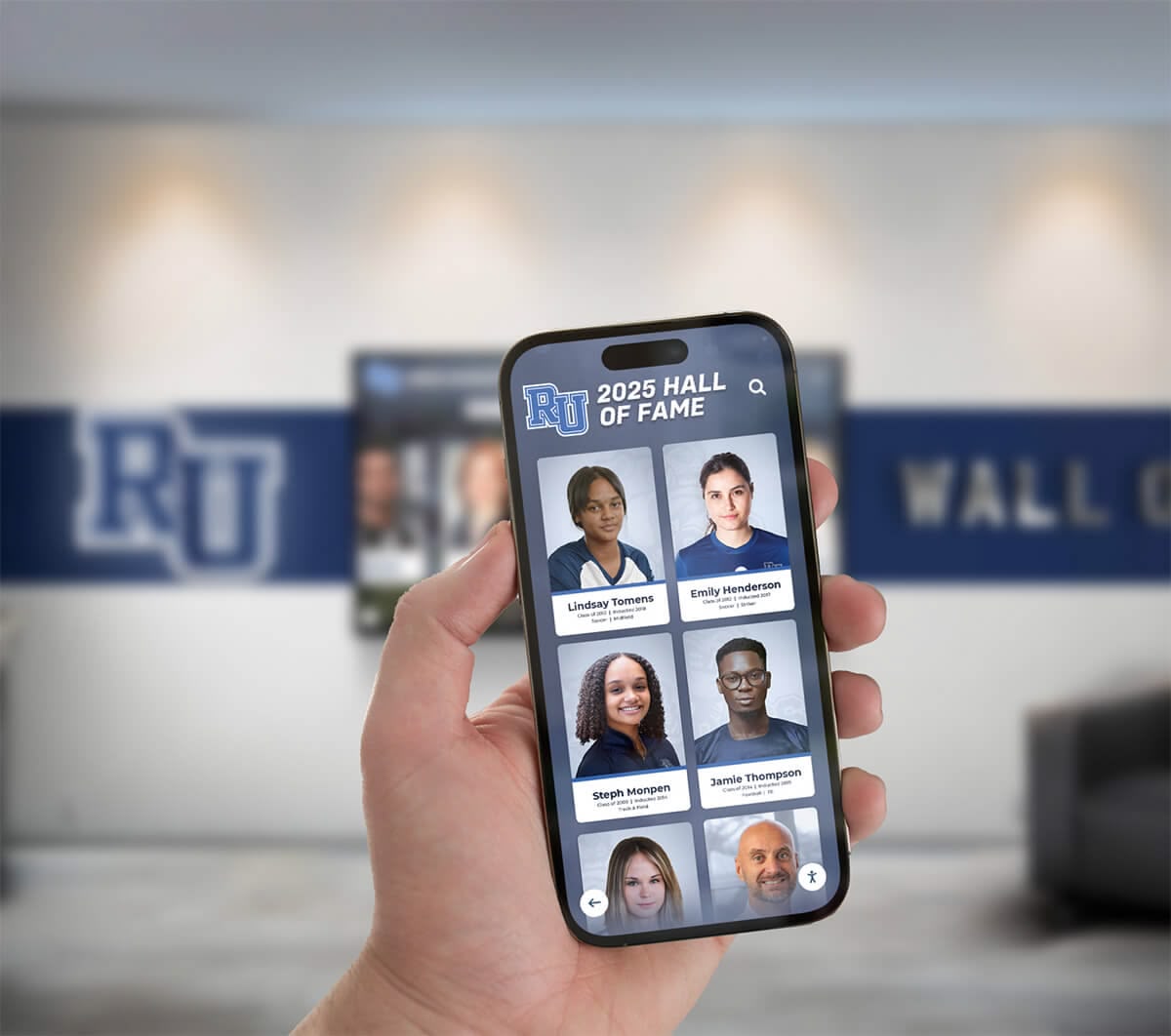
Voice Interaction and Accessibility: Voice control will enable hands-free navigation particularly valuable for accessibility supporting users with mobility limitations. Natural language voice queries provide alternative interaction modality accommodating different user preferences and abilities. Text-to-speech capabilities will read profile content aloud ensuring visually impaired users can fully access recognition. These accessibility improvements ensure recognition systems serve all audiences equitably regardless of abilities or interaction preferences.
Organizations implementing modern digital systems now position themselves to adopt these enhancements as they mature and become standard platform features. Cloud-based platforms receive automatic updates without requiring replacement investments, ensuring systems remain current across years.
Expanding Recognition Scope and Integration
Progressive institutions recognize that comprehensive recognition extends beyond athletics or narrow domains to celebrate diverse excellence across organizational life.
Digital recognition platforms established for athletics can expand to accommodate additional recognition domains creating unified systems celebrating complete institutional excellence. Academic achievement, fine and performing arts accomplishments, service learning and community contribution, leadership and character development, alumni achievement in careers and communities, and faculty or staff excellence all deserve recognition alongside athletic accomplishment.
This comprehensive approach demonstrates organizations value all excellence forms equally while providing single platforms serving diverse stakeholder interests. Unified recognition systems also prove more cost-effective than maintaining separate systems for each domain while creating more engaging comprehensive resources than fragmented domain-specific displays scattered across facilities.
Transforming Recognition from Constraint to Celebration
Educational institutions, athletic programs, nonprofits, and organizations of all types exist to develop excellence—helping people achieve extraordinary things in academics, athletics, arts, service, leadership, and life. When organizations help individuals and teams accomplish remarkable achievements, those accomplishments deserve recognition honoring their significance completely and permanently. The challenge has always been that achievement accumulates faster than physical recognition capacity grows, forcing impossible choices about what deserves visibility and what must sit forgotten in storage.
Touchscreen digital hall of fame walls and interactive awards systems eliminate these forced choices through unlimited digital capacity, engaging interactivity, instant updates, and comprehensive accessibility. Every championship team receives acknowledgment. Every individual record holder gains recognition. Every distinguished alumnus earns honor. Every award recipient enjoys celebration. Physical space limitations no longer dictate whose excellence gets celebrated and whose contributions disappear into forgotten archives.
Modern recognition systems transform organizational culture by demonstrating that every achievement truly matters. Current students, athletes, and members see clear pathways to excellence and understand their possible place in ongoing traditions. Alumni maintain connections with institutions honoring their contributions permanently. Communities take pride in comprehensive excellence documentation spanning decades. And prospective students, recruits, donors, and members witness organizational commitment to recognizing and celebrating individual accomplishment completely and equitably.
Whether addressing overflowing trophy cases, seeking improved engagement, supporting recruiting and development efforts, or simply wanting to honor achievement appropriately, digital recognition systems provide compelling solutions. They preserve complete institutional histories, create engaging exploration experiences, enable instant celebration of new accomplishments, ensure recognition reaches audiences anywhere through web accessibility, and finally make comprehensive celebration possible rather than forcing choices between honoring some while ignoring others.
The best touchscreen digital hall of fame walls don’t force choices between recognizing some achievements while ignoring others. They celebrate every accomplishment, honor every contributor, and preserve every moment of excellence that makes organizations special. Every person deserves recognition for their achievements—not just those whose excellence happens to fit limited physical space. Modern recognition systems finally make comprehensive celebration possible.
Organizations ready to transform recognition can explore purpose-built solutions combining intuitive content management, professional presentation, comprehensive features, and reliable support specifically designed for institutional needs. These platforms enable organizations to honor excellence appropriately while building recognition traditions that strengthen culture, engage communities, and inspire future members to pursue their own extraordinary achievements.
Ready to see how interactive recognition displays can transform how your organization celebrates excellence? Talk to our team to explore how Rocket Alumni Solutions can help your institution honor every achievement permanently through comprehensive digital hall of fame systems designed specifically for schools, athletic programs, and organizations committed to recognizing excellence without limitations.