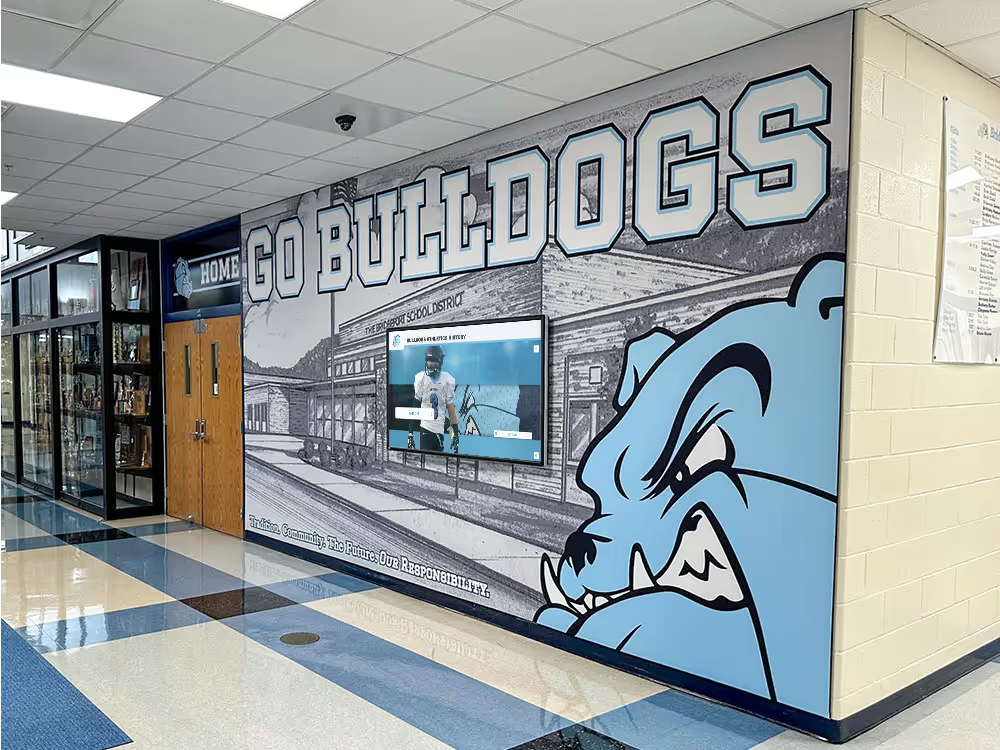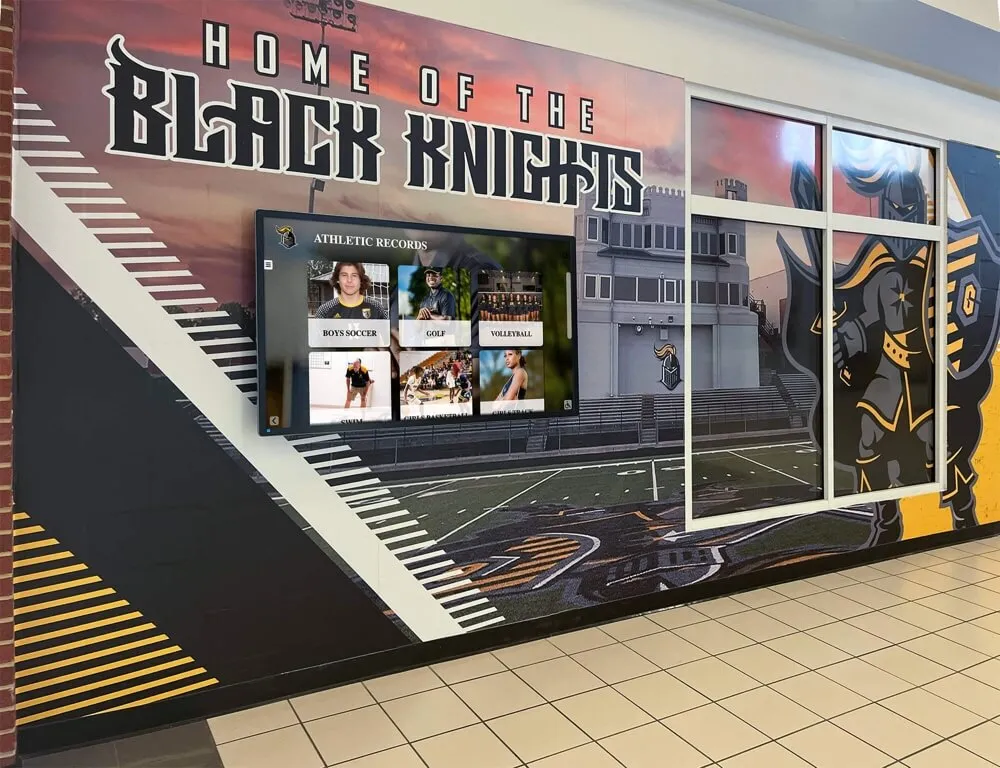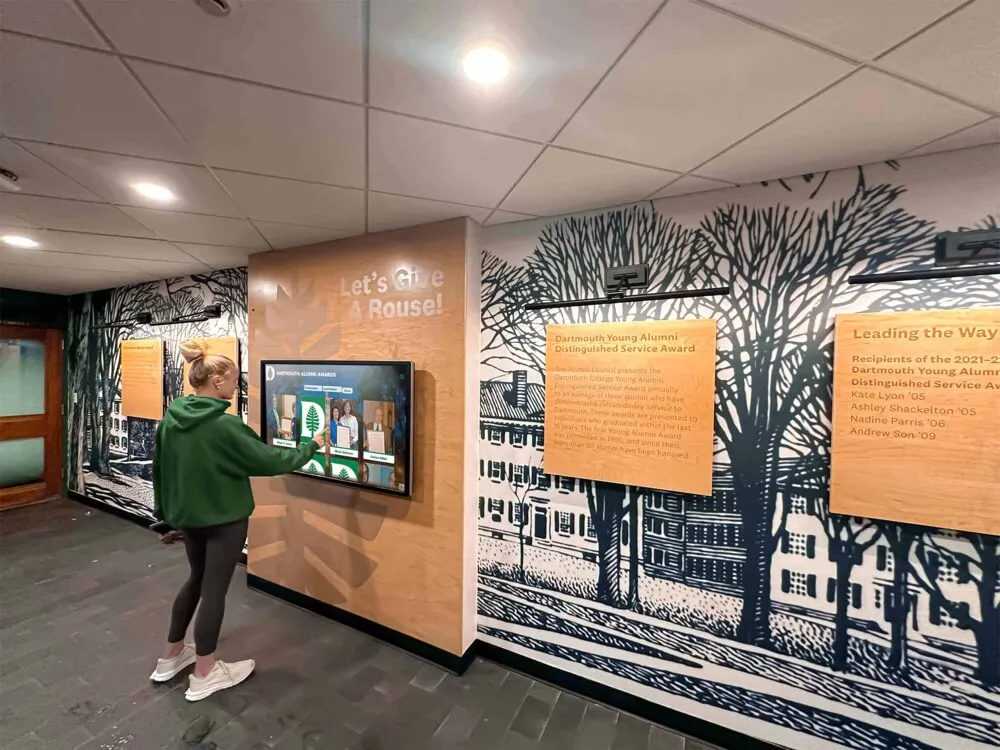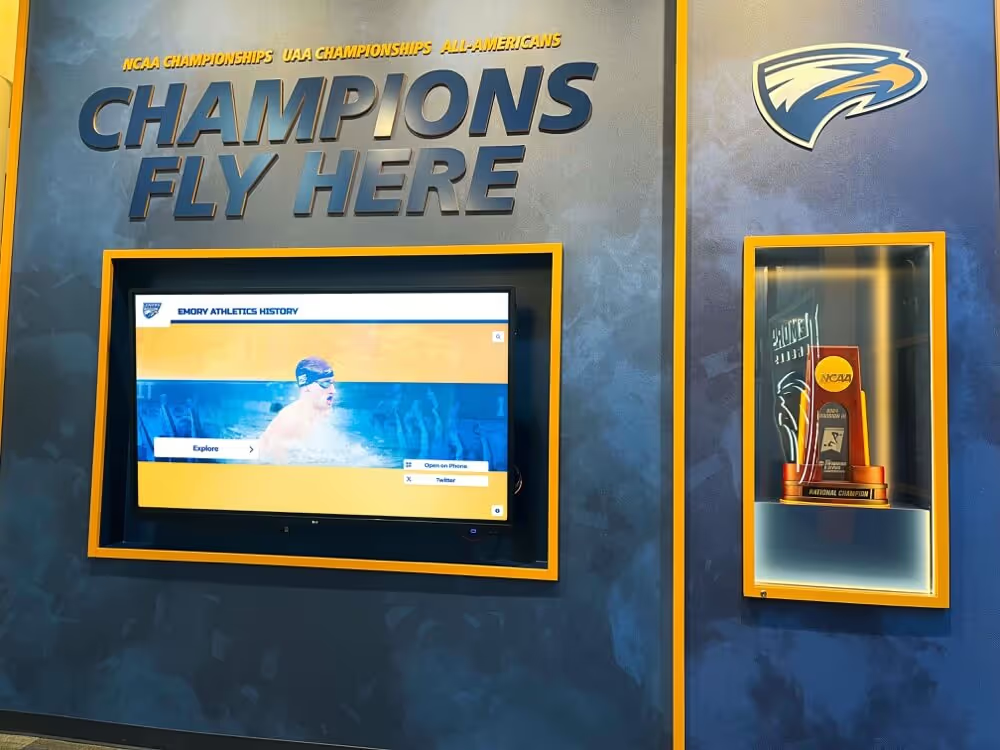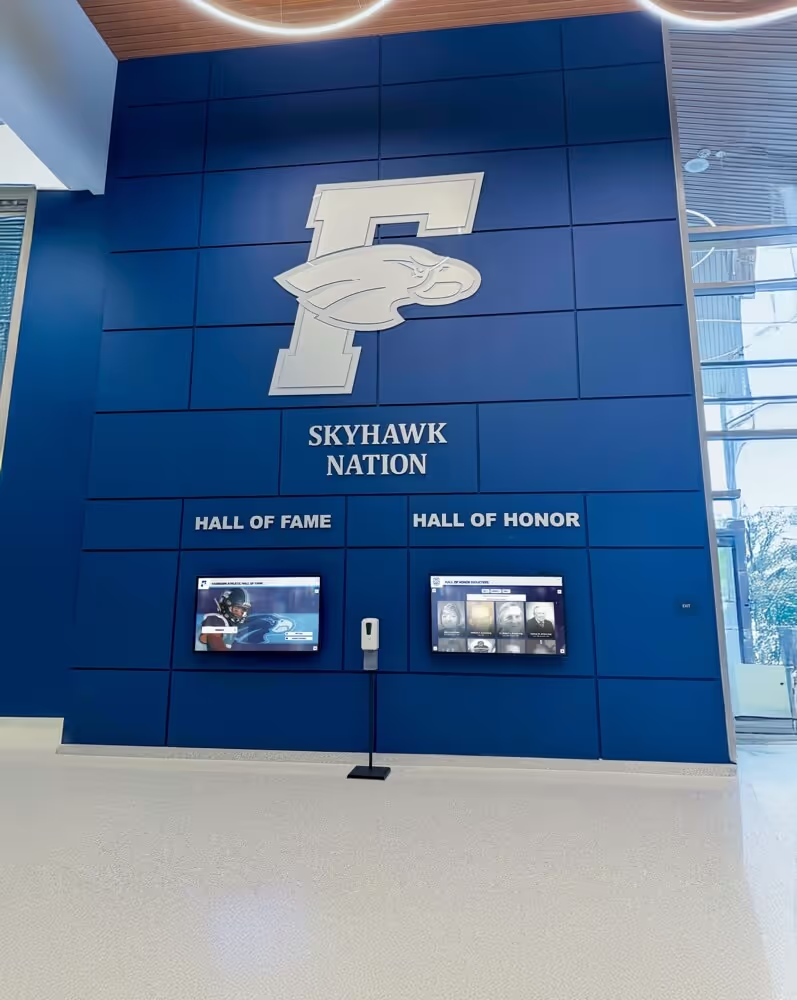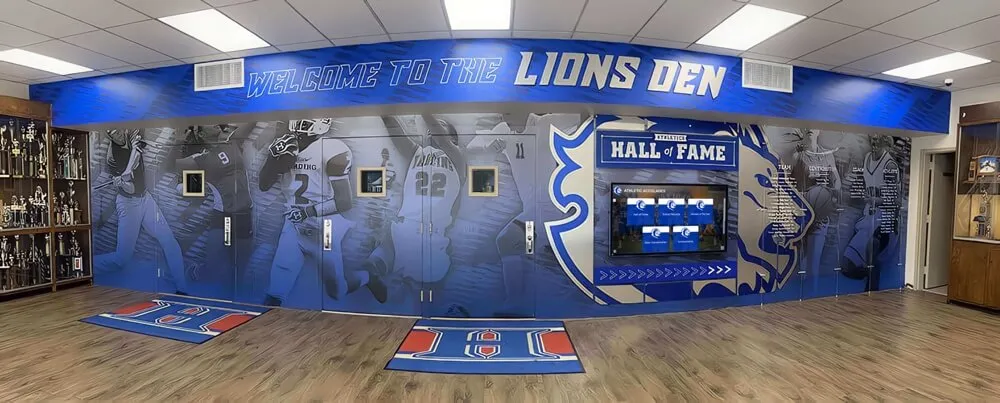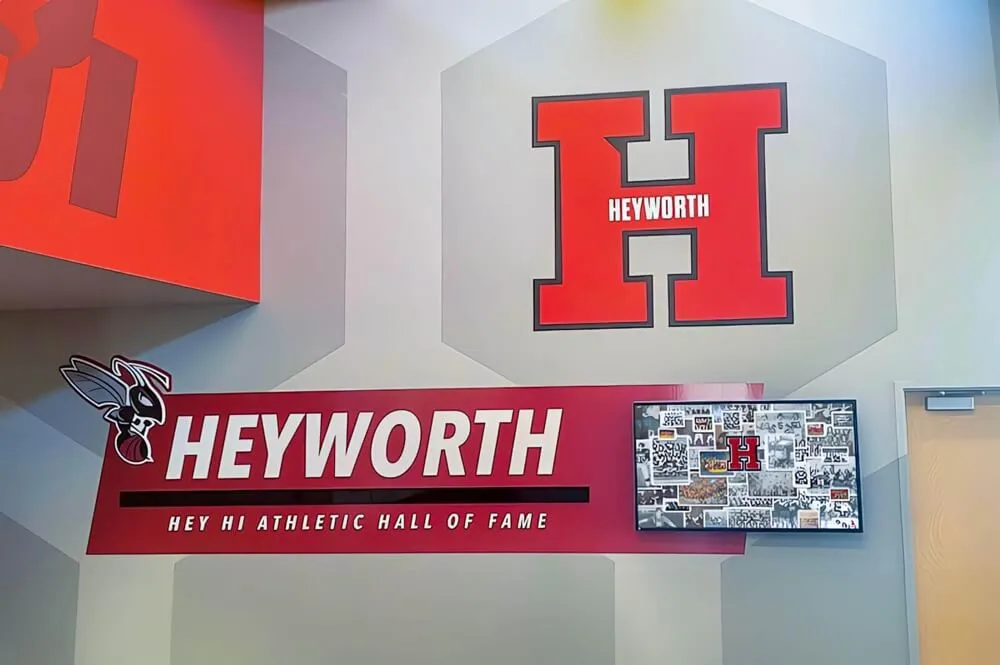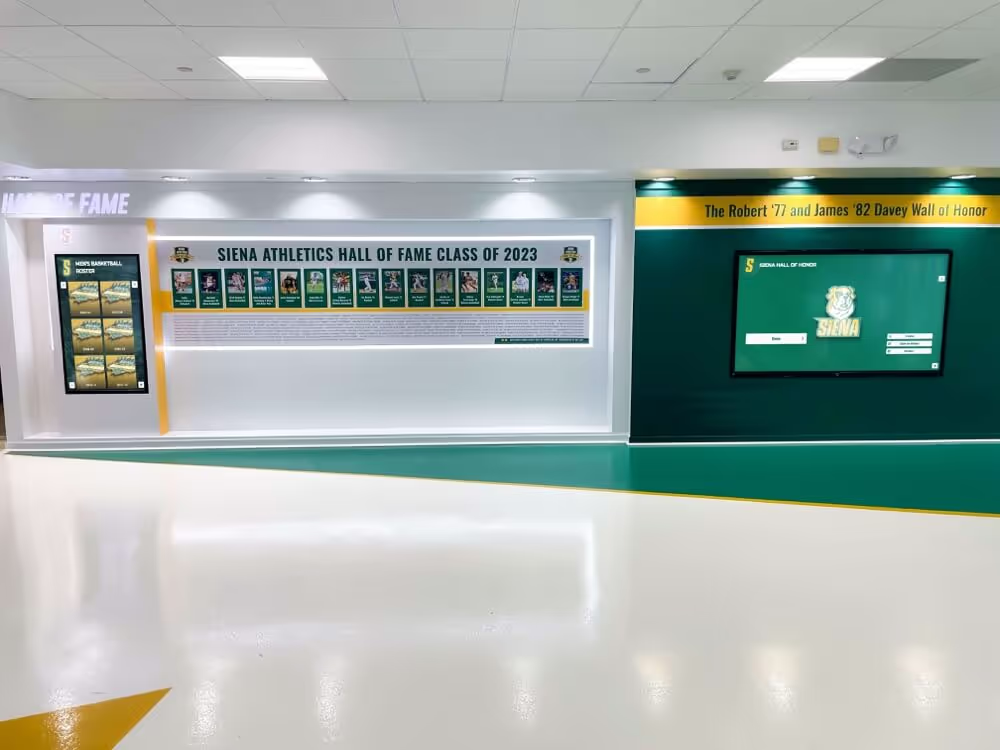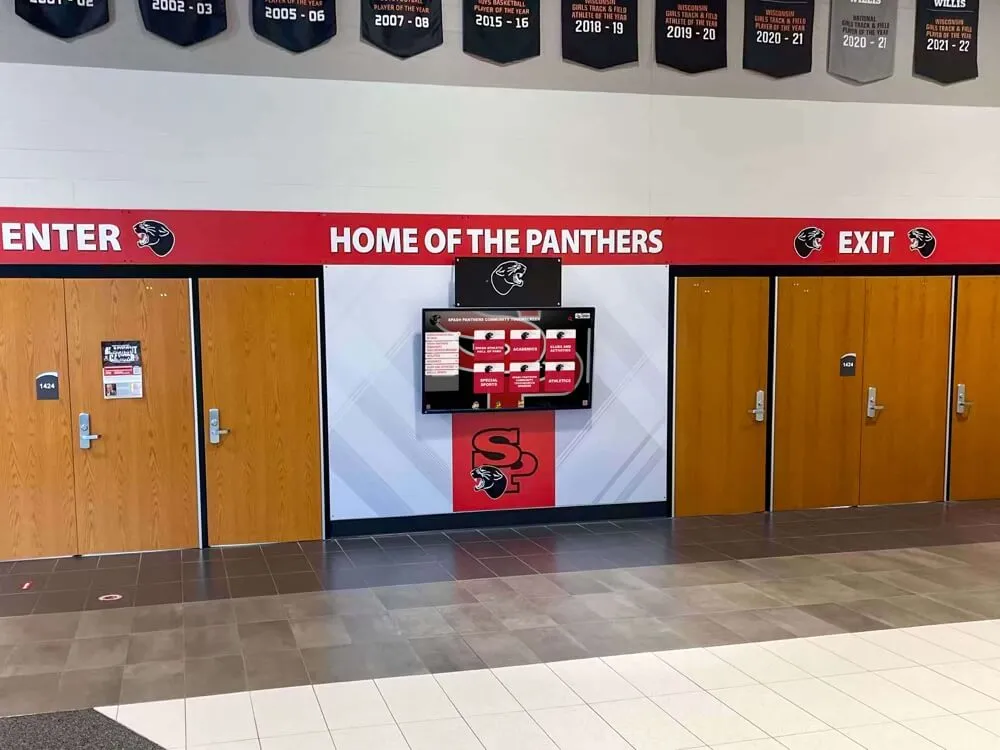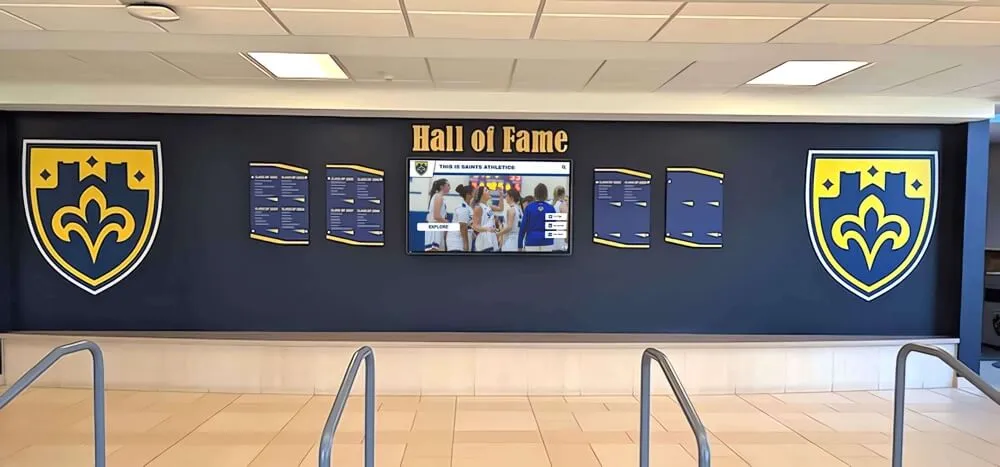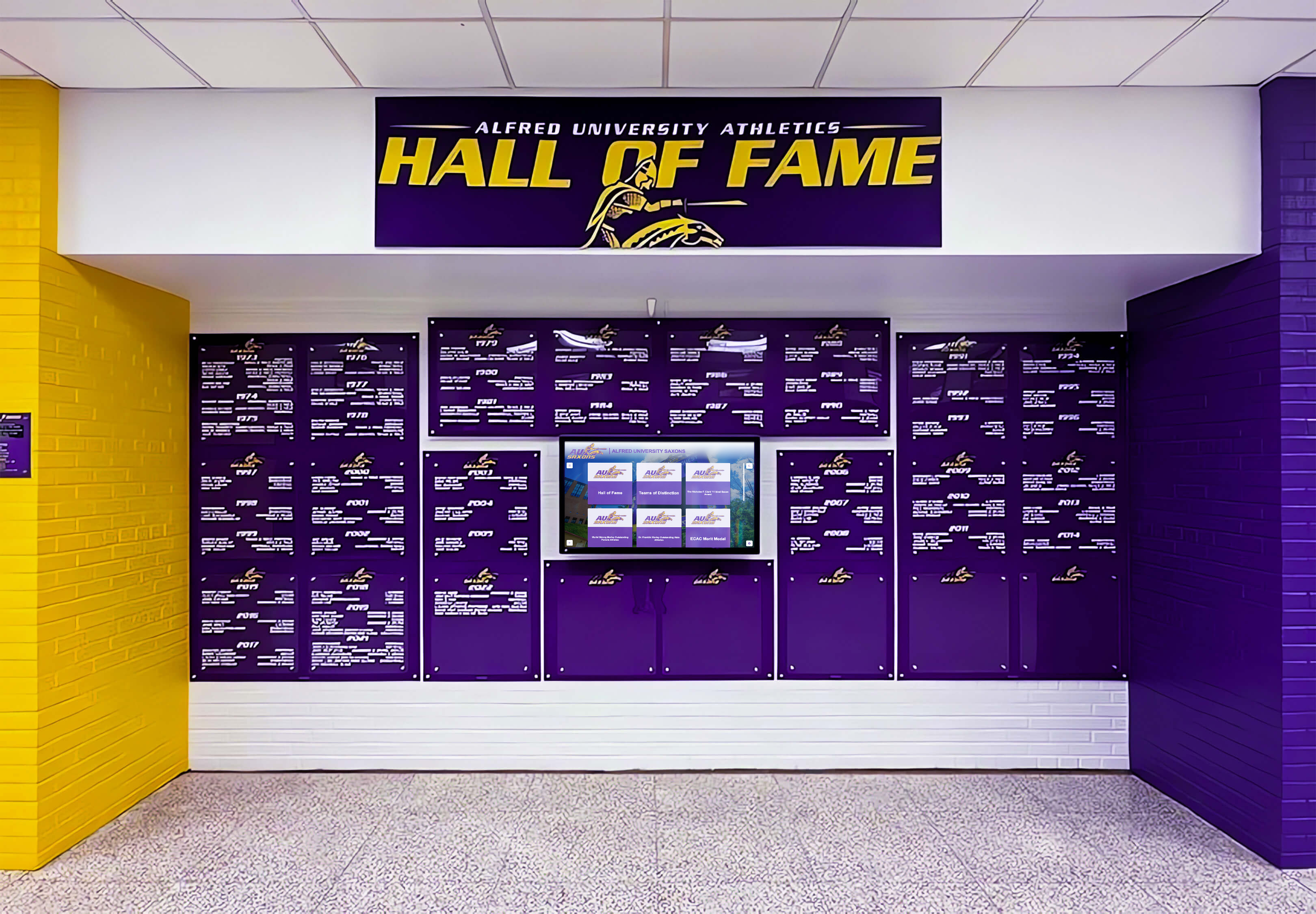




When a school district’s football team claims the conference crown, it isn’t just one campus celebrating — it’s an entire community. The same holds for every swimming gold, wrestling title, and soccer championship earned by any of your district’s schools. Yet most districts still scatter those triumphs across individual campus trophy cases where only the home-school audience ever sees them. A district championship recognition wall changes that: one unified installation that gives every hard-earned title a shared, permanent home visible to all families across the system.
Building that unified display means solving a coordination problem that individual schools never face. You’re managing branding from multiple campuses, championship data from multiple athletic departments, stakeholder expectations from multiple principals and booster clubs, and a budget that has to satisfy everyone fairly. The ideas below walk through concrete configurations — physical, digital, and hybrid — that athletic directors and district administrators have used to create recognition infrastructure worthy of multi-school athletic achievement.
Why Digital Beats Physical at District Scale
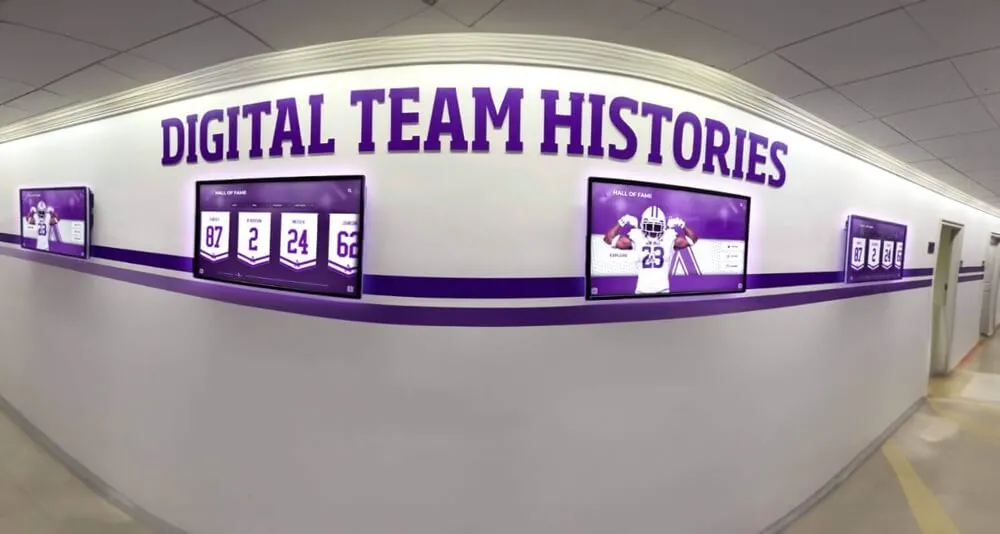
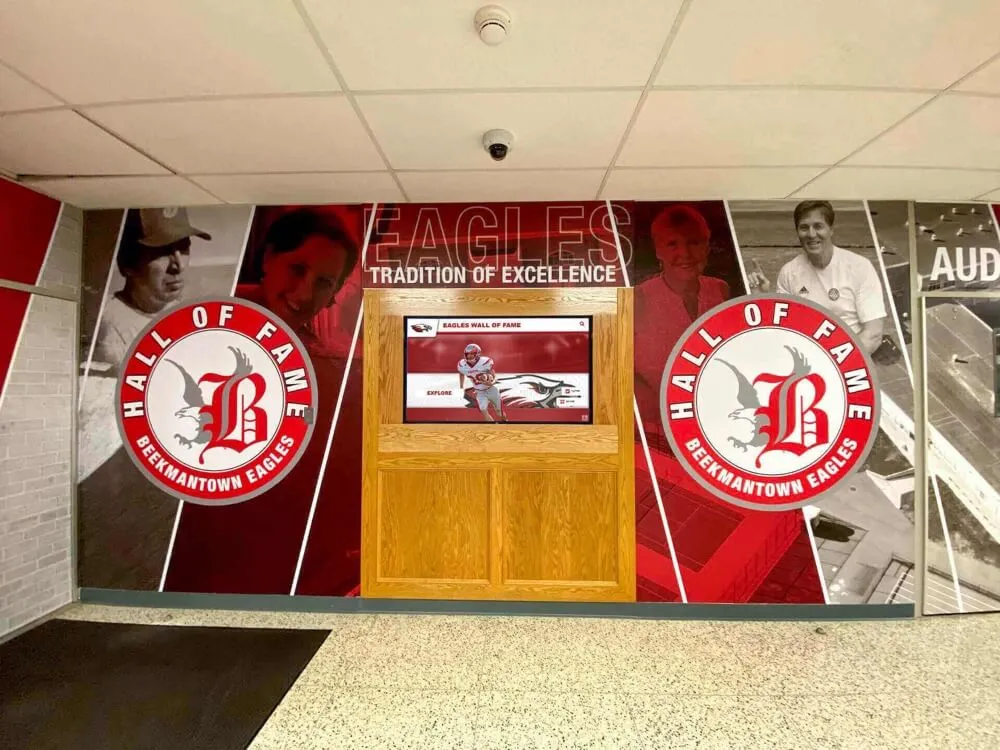
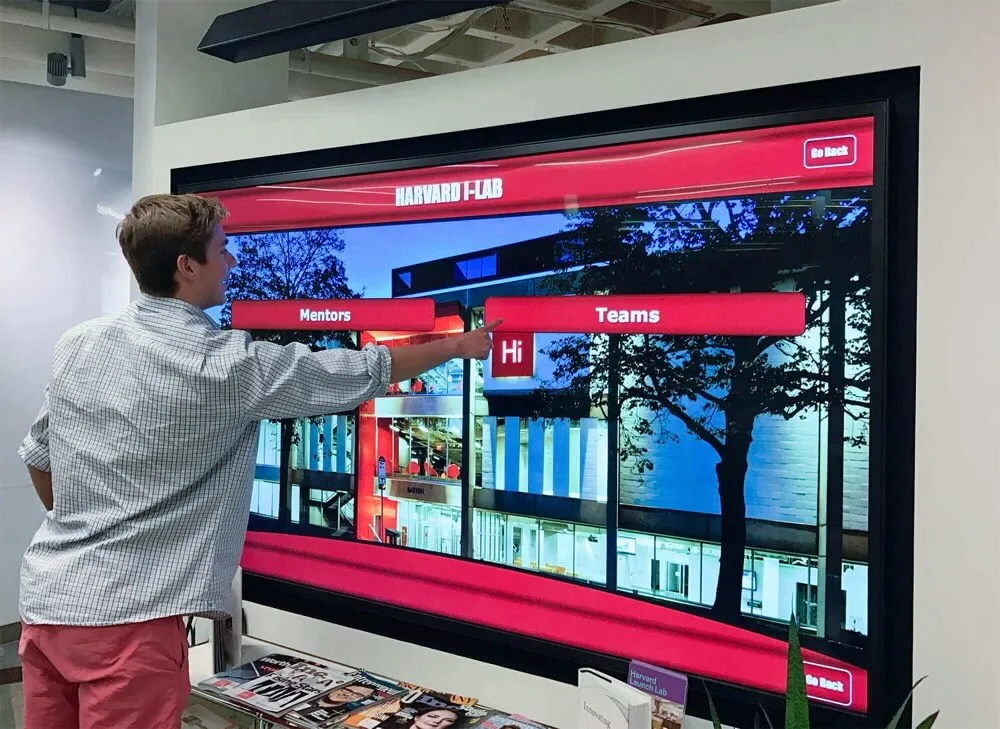
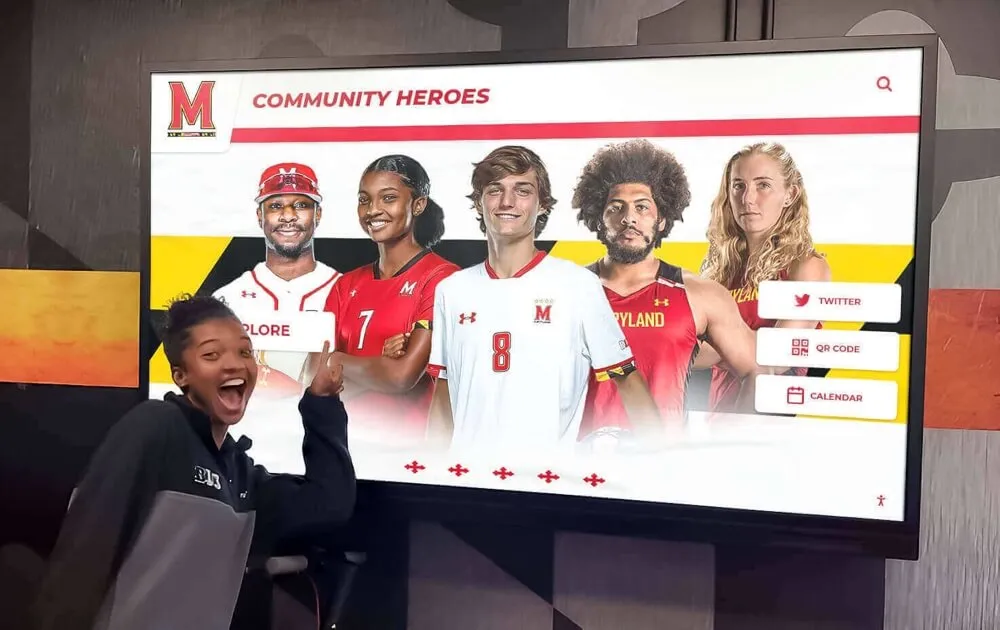
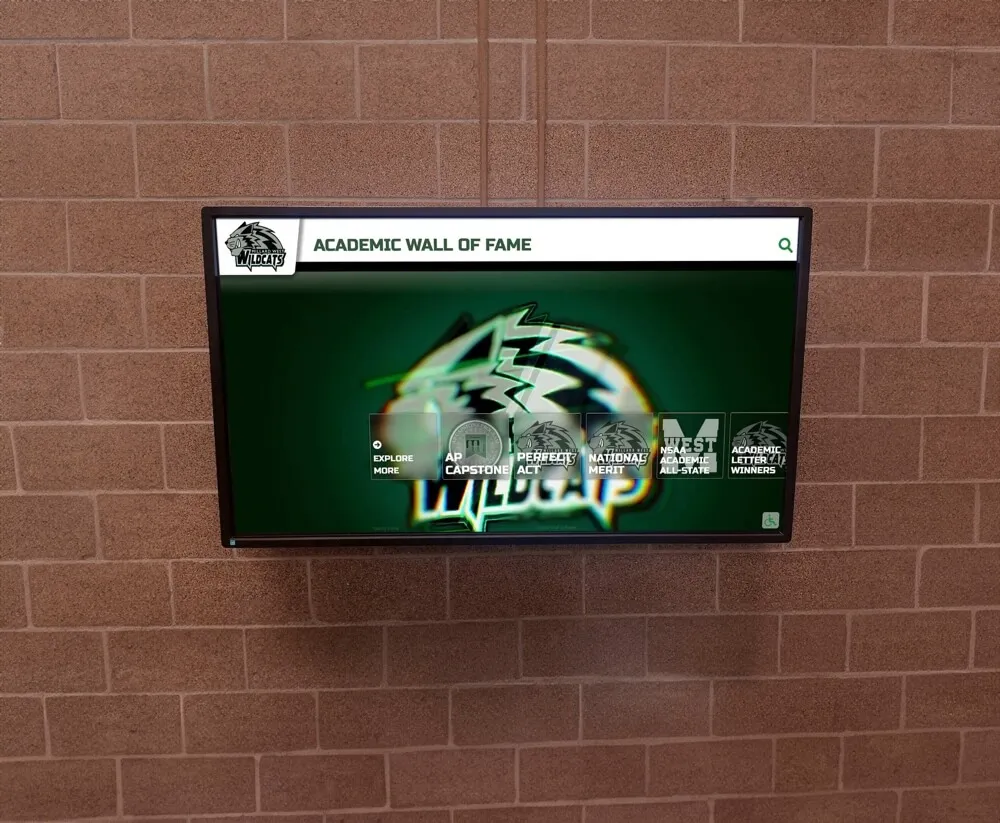
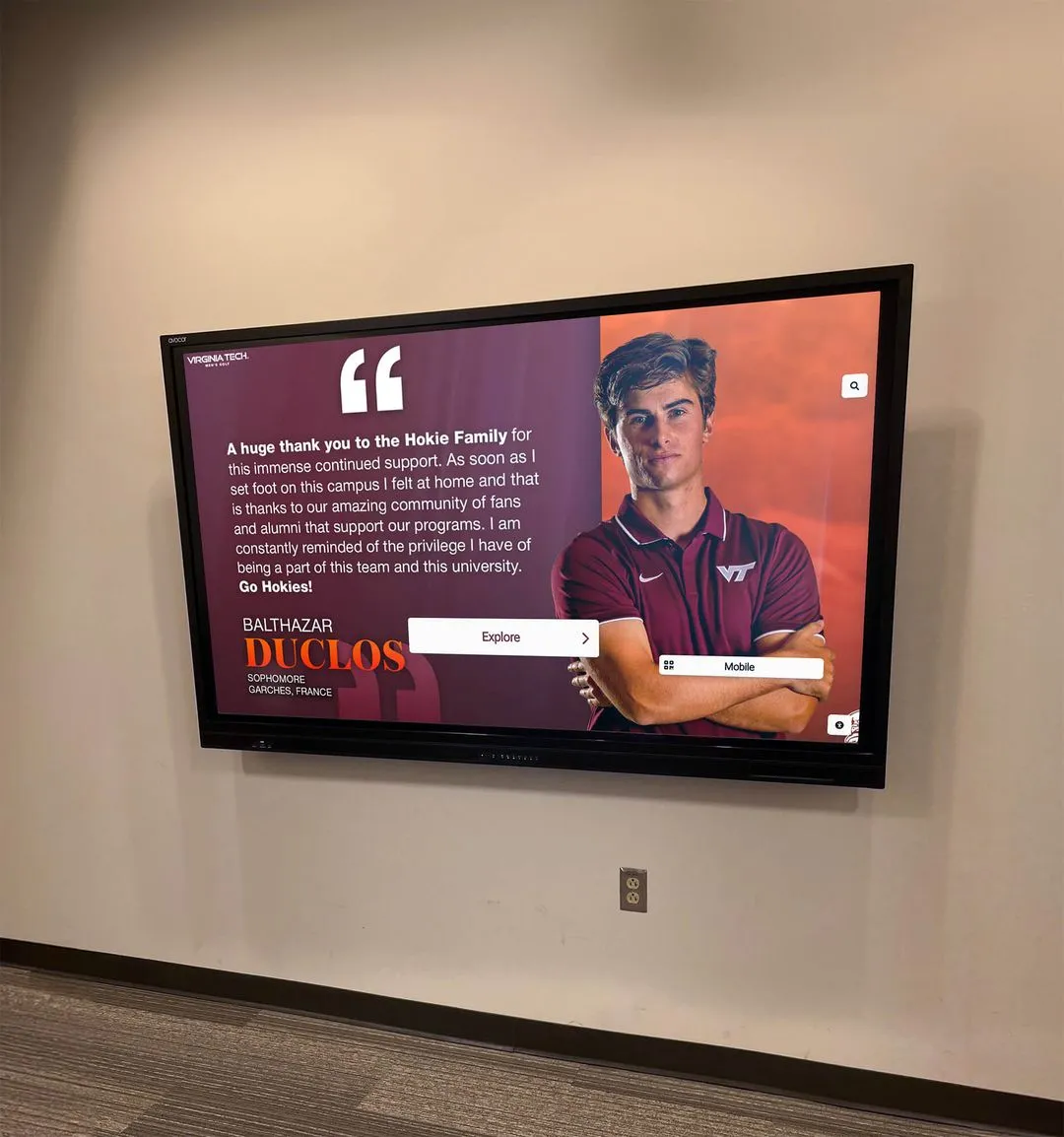
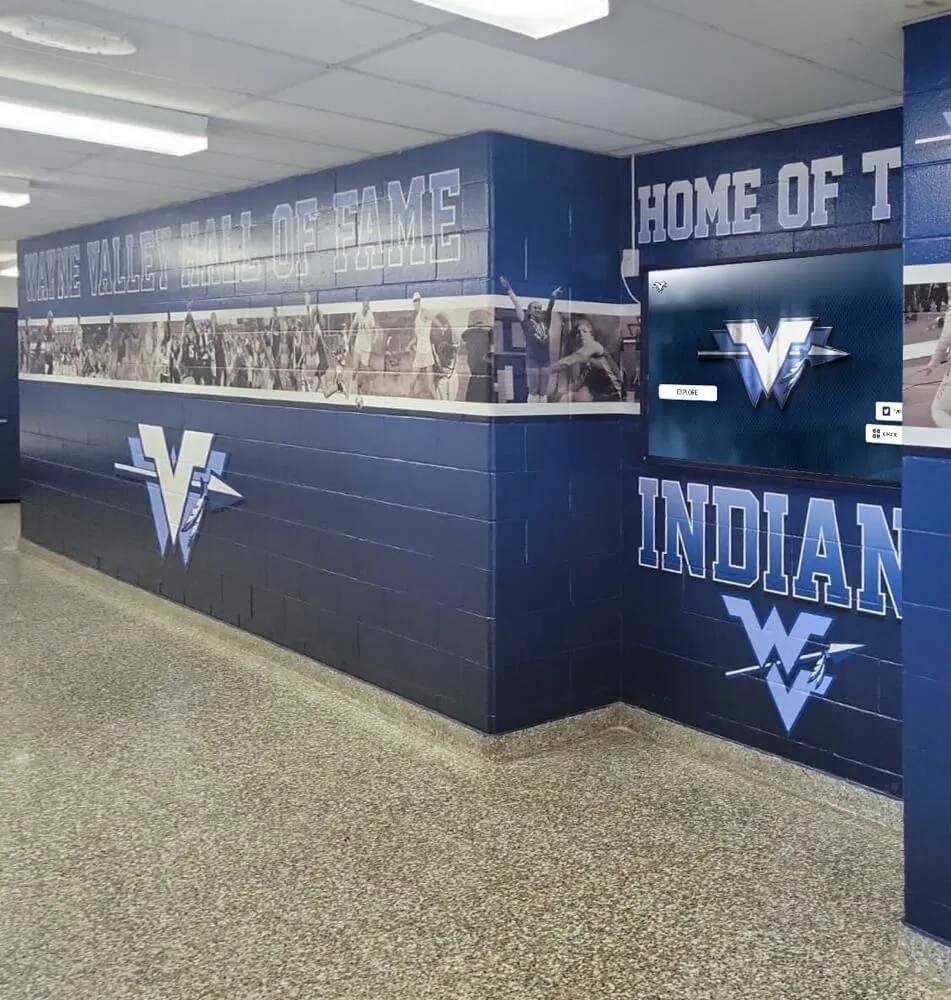
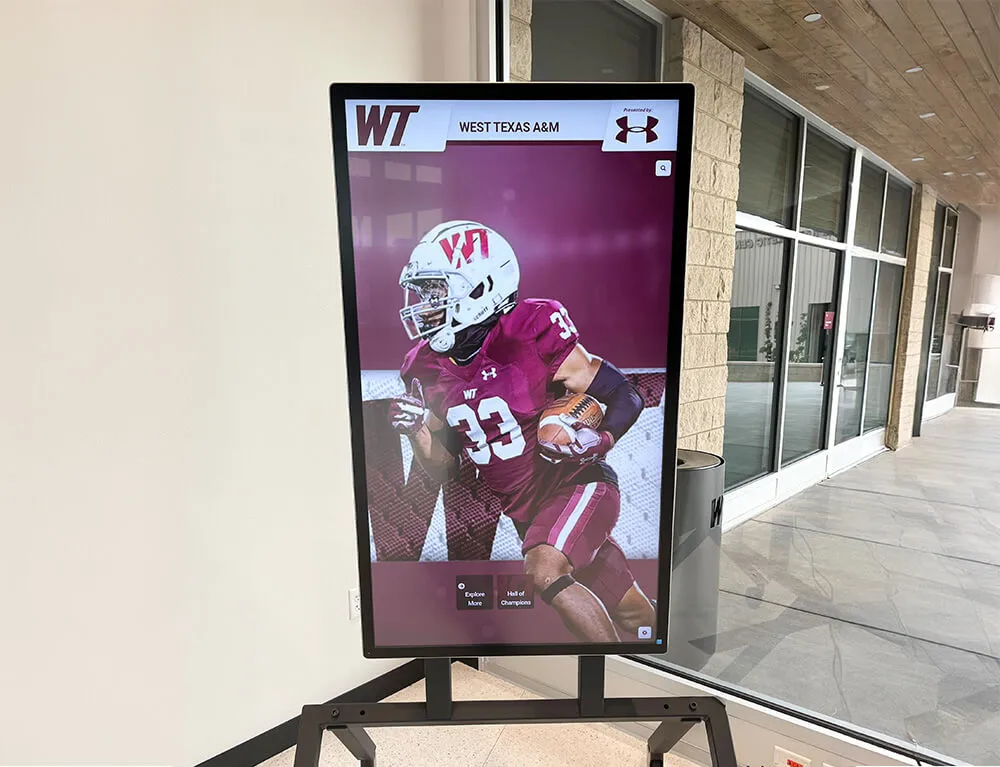
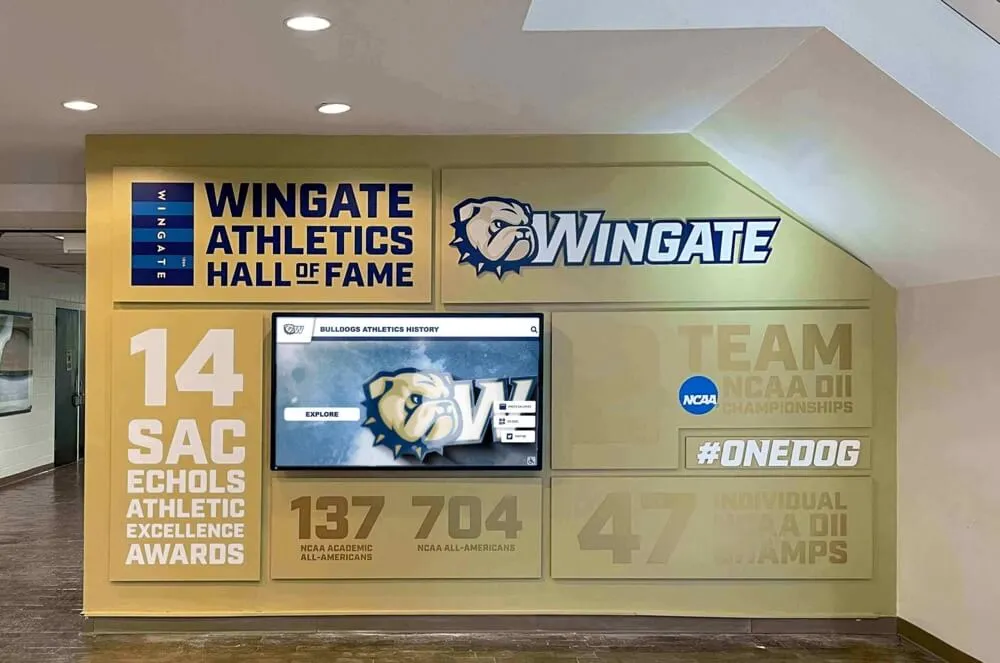
Physical plaques and banners can only scale so far before wall space runs out and maintenance costs compound. Touchscreen recognition platforms from Rocket Alumni Solutions handle unlimited championship entries from every school in a district, push updates across all campus displays simultaneously from a single admin dashboard, and deliver ADA-compliant interactive experiences that physical walls cannot match — without a facilities crew every time a new champion joins the record.
Idea 1: The Unified Banner Hall at the District Athletic Complex
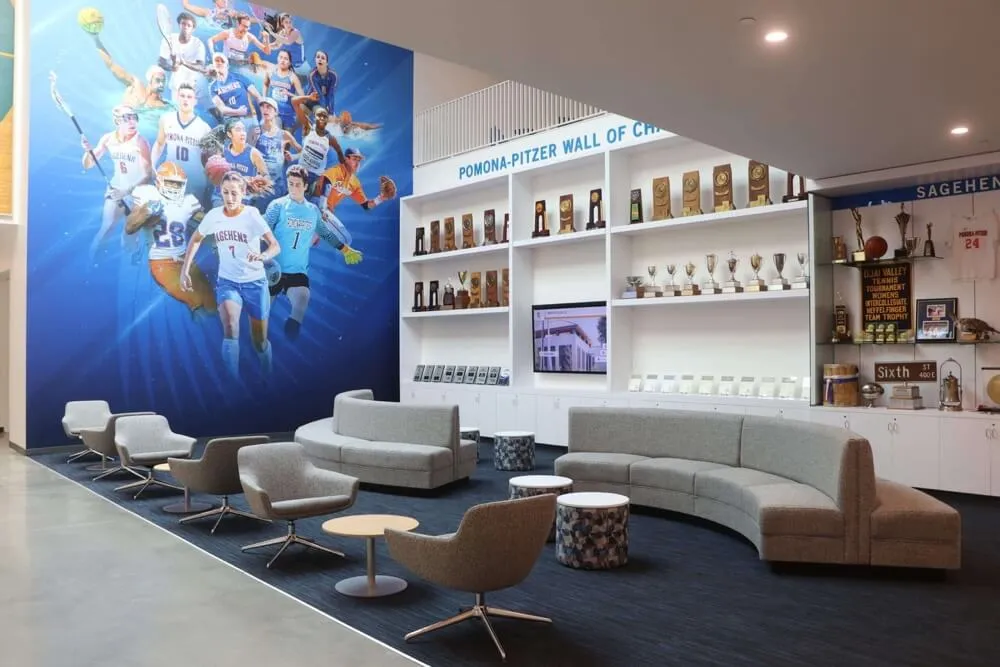
The most straightforward physical configuration centralizes all championship banners in one high-traffic space — typically the district’s flagship gymnasium or stadium corridor. Every school contributes banners to a single shared hall rather than hoarding them on individual campuses.
Making Multi-School Banners Visually Cohesive
The design challenge is honoring each school’s identity without letting one campus visually dominate. A color-border system solves this cleanly: every banner shares an identical silhouette, typography, and layout, but the border color maps to the earning school’s official palette. A visitor scanning the wall instantly sees which titles belong to which campus while reading the display as a unified collection.
Standard specifications that work across districts:
- Banner dimensions: 24"×72" fabric or 30"×84" vinyl — pick one and enforce it universally across all schools
- Required fields: Sport / School name / Year / Classification / Final record or score
- District logo: Small, neutral-colored mark in a fixed corner position on every banner
- School mascot: Displayed inside each school’s color-bordered section
Providing schools with a pre-approved design template prevents ad hoc banners that break visual cohesion. State championship banner planning guides cover spacing, fabric selection, and hardware considerations worth reviewing before committing to a layout.
Organizing the Banner Wall by Sport
Sport-first organization gives parents and alumni the fastest path to the records they care about. Football wins cluster together, basketball titles run in sequence, swimming championships occupy their own section — and within each sport, schools are arranged alphabetically or geographically rather than by championship count (which would favor dominant programs and create resentment).
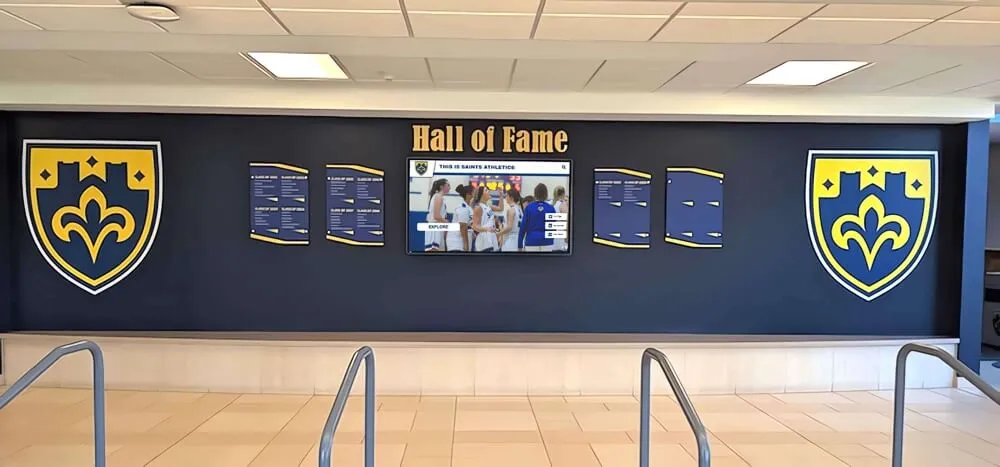
Leave deliberate expansion space. A district with 40 banners today will realistically reach 80 within a decade if athletic programs remain healthy. Plan the grid so adding new banners doesn’t require relocating the entire installation.
Idea 2: The School-Cluster Plaque Wall
Where a banner hall requires a large open wall or ceiling clearance, a plaque-based cluster wall fits into tighter spaces — administrative lobbies, trophy hallways, district offices. Each school receives an equal-sized section of the wall, and championship plaques are mounted within that section in chronological order.
Advantages of the Cluster Layout
Seeing all of School A’s championships in one cluster — and all of School B’s in the cluster directly beside it — makes cross-school comparison immediate. Board members and superintendents who visit the district office can survey decades of athletic achievement at a glance without navigating an entire athletic complex.
Engraved aluminum or UV-printed acrylic plaques both hold up well for 15+ years without fading. Budget roughly $40–$80 per plaque depending on size and material, plus mounting labor. A district adding 10 championships per year should anticipate $400–$800 in annual plaque costs in addition to the initial installation — a manageable recurring expense compared to full banner production and hanging.
The limitation: clusters fill up. Once a particularly successful school’s section reaches capacity, you’re either expanding into another school’s allocated space (politically problematic) or undertaking a full reinstallation. Build 30% more mounting capacity than current championship counts require.
Idea 3: The Rotating Photo Gallery
Championship photographs deliver something plaques and banners cannot — human faces. A well-curated photo gallery showing team portraits, trophy presentations, celebration moments, and action shots creates emotional resonance that draws viewers in and keeps them engaged longer than text-based displays.
Designing the Gallery for Multi-School Coverage
Rotate the featured position quarterly by school. Whichever campus most recently won a championship gets the prominent center display for that quarter; other schools’ photos occupy secondary positions. This prevents any single school from monopolizing the visual hierarchy based on historical dominance.
Frame every photograph with a consistent caption plate identifying:
- School name and mascot
- Sport and championship title
- Year and season record
- Key athletes or coach names where documentation supports it
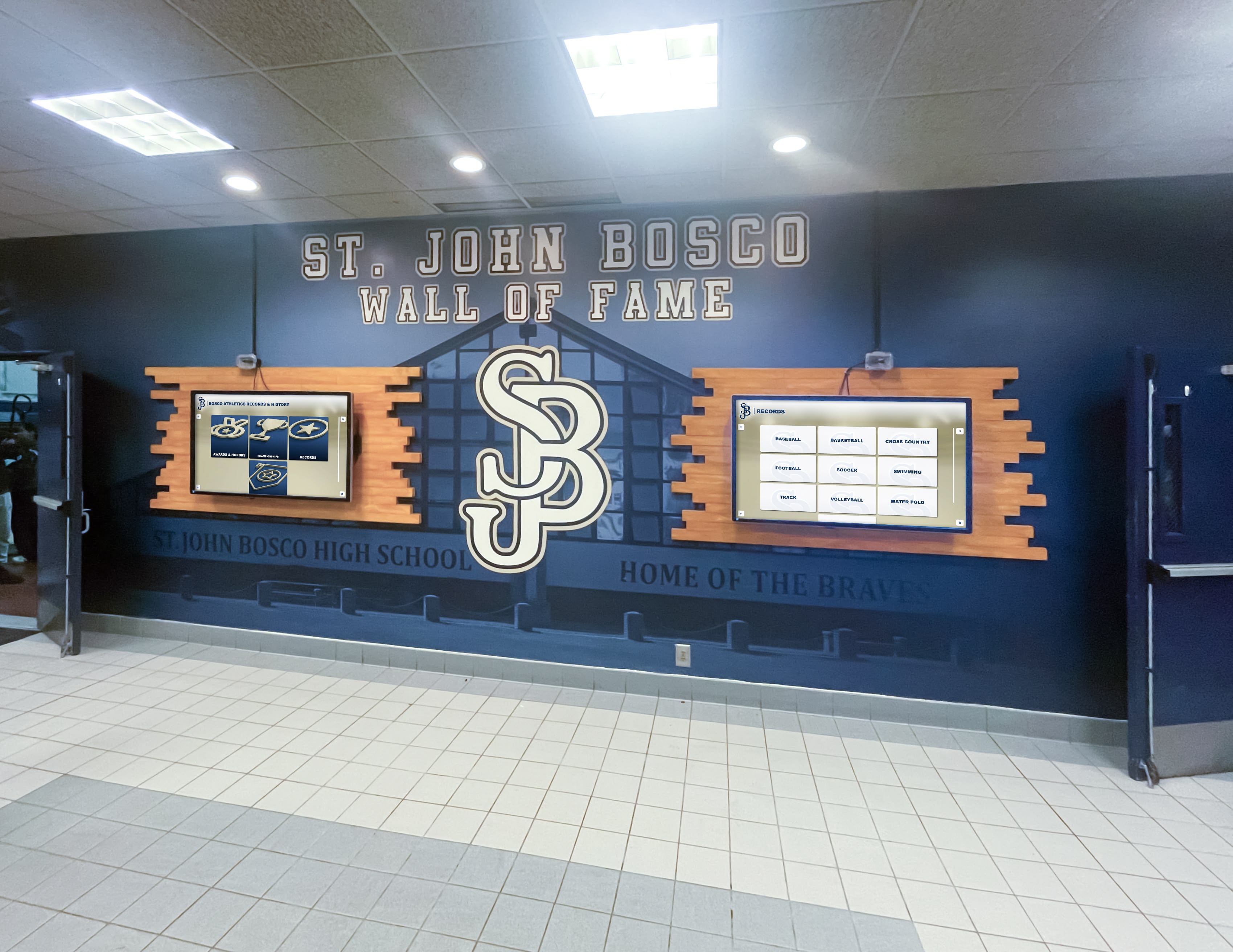
Pair the rotating gallery with a permanent foundation — even a simple bronze plaque listing all district championship titles by year — so the historical record remains visible when photographs rotate off the featured wall.
Idea 4: The Multi-Campus Touchscreen Network
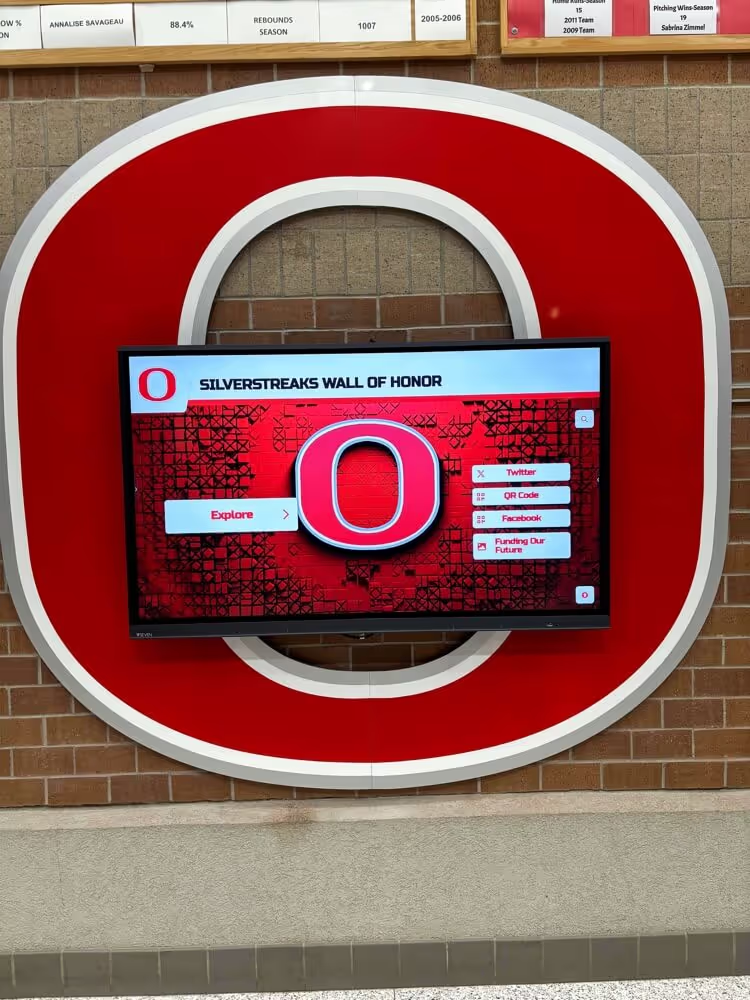
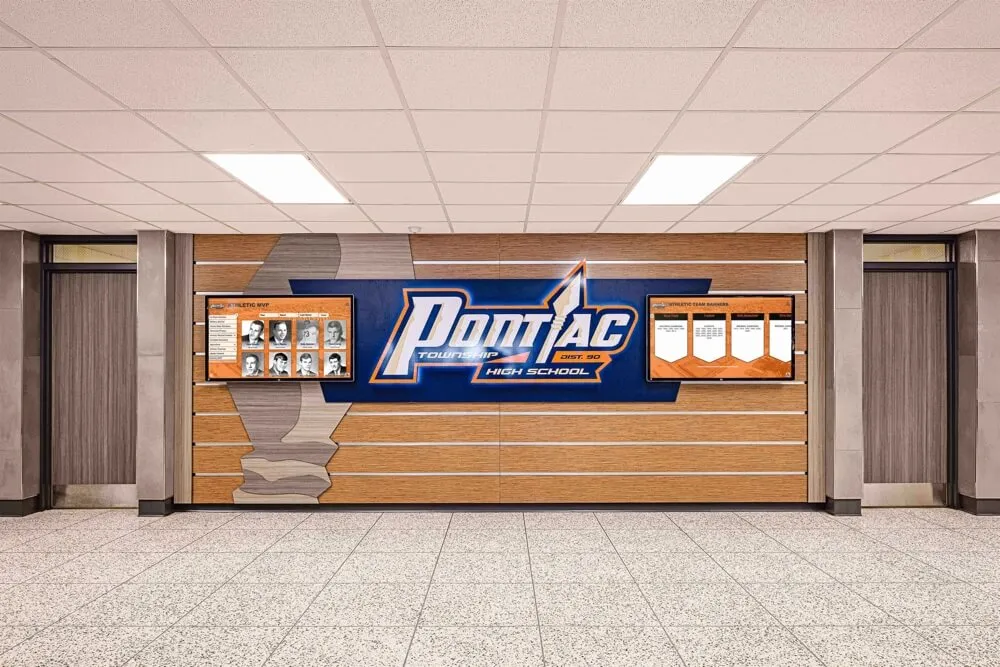
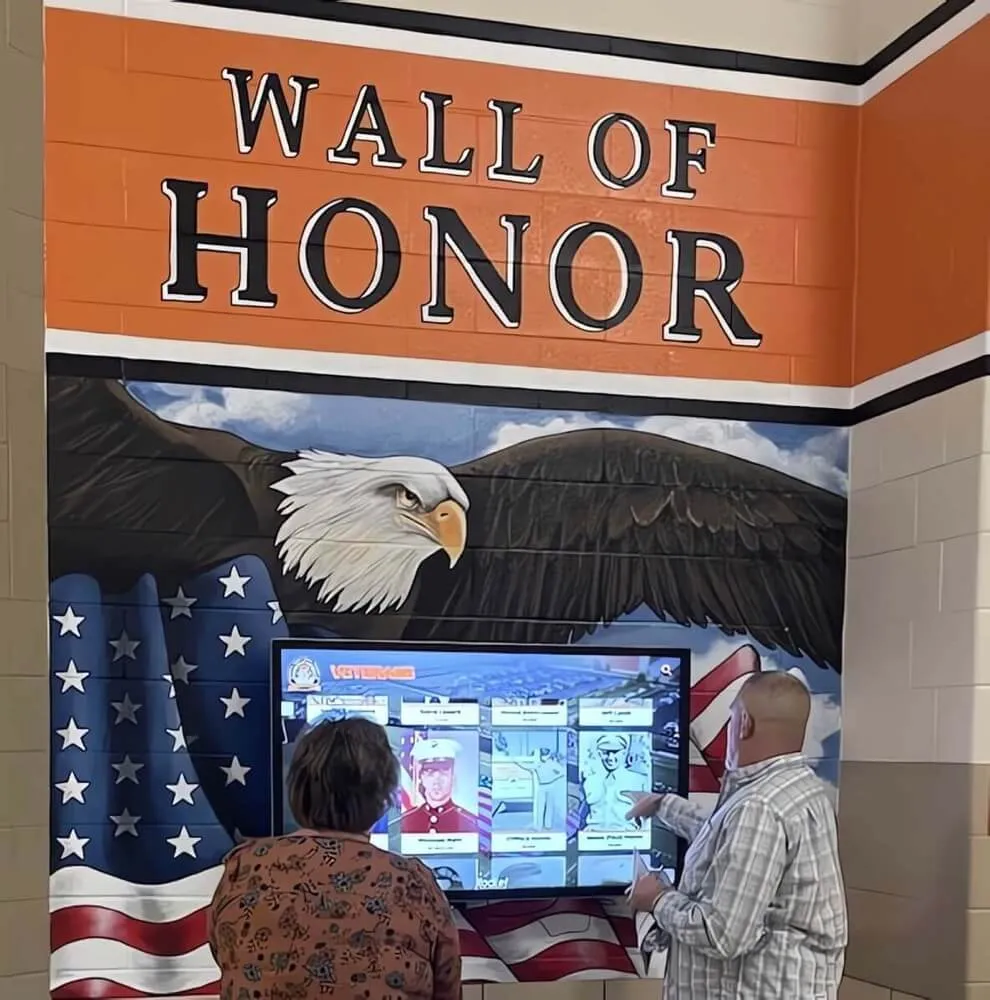
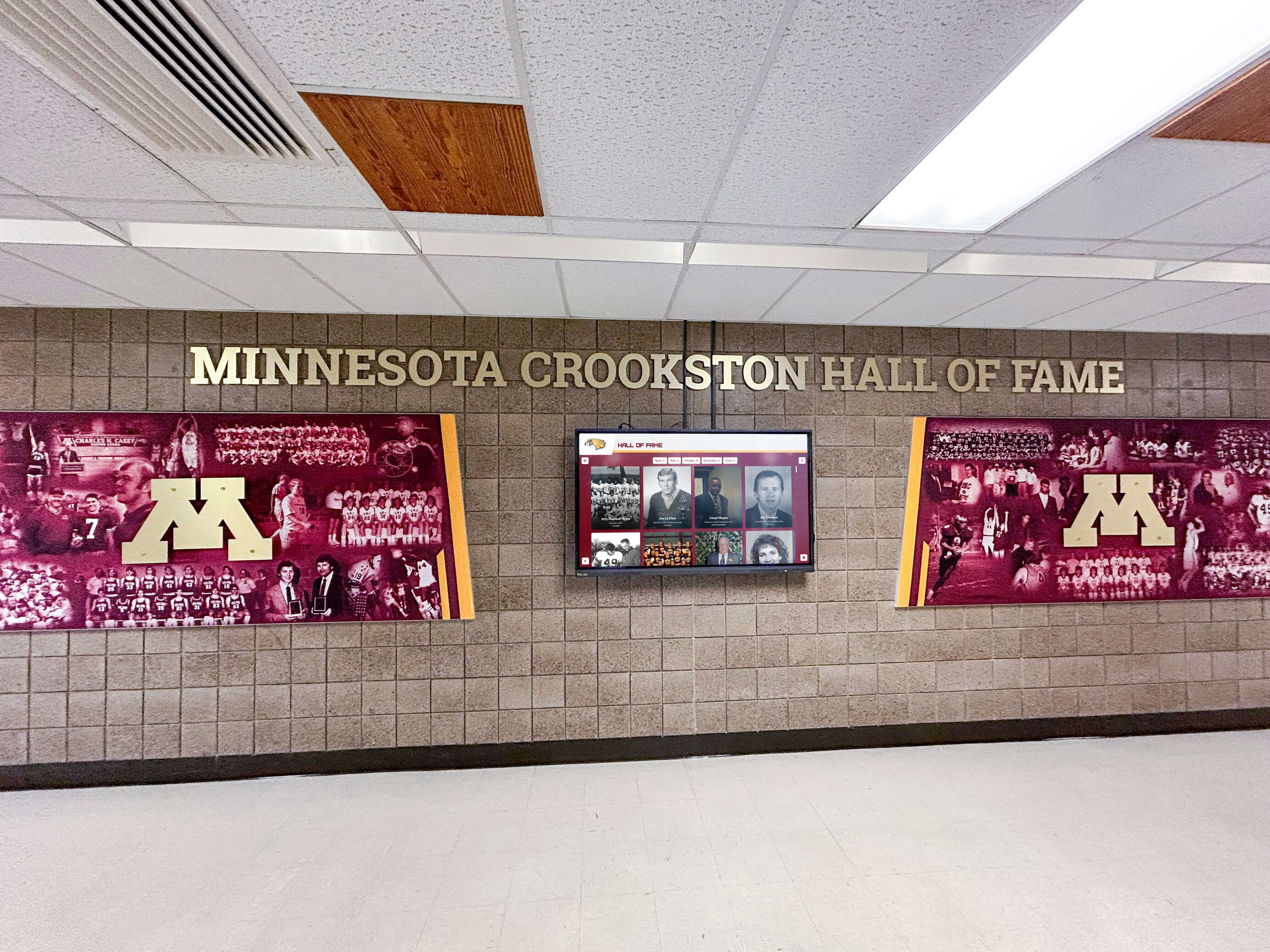
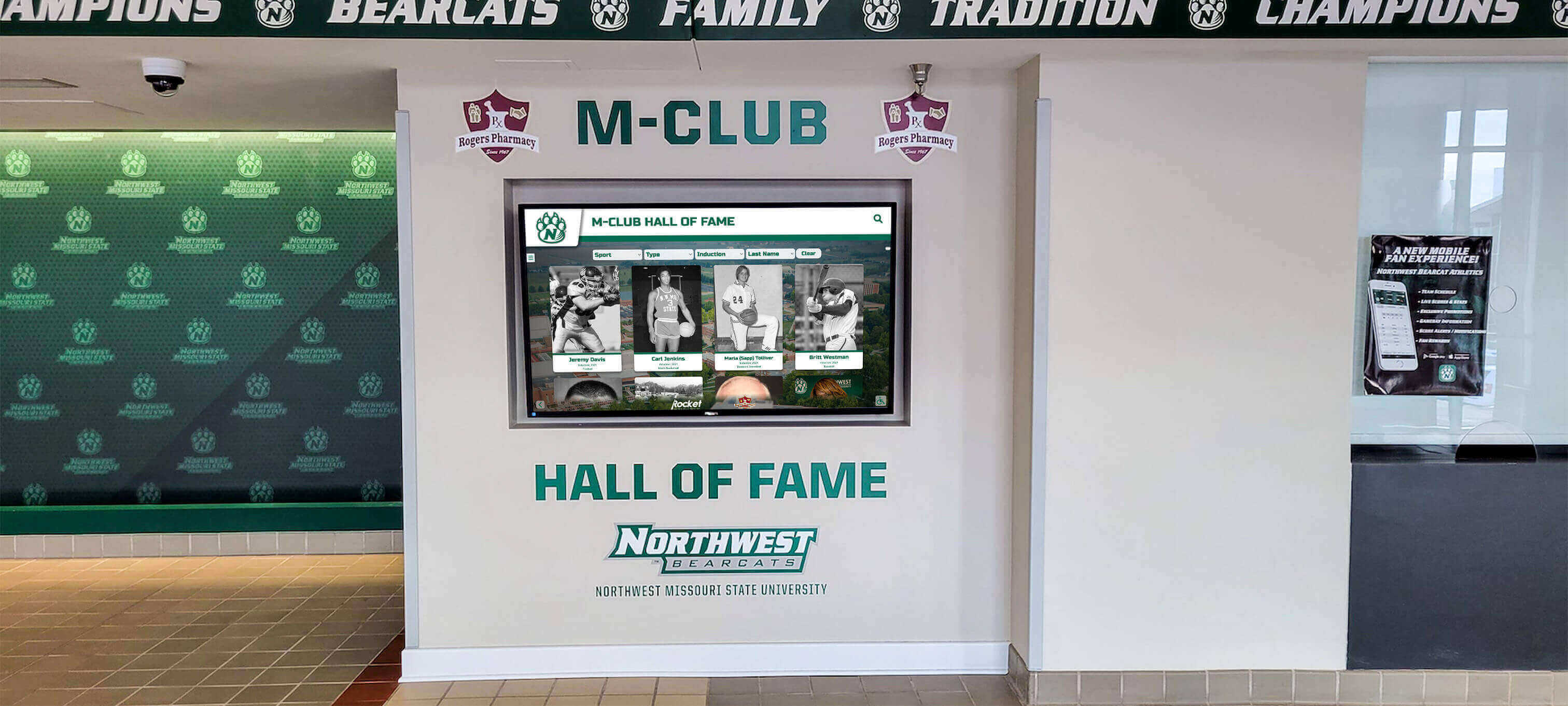
Synchronizing interactive touchscreen displays across all campuses simultaneously solves the visibility problem that physical displays cannot: students at School C can explore the championship history of every other school in the district without leaving their building.
How a Networked Display Works
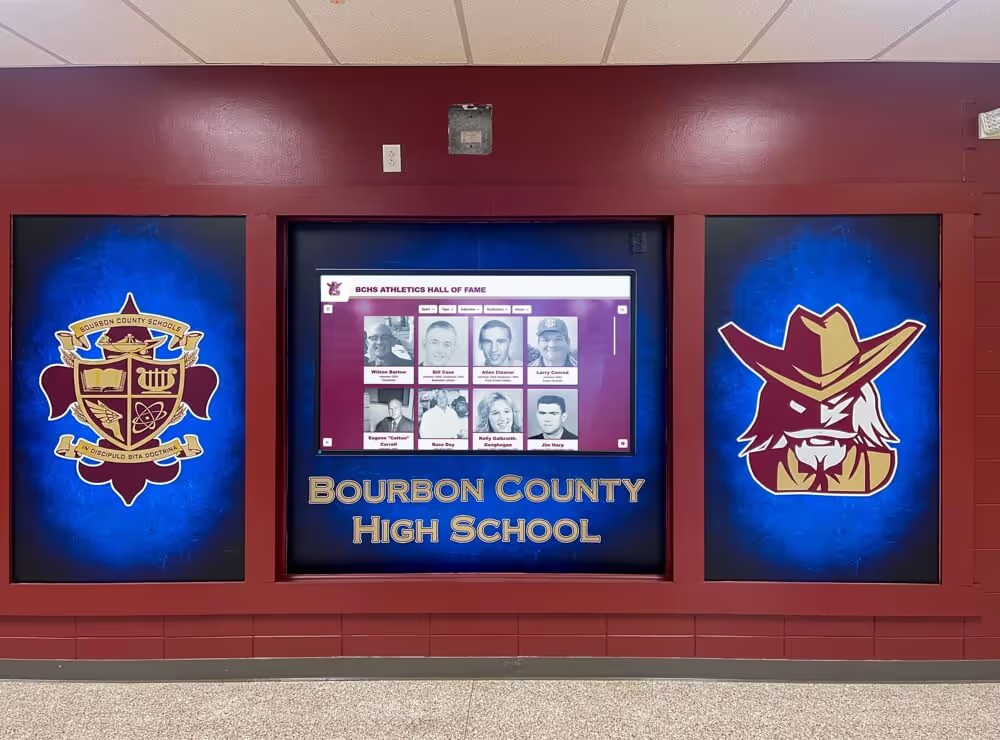
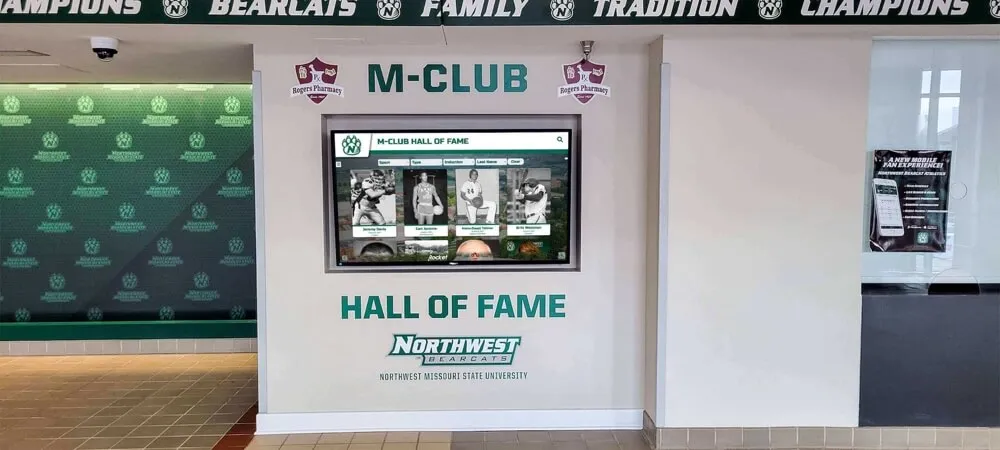
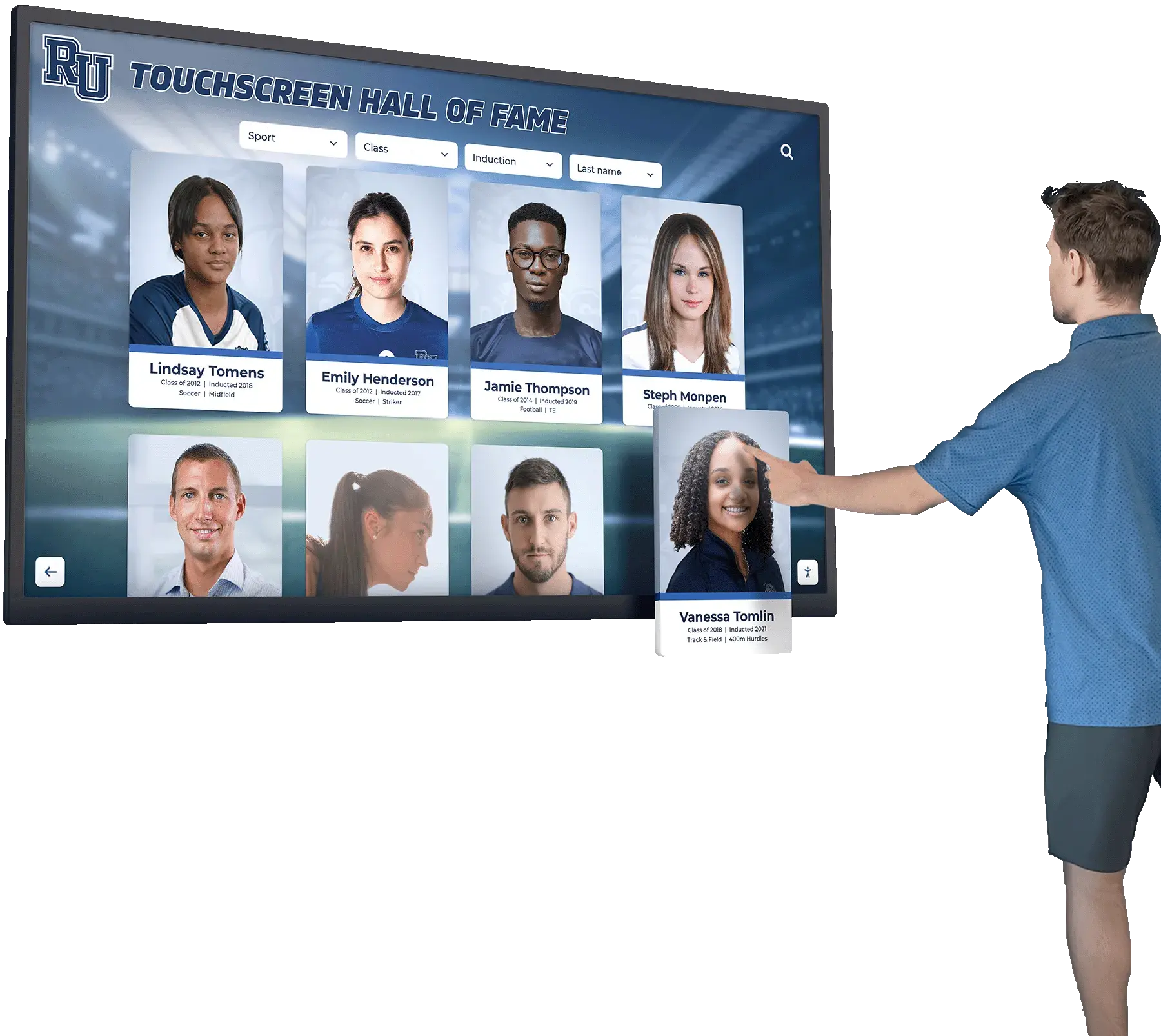
A central championship database stores records from all schools, organized by sport, year, school, and athlete. Each campus touchscreen connects to that database and displays district-wide data with filtering options that let users focus on one school, one sport, or one time period.
Key filtering capabilities that make multi-school displays useful:
- Filter by school name (see only Jefferson High’s championships)
- Filter by sport (see every district swimming title since 1985)
- Filter by decade (explore the 2000s championship era)
- Search by athlete name (find a specific player across multiple sports and years)
This approach is documented in detail in guides to digital recognition systems for multi-school athletic programs — the technical architecture translates directly from college conference settings to K-12 district deployments.
Platform Features to Evaluate
Not every touchscreen platform is built for multi-location district management. Before committing to a vendor, verify:
| Capability | Why It Matters for Districts |
|---|---|
| Multi-location admin dashboard | Push updates to all campuses from one login without visiting each site |
| School-level permissions | Individual school ADs update their own records without accessing other schools’ data |
| Unlimited record capacity | No ceiling on how many championships can be stored as history accumulates |
| ADA-compliant interface | Required for public-facing displays in educational settings |
| Mobile QR access | Alumni and families access the database from their phones off-site |
| Hardware flexibility | Large flagship displays at the district complex, smaller kiosks on campuses |
Learning how to modernize recognition walls provides a practical framework for evaluating when digital platforms outperform physical upgrades at each stage of a district’s recognition infrastructure.
Idea 5: The Hub-and-Spoke Architecture
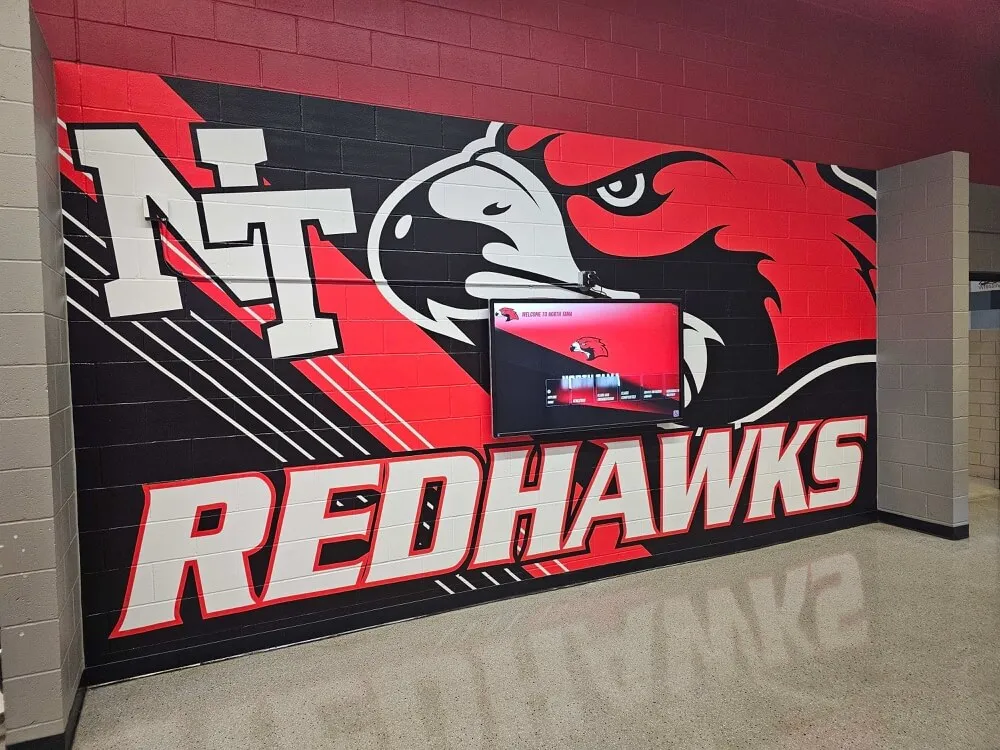
For districts where budget requires prioritization, a hub-and-spoke model concentrates the premium display experience at one central location while extending basic access to individual campuses.
Hub: The Flagship District Display
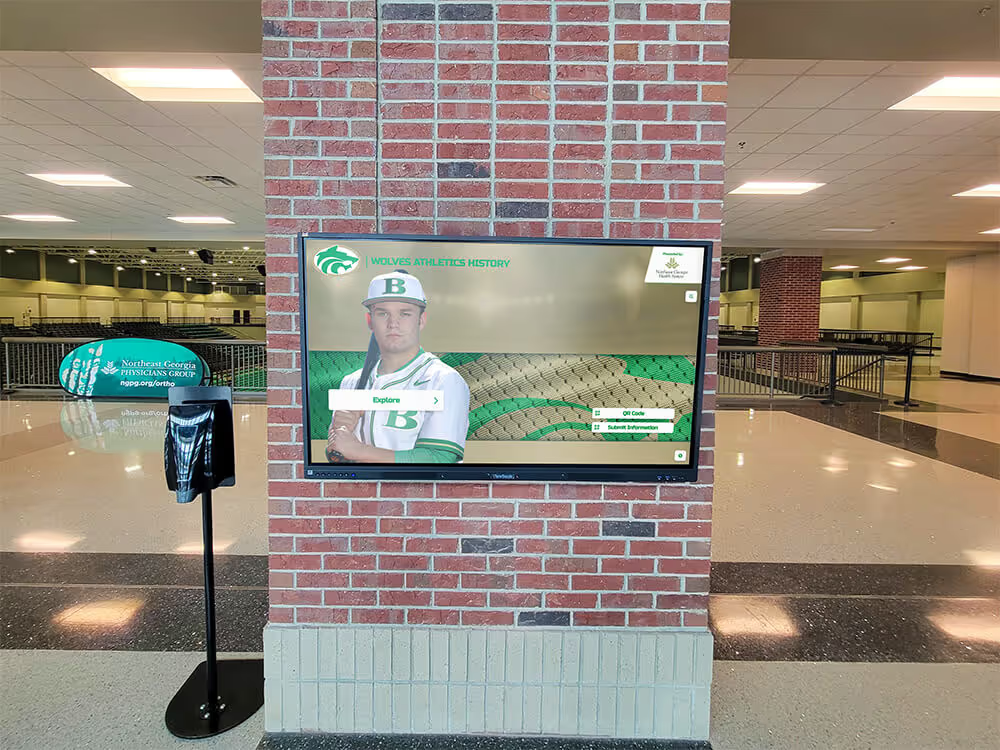
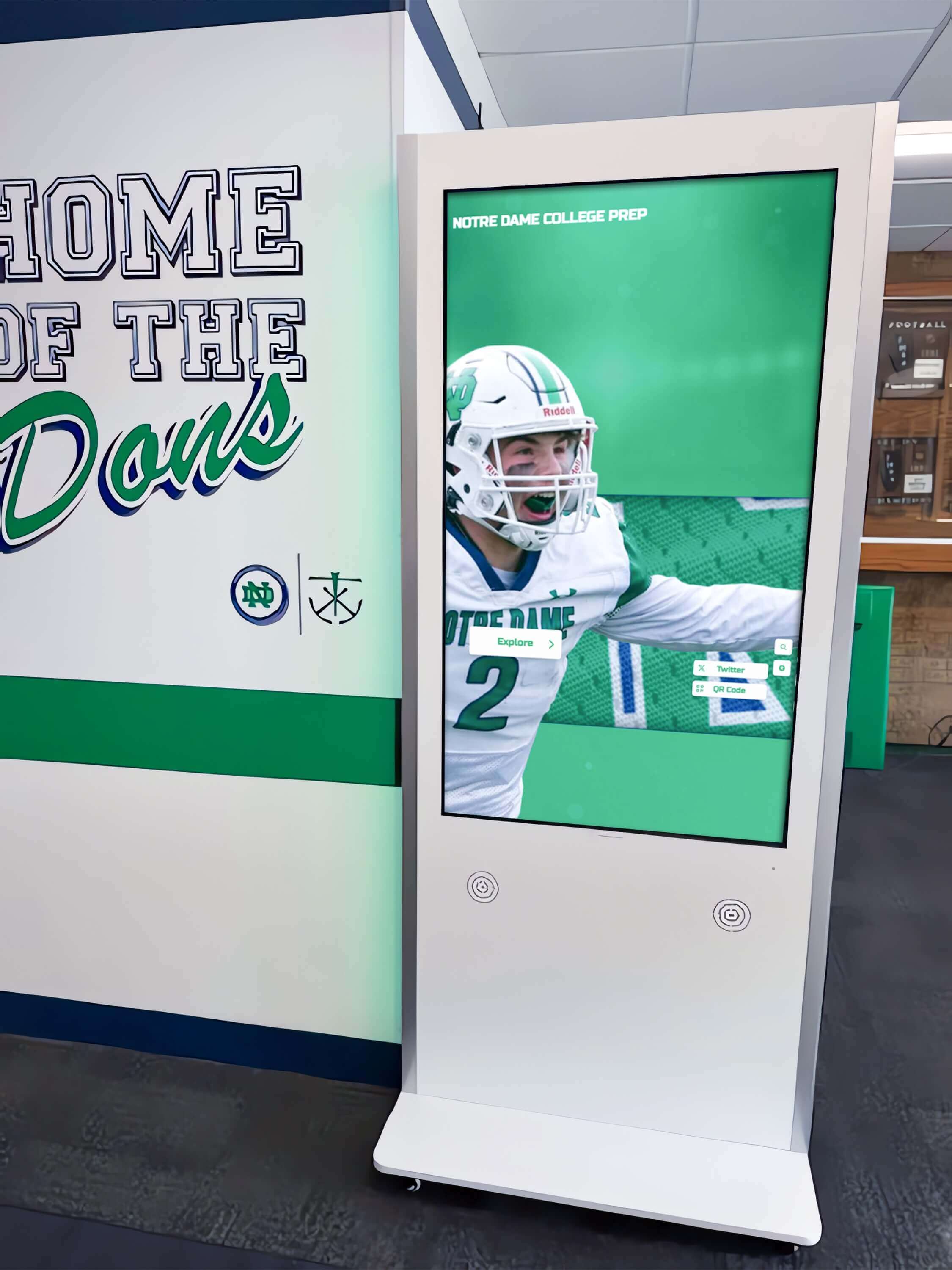
The hub is typically a large-format touchscreen — 55" to 86" diagonal — installed at the district’s primary athletic facility, stadium, or administrative headquarters. This display receives the highest-quality content: championship photographs, video highlights, coach profiles, season statistics, and the full historical record from every school.
The hub gets the highest-traffic placement because district-level events draw cross-campus audiences. A playoff game at the district stadium, a school board meeting at district headquarters, or an all-sports banquet in the district athletic facility exposes the hub display to families from every school simultaneously.
Spokes: Campus Kiosk Displays
Each individual school hosts a smaller touchscreen — typically 32" to 43" — connected to the same database as the hub. These displays present the full district-wide championship record but default to showing that campus’s history prominently, giving local audiences an entry point that feels personally relevant.
Campus kiosks cost less than the flagship hub because they run on smaller hardware and share the database infrastructure already established at the hub. Incremental expansion from hub to spokes is genuinely affordable once the central data layer exists.
Ready to Plan Your District Championship Recognition Wall?
Rocket Alumni Solutions builds touchscreen recognition systems purpose-designed for multi-campus school districts — from flagship hub displays at district athletic complexes to synchronized campus kiosks. Our platform handles unlimited championship records, remote updates, school-level data permissions, and ADA-compliant touchscreen interfaces across every location simultaneously.
Schedule a Demo with Rocket Alumni SolutionsIdea 6: The Cloud Database with QR Entry Points
Districts operating on constrained budgets don’t have to wait for a capital campaign before delivering digital recognition. A cloud-hosted championship database with QR code entry points at each school delivers the core benefit — accessible, searchable records — at a fraction of the cost of touchscreen hardware.
How the QR Model Works
The district athletic director maintains a central championship database — a professionally designed web application or structured platform — and distributes QR codes for each school’s unique view to be posted at campus entry points, gymnasium doors, and athletics hallways. Students, parents, and alumni scan the code with their phones and reach a mobile-optimized display of that school’s championship record within the district’s full history.
This model establishes the data infrastructure that will later power physical touchscreen installations if and when capital funding becomes available. Districts that build their championship database through QR-first deployment spend far less time on retroactive data entry when touchscreens eventually arrive.
Building the Database Before the Display
The data collection phase is invariably the hardest part of any district championship recognition project. Practical collection approaches:
- Designate a data coordinator at each school — ideally the athletic director or a senior coach — responsible for compiling championship records in a standardized spreadsheet format with agreed-upon fields
- Work backward from available digital records, then fill gaps using yearbooks, local newspaper archives, and state athletic association databases
- Contact alumni networks directly for historical gaps — former athletes and coaches often remember championship details accurately when asked
- Acknowledge data gaps transparently — publishing “Championship records verified from 1990 forward” is more credible than a display with suspicious absences
Building a school hall of fame from the ground up covers the full documentation workflow, and the same principles apply when scaling to district-wide data collection across multiple schools.
Designing for Multi-School Equity
The most politically sensitive aspect of a district championship recognition wall isn’t the technology — it’s ensuring that no school appears to receive preferential treatment. Athletic directors who manage this carefully avoid lasting resentment from schools with smaller championship counts.
Visual Parity Principles
Equal allocated space: Give every school the same physical or digital real estate regardless of championship volume. A school with 60 titles doesn’t get a larger section than a school with 12 — both receive the same display footprint, with the higher-volume school’s content organized more densely within its allocation.
Neutral district branding: The overall display visual framework should use district-level branding — district logo, a neutral color palette — as the container, with school-specific colors used only to identify entries within that neutral frame. No school’s colors dominate the overall aesthetic.
Alphabetical or geographic ordering: Organize school sections by name or geographic position rather than by championship count. Placing the most successful program at the center or top of the display implicitly signals dominance.
Consistent entry format: Every championship entry from every school should follow the same visual template. One school’s entries shouldn’t look more prominent than another’s due to formatting differences.
Governance: Who Approves Entries?
Establish a written governance protocol before collecting any data. The protocol should specify:
- Which achievement categories qualify for the district wall (team championships only? Individual championships too? Coaching milestones?)
- Who can nominate entries (school ADs, coaches, alumni?)
- Who approves entries (district AD alone? A committee including one representative per school?)
- What documentation is required for an entry to be approved
- What the update timeline is (entries added within 30 days of championship, 60 days, or at a fixed annual update?)
Governance clarity prevents disputes later. Schools that disagree with entry decisions need an established protocol to point to, not an ad hoc ruling from the district AD.
Connecting the Recognition Wall to Athletic Culture
A championship wall delivers maximum impact when it’s integrated into regular athletic events rather than installed and ignored.
Annual Induction Ceremonies
Schedule a district championship induction event tied to an existing high-profile calendar anchor — the all-sports banquet, the opening night of the district’s biggest rivalry game, or a dedicated recognition night at the district athletic complex. Newly inducted championships receive formal acknowledgment with coaches and athletes invited to participate.
Induction ceremonies reinforce the message that district championships occupy a different tier from individual school recognition. The public acknowledgment across school boundaries — watched by families from every campus simultaneously — elevates the recognition’s perceived value.
Engaging Alumni Through Championship History
A searchable championship display serves alumni differently from current students. Former athletes want validation that their achievements are remembered; a display that surfaces their specific records immediately when they search their name creates a powerful emotional connection.
Thoughtful alumni welcome area design makes championship recognition central to how returning alumni experience their school or district — a design priority that pays dividends when alumni engagement translates to mentorship participation or giving.
Districts that use championship recognition effectively in college recruitment digital recognition programs find that prospective student-athletes respond strongly to visible evidence of program championship history — making the recognition wall a legitimate recruiting asset, not just a ceremonial display.
Motivating Current Athletes
Current athletes who walk past a district championship wall every school day absorb its message differently from occasional visitors. For a sophomore who sees a championship banner from a player who graduated five years ago, the wall makes the possibility tangible — not just inspirational rhetoric, but documented proof that someone who stood in this same hallway achieved exactly that.
Gymnasium wall design that integrates championship recognition into athletic spaces where current athletes train creates consistent daily exposure to the program’s championship legacy — a motivational environment that digital signage and vinyl murals both contribute to effectively.
Funding a District Championship Recognition Wall
Budget is the most common barrier to moving from concept to installation. Most successful district recognition projects draw from multiple funding streams rather than a single capital allocation.
District capital improvement budget: The largest single source for major installations. Strongest case when the recognition wall is proposed as part of a broader athletic facility renovation or district-wide infrastructure upgrade.
Athletic department operating budget: Funds ongoing maintenance — new plaques, banner replacement, software subscription costs — more sustainably than one-time capital spending.
Booster club contributions: Booster organizations from individual schools can collectively contribute to a district-level display that benefits all programs. Booster fundraising strategies that frame contributions as supporting a shared community asset — rather than a single school — tend to generate broader participation.
Naming rights and sponsorships: Local businesses or alumni donors can fund named sections or provide naming rights for the overall display in exchange for permanent recognition. A “Smith Family District Championship Hall” funded by a district alumnus benefits from clear naming rights guidelines established before solicitation begins.
Phased implementation: Rather than requesting full funding upfront, propose Phase 1 (central database + flagship display) with Phase 2 (campus kiosks) funded in subsequent budget cycles once Phase 1 demonstrates community impact.
The connection between recognizing past champions and funding future programs is well-documented in development contexts — alumni who feel their achievements are genuinely honored by their institutions are more likely to give back. A district championship recognition wall isn’t just recognition infrastructure; it’s long-term alumni engagement infrastructure.
Physical vs. Digital: The Cost Realities at District Scale
Every physical display format carries a maintenance cost that compounds over time. Comparing digital wall of fame systems to traditional physical displays at a district’s scale reveals the crossover point where digital becomes more economical than physical.
For a district adding 15 championship records per year across eight schools:
| Item | Physical Display (Annual) | Digital System (Annual) |
|---|---|---|
| New plaque or banner production | $600–$1,200 | $0 |
| Installation labor | $400–$800 | $0 |
| Capacity expansion | Every 5–7 years, $3,000–$10,000 | Never — unlimited records |
| Cross-campus access | None | All campuses, simultaneous |
| Alumni off-site access | None | QR/mobile access included |
| Software/subscription | $0 | Platform subscription varies |
Over a 10-year period, most districts with active championship programs find physical maintenance costs exceed the cost of a digital platform — while the digital system provides substantially superior capabilities throughout the entire period.
Frequently Asked Questions
What’s the most important first step when planning a district championship recognition wall? Data collection. Before committing to any display format, establish how many championship records exist across all your schools and across what sports and time periods. That number determines whether a physical wall has enough capacity and whether digital infrastructure makes more financial sense than expanding physical displays indefinitely.
How do you prevent one school from visually dominating a multi-school recognition wall? Use equal allocated display space per school regardless of championship volume, organize schools alphabetically rather than by achievement count, and apply consistent visual templates that format every school’s entries identically. Neutral district-level branding — not any single school’s colors — should frame the overall display.
Can a district championship recognition wall include individual records, not just team championships? Yes, and individual records often generate the strongest personal connections for alumni and families. District-level all-time records by individual sport event — fastest 100-meter dash across all district schools, highest single-season scoring average in basketball — create compelling competitive context. Track individual records separately from team championships to prevent visual confusion.
What does a district-wide touchscreen recognition system cost? Initial costs vary significantly based on the number of campus locations, display sizes, and content complexity. Most districts evaluate platforms against their 5-year total cost of ownership — including physical display maintenance costs that would otherwise continue — rather than upfront hardware price alone. Scheduling a platform demo with specific district parameters produces more useful cost information than general estimates.
How do you handle championship records that predate available documentation? Publish what can be independently verified and acknowledge the gap explicitly — for example, “Records from 1970 to 1984 are incomplete due to limited archived documentation.” This is more credible than either omitting early history entirely or publishing unverified figures. Use the display launch as an opportunity to crowdsource historical corrections from alumni who attended during those periods.
See What's Possible for Your District's Championship Recognition
Rocket Alumni Solutions has built touchscreen recognition systems for school districts ranging from small rural systems to large multi-campus urban districts. Our platforms handle multi-location management, unlimited championship records, school-level administrative permissions, and ADA-compliant touchscreen access — deployed at your flagship athletic facility and synchronized across every campus simultaneously.
Schedule a Demo with Rocket Alumni Solutions