



When an athletic director inherits a record board, they almost always find marks that cannot be fully verified — a handwritten entry from 1978, a clipping from a local newspaper with no officials’ stamp, a tradition that “so-and-so ran a 4:32 mile” but no meet results to confirm it. The instinct is to remove anything that can’t be proven. That instinct costs programs their history. Athletic record uncertainty notation guidelines offer a better approach: keep the legacy record visible, but label it honestly so every viewer knows exactly what level of evidence stands behind the mark.

What These Guidelines Cover
Intent: demonstrate
These guidelines apply to any school or program managing an all-time record database that includes entries from before current documentation standards were in place. The notation system below establishes six symbols, defines how to assign them at entry time, and explains how to display them on both physical boards and digital record board platforms.
Uncertainty notation is not a disclaimer that undermines a record’s credibility. It is a transparency signal that increases trust: a community that sees honest labeling on legacy entries is far more likely to trust the verified entries alongside them. Programs that display athletic history across interactive hall of fame systems and digital recognition walls face this challenge directly — the display is public, but the evidence behind older entries is often incomplete. A notation system closes that gap without erasing history.
Step 1: Define When Uncertainty Notation Applies
Not every record needs a notation symbol. Applying symbols indiscriminately creates visual noise and trains viewers to ignore them. The notation system applies in three specific situations:
Legacy entries. Any record that was entered before the program’s current source citation standards were adopted. The cutoff date is usually the year the athletic department began requiring submission forms with official documentation.
Transferred records. Records migrated from a previous system — physical index cards, a coach’s spreadsheet, a retired athletic director’s filing cabinet — where the original source documentation was not transferred alongside the mark.
Contested or reconstructed entries. Records where the program has found conflicting claims (two alumni both report holding a record), where the mark was estimated from a narrative source rather than a measurement, or where a condition difference (non-standard timing, shortened course, adjusted weight class) separates the claim from a directly comparable mark.
Records submitted after adoption of current citation standards, with Tier 1 or confirmed Tier 2 source documentation on file, carry no uncertainty notation. They stand as posted.

Step 2: Establish Your Notation Key
A notation system only functions if the key is stable and public. Define your symbols before applying them to any entries. The following six-symbol key covers the range of uncertainty conditions most school athletic programs encounter.
| Symbol | Name | Meaning | Display Example |
|---|---|---|---|
| (V) | Verified | Primary source documentation on file | 4:28.3 (V) |
| (S) | Corroborated | Two or more secondary sources agree on the mark | 4:28 (S) |
| (~) | Estimated | Evidence corroborates a range; exact mark is uncertain | ~4:28 |
| (ca.) | Circa | Year of performance is approximate | 1979 (ca.) |
| (*) | Condition note | Mark adjusted for timing method, course, or weight class | 4:28.3 (*) |
| (P) | Pending | Record claim submitted; verification in progress | 4:28.3 (P) |
Notes on each symbol:
(V) Verified is optional if your program chooses to treat unmarked entries as verified by default. Some programs prefer explicit (V) notation on all entries to make the verification status unambiguous — particularly when a digital display shows historical and current records side by side.
(S) Corroborated applies when Tier 1 primary evidence is absent but at least two independent Tier 2 sources confirm the same mark: a newspaper report and a yearbook entry, a scorebook and a team photograph showing the score. The sources must be independent — two clippings from the same newspaper edition count as one source.
(~) Estimated applies when a source describes a performance without giving a precise mark. A newspaper account that reads “the mile run in roughly four and a half minutes” supports an estimated entry of ~4:30 with that clipping as the citation. The tilde precedes the number, not the symbol in parentheses, so viewers immediately see that the number itself is approximate.
(ca.) Circa is borrowed from historical scholarship and applies to the year column, not the performance mark. Use it when multiple sources suggest a performance happened in a two-to-three-year window but cannot confirm the specific year. Entry reads: “4:28 (S) — 1977 (ca.)”
(∗) Condition note applies when a mark was set under conditions that differ from current standards and a conversion or adjustment was applied: hand timing converted to FAT equivalent, a swim meet held in a 25-yard pool with conversion to 25-meter standards, or a weight room mark from a testing protocol that has since changed. Document the conversion method in the citation record even if it does not appear on the display.
(P) Pending is a temporary notation for claims currently moving through verification. A pending entry is visible on the display but cannot be treated as official. Set a maximum pendency window — 30 days is standard — after which the notation either converts to a permanent symbol or the entry is removed.
Step 3: Assign Notation at Entry Time
Uncertainty notation is assigned during the submission and review process, not after the fact. Assigning it retroactively across a large legacy database is possible but slower. Building the assignment into the submission workflow prevents gaps from accumulating.
The decision tree for notation assignment follows directly from source tier classification:
| Evidence on File | Notation Assigned |
|---|---|
| Tier 1 primary documentation (official meet results, certified timing) | No notation, or (V) if program uses explicit verification labels |
| Two or more independent Tier 2 sources (newspaper + yearbook, scorebook + video) | (S) |
| One Tier 2 source only | (S) with single-source flag in citation record; consider (∗) if condition adjustments were needed |
| Estimated mark from narrative description | (~) preceding the mark |
| Approximate year only | (ca.) in year column |
| Claim submitted, verification in progress | (P) |
| No documentation; oral attestation only | Do not publish; flag for further research |
The final row reflects an important boundary: uncertainty notation is not a mechanism for publishing unverifiable claims. A mark with no documentation at all — even with a credible witness — does not qualify for the display under this system. Notation labels incomplete evidence; it does not replace evidence.
Programs researching how other institutions manage athletic hall of fame documentation standards for historical inductees will find analogous practices in how programs handle pre-digital era inductee career statistics — the same source-tier logic applies.
Step 4: Format Notation Consistently on the Display
A notation system that appears differently from board to board or entry to entry defeats its own purpose. Define a formatting standard before updating any displays.
Physical Record Boards
On a physical vinyl or engraved record board, space is constrained. Use the abbreviated symbol format (one to three characters) immediately after the performance mark, in the same font size as the mark itself. Do not use subscripts or superscripts — they become illegible at normal viewing distance.
Correct: 4:28 (S) — J. Martinez — 1977 (ca.)
Avoid: 4:28² — J. Martinez — 1977
Post a legend card near the display. A 4×6 laminated card mounted at eye level within two feet of the board is sufficient. The legend lists each symbol and its meaning in plain language. Replace the card at the start of each school year.
Digital Record Boards
Digital platforms offer richer notation options without cluttering the display. The most effective approach uses two layers:
Layer 1 — Inline symbol. The notation symbol appears next to the mark in the record table, identical to the physical board format. Viewers see the symbol immediately without any interaction required.
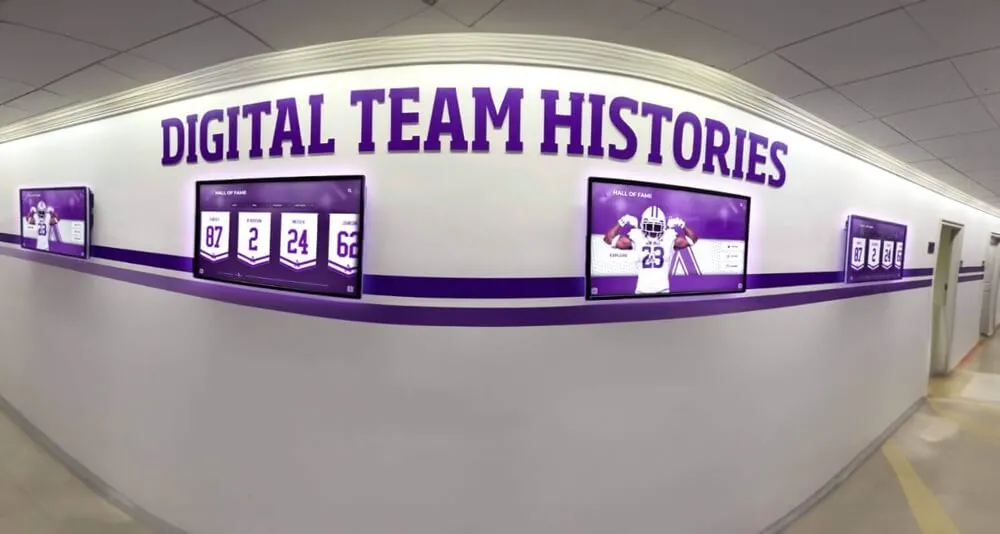
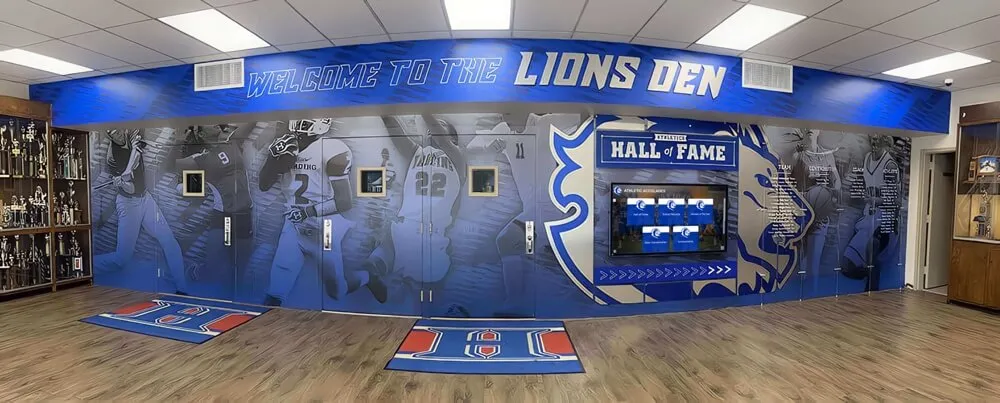
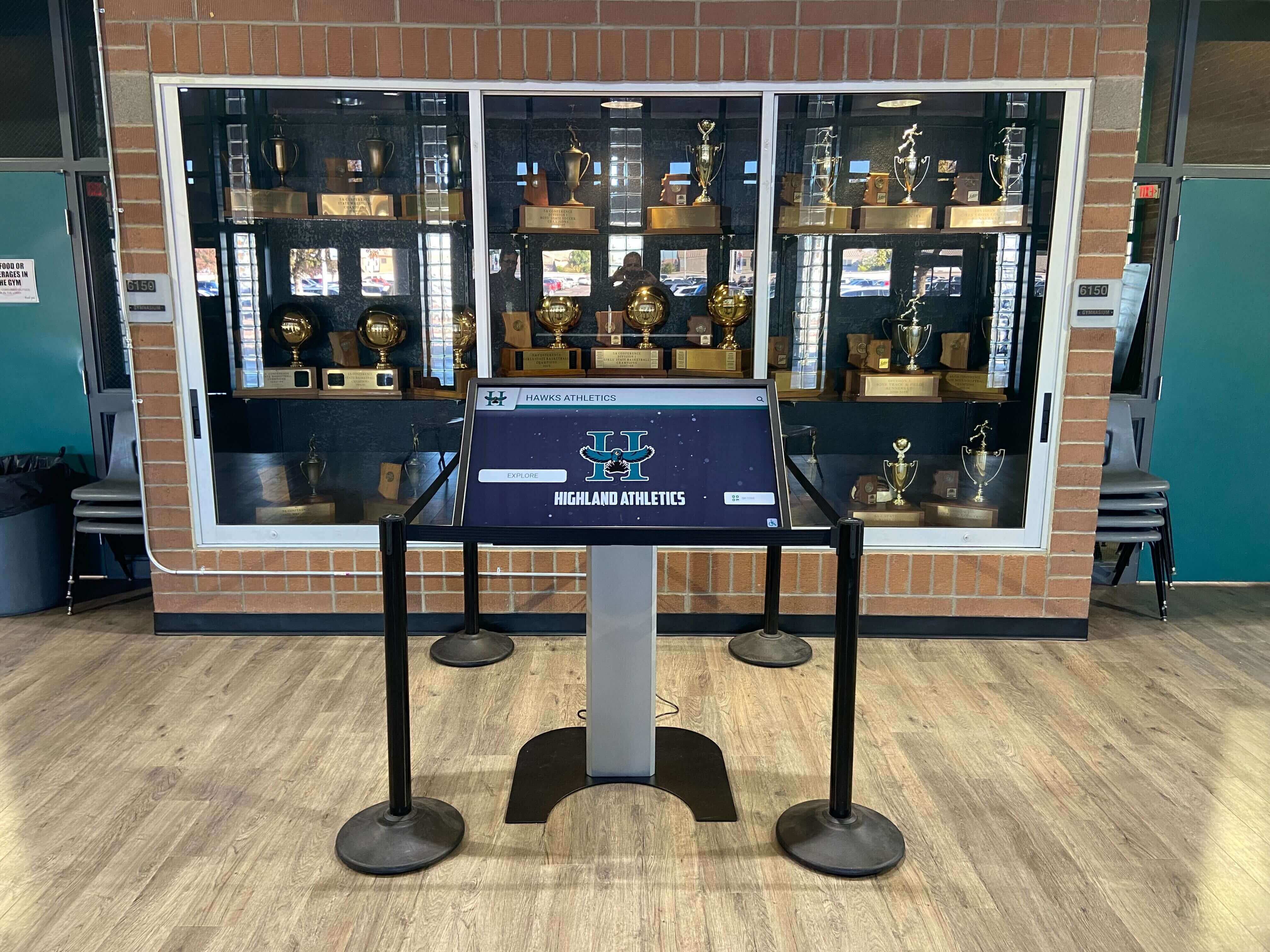
Layer 2 — On-demand detail. On interactive displays or web-based record boards, tapping or clicking the symbol opens a tooltip or panel showing the specific citation: what sources are on file, who reviewed them, and when the entry was approved. This keeps the primary display clean while making full documentation accessible to anyone who wants it.
Touchscreen display systems and augmented reality guides describe how layered information architecture works on interactive kiosks — the same principle applies here. The notation symbol is the visual hook; the citation detail is the deeper layer.
For programs using Rocket Alumni Solutions digital record boards, the record entry fields support custom notation in the mark field and citation text in a supporting notes field accessible to administrators and, when configured, to visitors on interactive displays.
Step 5: Communicate the Legend to Your Audience
A notation system only functions if your audience can interpret it. Visitors who see 4:28 (S) without a legend either ignore the symbol or misread it. Communication happens at three levels:
At the display. Legend card or on-screen legend visible without any action on the viewer’s part. For digital displays, a persistent footer or sidebar showing the two or three most commonly used symbols is enough. Reserve the full six-symbol legend for the administrative documentation and on-demand detail layer.
In program materials. The student-athlete handbook, the athletic department’s website, and the annual hall of fame program should each include a one-paragraph explanation of the notation system. Coaches who understand the system will answer parent questions consistently.
During recognition events. When a legacy record appears in a hall of fame induction ceremony, a senior night presentation, or a color guard or awards night program, include a brief verbal acknowledgment: “This record dates to 1977 and is listed as corroborated — we have two independent sources confirming the mark but no official meet results.” That acknowledgment is not a disclaimer; it is a demonstration of rigor that elevates the entire recognition.
Step 6: Document Conditions for Notation Removal
Uncertainty notation is not permanent. It reflects the current state of evidence, and that state can improve. Define the conditions under which each notation can be upgraded or removed.
| Current Notation | Condition for Upgrade | Upgrade Path |
|---|---|---|
| (P) Pending | Tier 1 or Tier 2 documentation received and approved | Remove (P); assign final notation |
| (S) Corroborated | Tier 1 primary documentation located | Remove (S); entry becomes verified or explicitly (V) |
| (~) Estimated | Precise mark confirmed from primary or secondary source | Remove (~); update mark to confirmed figure, assign (S) or (V) |
| (ca.) Circa | Specific year confirmed | Remove (ca.); update year field |
| (*) Condition note | Program determines no notation needed (conversion standard accepted as equivalent) | Remove (*) at AD discretion; document decision |
Notation upgrades require the same approval authority as original entry: the athletic director or designated assistant. Document each upgrade in the change log using the same format as other record corrections.
Never downgrade a notation unilaterally. If new information calls a previously verified record into question, treat it as a formal dispute and follow the corrections and appeals process defined in your publishing policy.
Step 7: Schedule Annual Notation Audits
Legacy database cleanup is not a one-time project. Every year, new sources surface: an alum finds a box of old meet programs, a coach submits documentation for a record that has been marked corroborated for a decade, or a newspaper archive digitizes issues that were previously inaccessible. An annual notation audit captures these updates systematically.
The audit has four components:
1. Review all (P) Pending entries. Any entry that has remained pending beyond the maximum pendency window should be either upgraded to a permanent notation or removed. Do not let pending entries accumulate indefinitely — they signal unresolved claims that will eventually generate community questions.
2. Survey coaches and alumni for new documentation. Send a brief annual message to coaching staff and alumni networks asking whether anyone has located primary source documentation for records currently marked (S) or (~). A single email sent to a head coach who has been at the school for twenty years often surfaces evidence no one thought to look for.
3. Cross-reference state association archives. Many state athletic associations have digitized meet results going back decades. Cross-referencing your corroborated entries against newly available state association data can upgrade (S) marks to (V) without requiring any additional outreach.
4. Review notation on board against the citation database. Confirm that every symbol on the physical or digital display has a corresponding citation record in the administrative database. Notation that appears on the display without a citation record in the database is an orphaned entry — it should not exist, and finding one signals a process gap.
Programs building sustainable digital athlete recognition archives integrate notation audits into the same annual review cycle as hall of fame nomination screening and record verification schedule reviews. Treating the audit as a recurring calendar event — not a special project — keeps the database current without requiring major periodic overhauls.
Notation Reference Table: All Symbols in One Place
| Symbol | Name | Applies To | Display Position | Removal Trigger |
|---|---|---|---|---|
| (V) | Verified | Mark | After mark | Optional; Tier 1 doc on file |
| (S) | Corroborated | Mark | After mark | Tier 1 doc located |
| (~) | Estimated | Mark | Before mark | Exact mark confirmed |
| (ca.) | Circa | Year | After year | Specific year confirmed |
| (*) | Condition note | Mark | After mark | AD discretion, documented |
| (P) | Pending | Mark | After mark | Verification complete |
Q&A: Common Questions About Uncertainty Notation
Does uncertainty notation apply to team records as well as individual records?
Yes. Team records — season win totals, consecutive championship streaks, single-season scoring marks — carry the same evidence requirements as individual performance records. A win-loss record from the 1960s sourced from a school yearbook with no official game-by-game verification qualifies for (S) notation under the same logic as an individual mark. Digital hall of fame systems that display team history sections alongside individual records benefit from consistent notation across both categories.
What if a community member disputes a corroborated record and claims it is wrong?
A dispute against an (S)-notated record follows the standard appeals process: the challenger submits a written appeal with documentation, the athletic director reviews within the defined window, and the department issues a decision. The (S) notation does not lower the evidentiary bar for a successful challenge — the challenger must produce evidence that contradicts the sources on file, not simply assert that the record is incorrect. If contradicting evidence is credible, the entry may be moved to a disputed status pending resolution.
Should uncertainty notation appear on records published on the school website?
Yes. Any public-facing display of legacy records — physical board, digital kiosk, school website, printed program — should carry the same notation as the primary record board. Inconsistent notation across display channels creates confusion and, more seriously, allows uncorroborated claims to appear verified on one channel while correctly labeled on another.
Can the program use uncertainty notation for academic records as well as athletic records?
The notation logic is portable. Programs that maintain academic recognition records and honor roll displays face similar documentation gaps for historical entries — valedictorians from the 1950s, merit award recipients from before GPA tracking was systematized. The same source-tier classification and notation key applies with minor modifications to the evidence types considered primary.
Is there a point at which a legacy record should simply be removed rather than notated?
The threshold for removal is a claim with no corroborating evidence at all — oral tradition only, no documentation of any tier. Uncertainty notation requires evidence; it does not replace it. If a record appears in the database with no citation of any kind and cannot be corroborated after a reasonable research effort, removal is appropriate. Document the removal in the change log with a note that the entry lacked corroborating documentation. If evidence surfaces later, the record can be reinstated using the standard submission process.
How does uncertainty notation affect an athlete who holds a notated record?
For the athlete, a corroborated or estimated record is still their record — the notation describes the documentation status, not the athlete’s achievement. When communicating with athletes or families about notated entries, be clear that the symbol reflects evidence on file, not doubt about the performance. A notation upgrade from (S) to (V) is worth communicating directly to the athlete or their family if they are still reachable — it is a meaningful validation of a mark they have held for years.
How should the program handle records that appear in 1,000-point scorer or multi-year milestone recognition programs where the counting itself is undocumented?
Career counting records — total points, career wins, consecutive starts — require documentation for each contributing event, not just the final milestone. If game-by-game scoring records are incomplete for a historical scorer, the total is at best (S)-notated and may be (~) estimated if the documentation gap is significant. The program should be explicit about this: “Career points total based on available game records; seasons 1971-72 and 1972-73 scorebook records are not on file.”
From Notation to Display: Making Legacy Records Visible
A notation system solves the documentation problem, but the display medium determines how effectively that solution reaches your audience. Physical boards can show notation, but they cannot show the citation detail behind it. Every time a viewer has a question about what (S) means or what source is on file, that question goes unanswered unless they track down an athletic director.
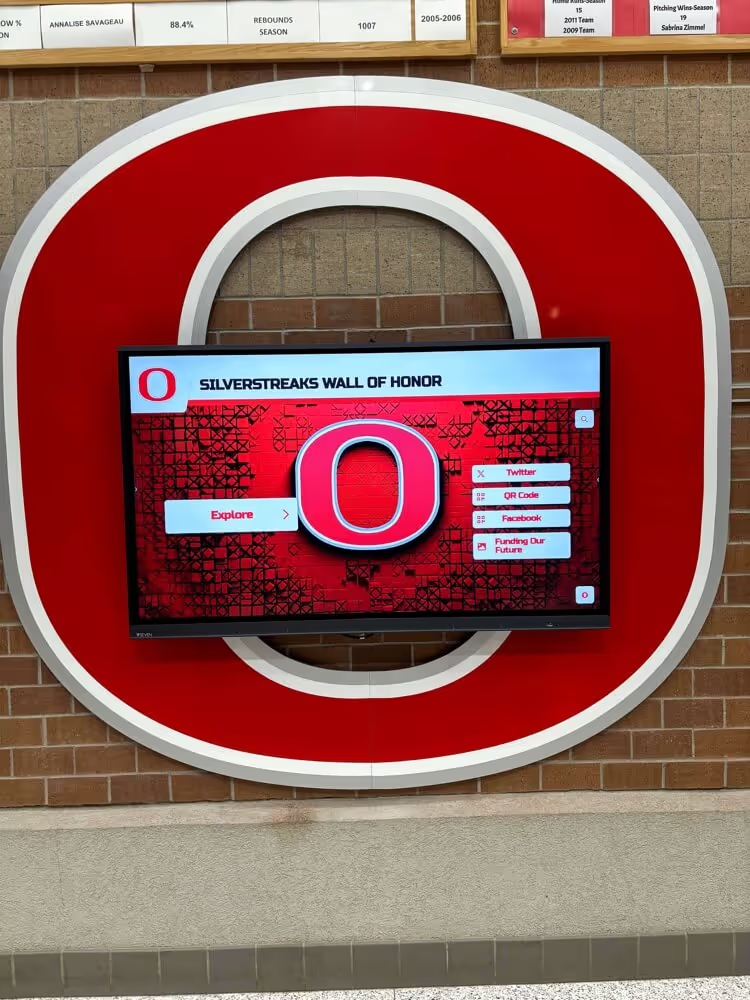
Digital record boards change that. A platform that stores citation records alongside every entry can surface the full evidence record for any notated mark — on demand, on screen, without staff involvement. A visitor at a gym lobby touchscreen display can tap a corroborated mark and see the two sources that support it, the date of the last notation audit, and the name of the athletic director who approved the entry. That level of transparency turns uncertainty notation from a caveat into a credibility signal.
Rocket Alumni Solutions builds digital record boards specifically for school athletic programs, with entry fields that support notation, citation notes, and administrative documentation stored alongside every mark. Legacy records can be uploaded with notation applied, all-time rankings update automatically as new records are set, and the full history — including superseded records and their notation status — is preserved indefinitely.
Programs that have spent years silently omitting underdocumented legacy records because there was no clean way to show them can use a notation system to finally put that history back where it belongs: on the board, honestly labeled, visible to every athlete, family member, and alum who walks through the door. For programs evaluating when to modernize a traditional hall of fame or upgrade their record display infrastructure, the transition to a digital platform is the right moment to implement a notation system — migrate the legacy database with notation applied from the start, and the display is honest on day one.
See How Rocket Handles Legacy Records and Notation
Rocket Alumni Solutions digital record boards store citation notes, support custom notation, auto-rank all entries, and preserve full historical records — so every mark on your display is traceable, honest, and permanent.
Schedule a Demo